Disclosure: At Honestly Tennis, we independently test gear. As an Amazon Associate, we earn from qualifying purchases at no extra cost to you.
That gorgeous metallic red paint job has fooled plenty of intermediate tennis players.
You walk into a tennis shop, pick up the Wilson Clash 100 v2, give it a couple of shadow swings, and suddenly convince yourself you’ve found the secret to adding 15 MPH to your forehand. Maybe it’ll even fix that lazy footwork you’ve been ignoring for three seasons.
I’ve got news: it won’t.
After more than a decade coaching on sun-baked American public hard courts, I’ve watched players spend serious money on expensive frames when what they really needed was better spacing, earlier preparation, and another hundred hours of disciplined practice.
But here’s where the Clash gets interesting.
For the 3.5 or 4.0 club player whose elbow starts barking after the second set, this racket deserves a very different conversation.
The Wilson Clash 100 v2 isn’t your typical modern power racket. It’s an exceptionally flexible, remarkably comfortable frame that challenges the usual relationship between stiffness, stability, and swing speed.
And that flexibility is both its greatest strength and its most frustrating weakness.
The brutal reality? The Clash 100 v2 is an arm-saving engineering marvel, but it can behave like an unpredictable noodle when you try to flatten out a put-away ball.
It rewards topspin, relaxed acceleration, and consistent contact. It punishes players who expect a crisp, predictable response on every aggressive swing.
If you’re still figuring out which racket actually fits your development, start with our guide to the best tennis rackets for intermediate players.
Otherwise, stick around.
This Wilson Clash 100 v2 review digs into the specs, court performance, string setups, weaknesses, and player profiles that matter before you spend your hard-earned cash.
Why Trust Coach Mitchell?
My standard for reviewing tennis equipment is simple: judge the frame by what happens when the ball gets heavy, your legs get tired, and your opponent starts targeting your weaker wing.
A serious Clash test requires more than ten minutes of easy rallying. I bought this frame with my own money, strung it at three distinct tensions (48, 52, and 56 pounds) with both polyester and multifilament, and put 40-plus hitting hours on it with 3.5 to 4.5 club players.
We ran extensive groundstroke drills, competitive sets, serves, returns, and pressure volleys under high summer heat: no Wilson sponsorships, no free demo bags, and zero patience for marketing fluff.
Marketing slogans don’t win third-set tiebreakers—your racket either performs under pressure or it gets in your way.
Wilson Clash 100 v2 Specs: The Numbers That Actually Matter
Before we start talking about feel, let’s examine the hardware. These are the core Wilson Clash 100 v2 specs you need to understand:
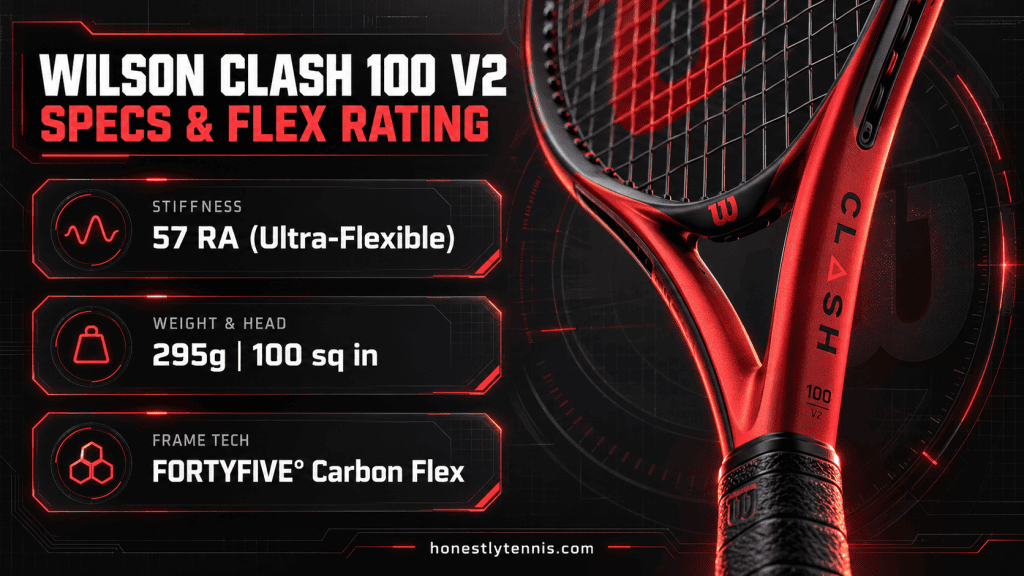
- Head Size: 100 square inches
- Unstrung Weight: 295 g / 10.4 oz
- Balance: 310 mm / approximately 10 points head-light, unstrung
- String Pattern: 16×19 (with revised string-bed construction on the v2)
- Stiffness Rating: Approximately 57 RA (extremely flexible)
- Beam Width: 24.5 mm flat beam
- Length: 27 inches
- Construction: Graphite composite with FORTYFIVE° technology
- Recommended Player Level: Recreational intermediate through advanced recreational
- Primary Strength: Arm comfort, maneuverability, and accessible topspin
- Primary Weakness: Muted feedback and less predictable directional control on flattened swings
One technical correction worth making: the Clash 100 v2 is a 16×19 racket, not a true 16×20. Wilson revised the string-bed layout and spacing for better sweet spot consistency, but the frame retains a 16×19 drill pattern.
Now, the most important number on that list isn’t the weight. It’s the stiffness rating.
Why 57 RA Changes Everything
RA is a measurement of a racket’s resistance to bending under a standardized test. Higher RA numbers indicate a stiffer frame, while lower numbers indicate greater flexibility.
A modern power racket sits in the upper 60s or low 70s. The Clash 100 v2 lives down around 57 RA.
That’s a massive difference in how the frame responds to impact. When the ball meets the string bed, the Clash’s flexible construction allows the frame to bend significantly more than a conventional stiff power racket.
You notice it through the softer impact sensation, longer-feeling pocketing, and dramatically muted vibration. But flexibility isn’t free. The same bending that makes the Clash comfortable can make it feel less direct when you’re trying to drive the ball hard and flat.
Is 295 Grams Enough Weight?
For most intermediate players, absolutely. At 295 grams unstrung, the Clash sits in a practical weight class. It’s substantial enough for normal rallying without becoming exhausting during long three-set matches.
Once you add strings, an overgrip, and a dampener, expect the actual playing weight to climb into the low 310-gram range, depending on your setup. That keeps it fast and manageable for players who want to generate their own racket-head speed.
The catch is stability. Against heavy incoming pace, this relatively light frame won’t always deliver the effortless resistance of a heavier, higher-swingweight player’s racket. If you’re constantly blocking back 90 MPH groundstrokes, you’ll feel the hoop flutter.
Groundstrokes: Pocketing Heaven vs. The “Trampoline” Trap
Groundstrokes are where the Clash earns its reputation. They’re also where it exposes its biggest personality disorder.
Hit with spin, and the racket feels beautifully connected to the ball. Try to flatten everything out, and you might start wondering whether somebody moved the baseline backward.
Forehands: Big Swings, Soft Landings
The first thing many players notice with the Clash is the pocketing sensation. On a clean topspin forehand, the ball feels as though it sinks into the string bed before launching back toward your opponent.
That sensation encourages relaxed acceleration. Instead of protecting your arm from every impact, you can concentrate on turning your hips, dropping the racket head, and accelerating through the contact zone.
For an intermediate player developing a modern forehand, that’s valuable. The 100-square-inch head also provides a forgiving hitting area, especially compared with demanding 97- or 98-square-inch control frames.
But don’t confuse forgiveness with automatic accuracy. The Clash still requires sound spacing, consistent swing paths, and disciplined contact.
Backhands: A Comfortable Rallying Partner
Two-handed backhand players will appreciate the Clash’s maneuverability. Its head-light balance makes preparation relatively easy, and the flexible response takes the harsh sting out of firm crosscourt exchanges.
For players who tend to muscle their backhands, the softer impact encourages a smoother swing. One-handed backhand players get a more complicated deal.
The racket is maneuverable enough to accelerate through the ball, but the softer feedback may leave traditional players craving a firmer, more authoritative contact sensation. When you strike cleanly in the sweet spot, the ball deepens nicely. When contact drifts outside the sweet spot, the response feels hollow.
The Launch Angle Mystery: Where The Trouble Starts
Picture this: you’re playing a 4.0 league match. Your opponent floats a weak second serve return just inside the service line.
You step forward, load your outside leg, and prepare to bury a forehand into the open court. With a crisp, familiar frame, you drive through that ball with a relatively flat swing path.
With the Clash, the combination of flexible frame response, string-bed movement, incoming ball speed, and your swing mechanics can produce a higher or less predictable launch than you expected. The ball sails two feet beyond the baseline.
You stare at the strings. Your opponent gets another point they didn’t deserve.
This is the central concern in my Wilson Clash 100 v2 review: the Clash can be wonderfully forgiving during topspin rallies yet frustratingly inconsistent when you demand flat, surgical put-away control.
If you take one technical insight from this Wilson Clash 100 v2 review, let it be this: keep your swing path steep with plenty of upward brush, or prepare to watch flat balls sail.
Why Topspin Is Your Best Friend
The Clash performs best when you give the ball a healthy upward brushing action. That doesn’t mean you need an exaggerated windshield-wiper forehand on every shot, but you must generate enough spin to create margin above the net while bringing the ball down inside the lines.
The open 16×19 pattern supports spin production, provided your technique supplies the necessary racket-head speed. When you combine that pattern with the Clash’s comfortable response, long baseline exchanges become enjoyable.
You can rally with shape, change direction, and work the ball deep without feeling as though you’re swinging a metal pipe. But if your natural game is built around low, penetrating, flat drives, you will spend more time adjusting than winning.
Groundstroke Score: 8.0 / 10
Coaching assessment: Best for spin-oriented baseline play. Excellent rallying frame for players who build points with spin and consistency, but less convincing when your strategy depends on crushing flat winners.
Serves & Overheads: Where You Pay the Flex Tax
Serving exposes the difference between comfortable flexibility and raw power. And with the Clash, that difference is noticeable.
Kick Serves: Plenty to Work With
The Clash’s manageable weight makes it relatively easy to accelerate up and across the back of the ball. That’s good news for kick-serve players.
You can generate useful spin and net clearance without feeling as though you’re dragging an anchor through the service motion. The soft response also makes repetitive serving sessions painless for tired shoulders.
Remember, though: a racket doesn’t manufacture a kick serve on its own. Your toss location, shoulder rotation, racket-head speed, and upward swing path still do the heavy lifting.
Slice Serves: Better Than Expected
Slice serves are another strength. The 16×19 pattern offers plenty of bite for carving around the outside of the ball, and the maneuverable balance helps you maintain racket-head speed.
On the deuce court, you can use a wide slice to pull a right-handed opponent off the doubles alley. On the ad court, a well-placed slice into the body jams aggressive returners.
The Clash rewards placement and spin rather than brute-force serving. That’s a sensible trade if you understand point construction.
Flat First Serves: Don’t Expect Free MPH
Now for the reality check. If your primary weapon is a flat first serve, the Clash will leave you wanting more.
Compared with a stiffer power frame like the Babolat Pure Drive, the Clash offers a noticeably softer, less explosive sensation at impact. You realistically lose about 5 to 8 MPH on flat bombs because the frame absorbs impact energy through bending rather than transferring it directly into the ball.
The Pure Drive is built to give you crisp, effortless pace. The Clash prioritizes flex and arm preservation. If you expect the Clash to turn a 95 MPH serve into a 105 MPH rocket, prepare for disappointment.
Overheads: Timing Matters
Overheads reveal another subtle quirk. Because the Clash pockets the ball longer, players accustomed to crisp frames may mistime aggressive smashes.
The perceived dwell time slightly delays the ball’s release from the string bed. Don’t compensate by chopping down harder; focus on early shoulder preparation, full extension, and clean timing.
Serve Score: 7.3 / 10
Coaching assessment: Strong for spin and placement; less compelling for raw flat speed.
Volleys & Touch at the Net: Soft Hands, Weak Punches
At the net, the Clash is a fascinating contradiction. For delicate touch shots, its soft response feels silky smooth. For aggressive punch volleys, that same softness can leave you vulnerable.
Drop Volleys: Beautifully Plush
Imagine your opponent scrambling forward after a short approach shot, flicking a desperate passing attempt toward your forehand volley. You soften your grip, keep the racket face stable, and let the ball die just over the net.
The Clash’s muted response excels at that kind of touch. It doesn’t produce the harsh, metallic feedback common in stiff frames. Reflex pickups and short-angle volleys feel natural and cushioned.
For recreational doubles players who rely on placement, that’s an undeniable asset.
Punch Volleys: You Must Supply the Authority
Now imagine defending at the net against a heavy 4.5 baseline driver. They fire a rocket straight at your chest, and you need to stick a firm volley deep through the middle.
With a stiff, heavier frame, you can redirect that pace with a short, compact punch. With the Clash, you must supply full physical commitment and clean forward weight transfer.
If you just dangle the racket and hope the frame does the work, the response is weak. The ball floats short, your opponent pounces, and you’re suddenly on defense. The Clash can hit firm volleys, but it won’t do the punching for you.
Net Play Score: 7.5 / 10
Coaching assessment: Excellent touch and vibration dampening; average punch-volley authority.
The 57 RA Flex: A Medical Miracle for Tennis Elbow?
This is the section that matters most to players whose arms have taken a beating.
I see it every week on public courts: a player finishes two sets, shakes out their hitting arm, rubs their outer elbow, and complains that every backhand feels like an electric shock down their forearm. Then they pack up their 71 RA power stick strung with stiff poly at 58 pounds.
That is tennis insanity.
Why the Clash Feels Different
The Wilson Clash 100 v2 has an extraordinarily low stiffness rating for a modern 100-square-inch performance racket. At roughly 57 RA, it bends far more willingly than almost anything else on the shelf.
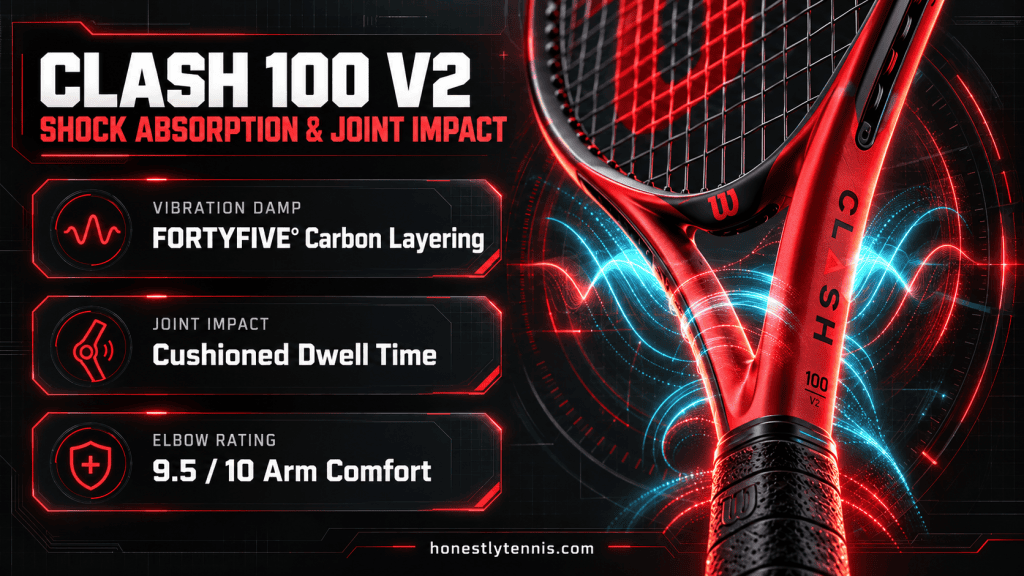
Wilson’s FORTYFIVE° carbon mapping is designed to allow the frame to bend both vertically and horizontally while resisting unwanted torsional twisting. The result is a uniquely soft impact that cushions joints while maintaining respectable stability.
This engineering feat is precisely why the Clash holds a dominant spot in our guide to the best tennis rackets for tennis elbow.
Does It Actually Absorb Shock?
Yes. The flexible carbon structure actively dissipates high-frequency vibration before it reaches your wrist, forearm tendons, and elbow joint.
However, let’s establish an honest boundary: an arm-friendly racket is equipment management, not medical treatment. If you have chronic tendinopathy, changing frames will reduce aggravating forces, but it won’t magically repair torn tendon fibers.
You still need proper rest, physical therapy, and biomechanical corrections. What the Clash provides is a genuinely protective platform that lets sensitive arms play without agony.
Off-Center Hits: The Spongy Surprise
Even with its plush profile, the Clash has a distinct quirk on mishits. Catch the ball near the tip or outer edges of the hoop, and the feedback feels remarkably spongy.
Traditional players often describe it as hollow or disconnected. Instead of a crisp signal telling you where contact occurred, you get a muted thud.
For elbow sufferers, that lack of harsh feedback is a blessing. For precision purists who rely on tactile feedback, it can take some adjustment.
Comfort Score: 9.5 / 10
Coaching assessment: The gold standard for arm preservation in the modern 100-square-inch market.
The String Setup Formula: Crucial Coach Advice
You can buy the most comfortable racket on earth and completely ruin it with the wrong string setup. Don’t undermine a $270 investment by making rookie stringing mistakes.
What NOT to Do: Stiff Poly at 55+ Pounds
If you buy the Clash for arm comfort, do not string a stiff polyester at 55 pounds or higher. High tension on stiff monofilament chokes out the racket’s natural pocketing and turns the string bed into concrete.
You lose the plush feel and turn mishits into jarring vibrations.
My Starting Formula: Soft Co-Poly at 48–50 Pounds
For intermediate players who swing fast, need spin control, and break strings regularly, start with a soft co-poly at 48 to 50 pounds.
Luxilon Element is an ideal match—it provides the spin and snapback of poly while offering one of the softest impact profiles in its class. Solinco Confidential is another solid option for players seeking firmer directional control, though you should drop the tension to 46–48 pounds.
Maximum Comfort: Wilson NXT Multifilament
If your elbow is actively inflamed or you simply want pillowy comfort, string a premium multifilament like Wilson NXT at 52 to 54 pounds.
Multifilament strings offer superior elasticity, pocketing, and vibration dampening. You will sacrifice some spin potential and string durability compared to poly, but your tendons will thank you.
String Setup Comparison
| String Setup | Starting Tension | Ideal Target & Primary Benefit |
|---|---|---|
| Luxilon Element | 48–50 lbs | Best for spin, control, and arm-friendly poly feel |
| Solinco Confidential | 46–48 lbs | Best for directional control for healthy arms |
| Wilson NXT | 52–54 lbs | Best for maximum arm comfort and easy depth |
| Poly / Multi Hybrid | 48–52 lbs | Best for balanced blend of spin and comfort |
Don’t Cook Your Racket in the Trunk
One non-negotiable coaching rule: never leave a flexible composite frame baking in your car trunk during summer heat.
Excessive heat breaks down string tension overnight, softens composite resins, and degrades grip adhesives. Always transport and protect your frames in a dedicated tennis racket bag with thermal insulation.
Wilson Clash 100 v2 vs. Babolat Pure Drive: The Clash of Ideologies
In this Wilson Clash 100 v2 review, comparing it against the Babolat Pure Drive is essential because they represent completely opposing equipment philosophies.
The Babolat Pure Drive is a stiff (~71 RA), explosive power machine designed for effortless depth and blistering winners. The Wilson Clash 100 v2 (~57 RA) is a flexible, plush counterpuncher designed for dwell time, spin, and joint longevity.
Head-to-Head Comparison
| Feature / Metric | Wilson Clash 100 v2 | Babolat Pure Drive |
|---|---|---|
| Head Size | 100 sq in | 100 sq in |
| Unstrung Weight | 295 g / 10.4 oz | 300 g / 10.6 oz |
| Flex Rating | ~57 RA (Very Flexible) | ~71 RA (Very Stiff) |
| Impact Feel | Plush, muted, deep pocketing | Crisp, firm, immediate |
| Free Flat Power | Moderate | Explosive |
| Topspin Potential | Very Good | Very Good |
| Arm Comfort | 9.5 / 10 (Elite) | 6.5 / 10 (Setup Dependent) |
| Punch Volley Authority | Moderate | Authoritative |
| Target Player | Comfort & spin baseliner | Aggressive power baseliner |
If you want raw put-away power and don’t suffer from joint pain, check out our in-depth Babolat Pure Drive vs Wilson Clash breakdown. But if arm safety is your priority, the Clash is the indisputable winner.
Where It Bleeds: The Brutal Drawbacks
Every frame has flaws, and the Clash is no exception. Here are the three honest weaknesses you must accept before buying:
1. Erratic Launch Angle on Flat Strokes
When you brush up with heavy topspin, the Clash is predictable. But when you step inside the baseline and try to flatten out a short ball, the extreme frame flex and string movement can launch the ball unexpectedly high, sending put-away shots sailing long.
2. Muted, Detached Feedback
The vibration dampening is so intense that off-center hits feel like striking the ball with a wet sponge. Players accustomed to crisp, surgical feedback (like a Wilson Pro Staff) will feel disconnected from the ball.
3. Limited Free Plow-Through Against Heavy Pace
At 295 grams unstrung, the Clash lacks the mass to effortlessly absorb 90+ MPH heavy topspin drives. Against advanced opponents, you must prepare early and drive through the ball with full commitment, or the frame will flutter in your hand.
Who Should Buy It vs. Who Should Walk Away?
Buy the Wilson Clash 100 v2 if:
- You suffer from tennis elbow, wrist discomfort, or shoulder soreness.
- You play with heavy topspin and construct points from the baseline.
- You want modern 100 sq in forgiveness without the joint-destroying stiffness of typical power frames.
- You prioritize arm longevity and maneuverability over brute flat power.
Walk Away from the Clash if:
- You are an aggressive flat-ball striker who attacks every short ball.
- You demand crisp, metallic feedback on every strike.
- You live and die by a 110+ MPH flat first serve.
- You are a serve-and-volley purist who needs immediate punch-volley authority.
Wilson Clash 100 v2 Review: Frequently Asked Questions
Is the Wilson Clash 100 v2 good for beginners?
It is very forgiving and comfortable, but at $270, it is an expensive choice for someone still learning basic strokes. Dedicated beginners can certainly use it, but intermediate players benefit most from its specific flex characteristics.
Does the Wilson Clash 100 v2 cause tennis elbow?
No. Its ultra-low 57 RA stiffness makes it one of the most arm-friendly modern performance frames available. When paired with a soft string setup, it is exceptionally gentle on joints.
Is the Wilson Clash 100 v2 a power racket?
Not in the traditional sense. It provides moderate power through swing speed and dwell time, but it lacks the explosive, stiff pop of a Babolat Pure Drive.
What is the best string tension for the Wilson Clash 100 v2?
For soft polyester (like Luxilon Element), string between 48 and 50 lbs. For multifilament (like Wilson NXT), string between 52 and 54 lbs.
Is the Wilson Clash 100 v2 good for doubles?
Yes, for players who rely on quick reflex volleys, soft touch drops, and consistent returns. However, aggressive net rushers looking for heavy punch volleys will need clean forward momentum.
Final Verdict: The Noodle That Saved My Arm
To wrap up this wilson clash 100 v2 review, stripping away the marketing reveals an engineering anomaly that genuinely challenges modern racket design.
It isn’t a magic wand for broken footwork, and it won’t magically add 15 MPH to your groundstrokes. If you hit flat, it can be frustratingly erratic.
But if you are a topspin-oriented club player who wants to play three sets on Saturday without waking up with an aching elbow on Sunday, this frame is worth every penny.
Coach Mitchell’s Final Scorecard
- Overall Score: 8.2 / 10
- Arm Comfort: 9.5 / 10
- Topspin Potential: 8.5 / 10
- Maneuverability: 8.5 / 10
- Groundstrokes: 8.0 / 10
- Serves: 7.3 / 10
- Volleys: 7.5 / 10
- Flat-Shot Precision: 6.5 / 10
- Stability Against Heavy Pace: 7.0 / 10
Stop blaming your racket for unforced errors, string it at reasonable tensions, brush up on the ball, and get back on the practice court.


Hi, I’m Coach Mitchell. With over a decade of experience on the tennis court, I created Honestly Tennis to share my passion for the game. Whether you are a beginner looking for your first racquet or an advanced player wanting to upgrade your gear, my goal is to provide honest reviews and helpful guides to elevate your game.