Disclosure: At Honestly Tennis, we independently test gear. As an Amazon Associate, we earn from qualifying purchases at no extra cost to you.
Every Tuesday morning, a 3.5 league player walks up to my stringing machine, drops a chipped Babolat Pure Drive on the counter, and utters the seven most destructive words in recreational tennis: “Just string it at 55 pounds, Coach.”
When I ask why they want 55 pounds, they point to the tiny factory decal inside the throat of the racket that reads Recommended Tension: 50–60 lbs. They figure splitting the difference right down the middle is the safest, smartest play on the court.
That lazy middle-of-the-road advice is the primary reason half of your local USTA league plays with a neoprene Velcro strap wrapped tightly around their forearm. Those printed tension ranges on the side of your frame are fossilized leftovers from the 1990s, back when everyone played with stretchy synthetic gut or natural cow gut. Slapping a modern, ultra-stiff co-polyester string into a stiff graphite frame at 55 or 58 pounds turns your stringbed into a literal frying pan.
Here is the golden rule of equipment physics that big racket brands rarely emphasize: string tension is the actual engine of your racket, not an afterthought. You can spend $280 on the latest carbon-fiber frame, but if your tension is off by six pounds, that frame will play like a two-by-four from the hardware store. The stringbed accounts for roughly 50% of how a racket transfers energy, absorbs shock, and shapes the flight of the ball.
Understanding loose vs tight tennis string tension comes down to a fundamental mechanical trade-off between free elastic power and surgical directional control. In this tennis string tension guide, we are going to strip away the pro-shop myths, break down the exact ball-on-string physics, and dial in the exact poundage your swing speed actually deserves. Grab a coffee and pull up a chair by the baseline fence, because we are fixing your setup today.
Why Trust Coach Mitchell?
I do not write equipment guides from a climate-controlled corporate office, and I do not take checks from string manufacturers to hype up their latest neon-colored polyester. I have spent the last twelve years grinding on sun-baked public hard courts across the US, feeding thousands of balls a week to everyone from 3.0 adult clinic regulars to D1 college recruits. When my knees are done barking after six hours on court, I spend my evenings locked behind a stringing machine.
Over the past decade, I have strung more than 4,000 rackets across both mechanical lockout crank machines and tour-level electronic constant-pull machines. I have seen firsthand how a three-pound tension adjustment can turn a chronic net-skimmer into a deep-court menace within a single warmup session. I have also watched stubborn 4.0 men ruin their rotator cuffs and elbow tendons because their ego refused to let them drop below 56 pounds.
I treat my own frames and my students’ rackets like a rolling laboratory. I have personally tested tensions ranging from a ridiculous, fishnet-loose 35 pounds all the way up to a board-stiff 64 pounds across every string material on the market. Every recommendation below is forged from snapped strings, blistered knuckles, digital stringbed stiffness readings, and thousands of sets of real match data.
The Core Physics: What Actually Happens on Impact?
Most recreational players think a tighter stringbed acts like a tightly wound catapult that shoots the ball faster across the net. That intuition is 100% backward, and believing it will ruin your groundstrokes. To understand why, you have to look at what happens during the four milliseconds a fuzzy yellow ball collides with your stringbed.
The Trampoline Effect (Coefficient of Restitution)
When a tennis ball hits an immovable concrete wall at 60 mph, the rubber core of the ball flattens out to nearly half its original diameter. That violent compression generates internal friction and heat inside the rubber, which wastes roughly 45% of the ball’s kinetic energy. In physics terms, a tennis ball has a terrible coefficient of restitution—it only returns about 55% of the energy used to compress it.
The strict equipment testing protocols set by the International Tennis Federation (ITF) dictate exactly how much a legal ball must bounce and deform under pressure. But out here on the public courts, all you really need to understand is that your stringbed is entirely responsible for managing that violent compression.
Your tennis strings, on the other hand, are vastly more efficient energy springs than the rubber ball. Even a stiff polyester stringbed returns roughly 90% to 95% of the energy stored in it when it stretches and rebounds. Therefore, the more the stringbed stretches on impact, the less the ball gets crushed, and the more total speed stays in your shot.
When you string a racket looser, you lower the surface stiffness of the stringplane. Upon impact, the strings deflect deeply like a gymnastics trampoline, preventing the ball from flattening out and wasting energy as heat. When you string a racket tight, the stringbed refuses to give way, forcing the ball to do all the compressing and killing your outgoing ball speed.
When comparing loose vs tight tennis string tension, the trampoline effect determines how much energy rebounds into the ball.
Dwell Time, Pocketing, and the Spin Window
Dwell time is the exact duration—measured in milliseconds—that the ball remains nested in your strings before launching back over the net. On a standard groundstroke, dwell time hovers right around 4 to 5 milliseconds. While a human brain cannot consciously steer a racket mid-impact in 4 milliseconds, your nervous system absolutely registers the frequency and depth of that pocketed sensation.
A looser stringbed increases ball pocketing, sinking the ball deeper into the stringplane before releasing it. That split-second increase in dwell time softens the peak impact force on your hand and raises the outgoing launch angle of the shot. Your shot leaves the strings at a slightly higher trajectory, giving you automatic net clearance and pushing your average landing spot three to four feet closer to the opponent’s baseline.
A tighter stringbed minimizes pocketing and kicks the ball off the stringplane almost instantaneously. Because the ball does not sink deep into the strings, it exits at a lower, flatter launch angle that closely mirrors the exact angle of your racket face at contact. If your racket face is off by two degrees at impact with a tight stringjob, that ball is going straight into the bottom of the net or sailing past the baseline.
Friction, Main String Deflection, and Snapback
Twenty years ago, coaches thought topspin came solely from the rough texture of the strings biting into the felt of the ball. High-speed phantom cameras operating at 10,000 frames per second proved that theory incomplete. Real modern heavy topspin comes from a mechanical phenomenon called main string snapback.
As you brush up the back of the ball on a topspin forehand, the incoming force drags the vertical main strings sideways across the horizontal cross strings. While the ball is still flattened against the stringbed, those stretched main strings reach their elastic limit and violently snap back into their original straight positions. That whip-like lateral recoil imparts massive rotational torque onto the ball right as it leaves the racket.
When you analyze loose vs tight tennis string tension through the lens of snapback, tension controls the friction where the mains and crosses intersect. If your strings are pulled at 60 pounds, the cross strings clamp down on the main strings like a vise, locking them in place and preventing lateral movement. Dropping your tension into the mid-to-high 40s reduces intersection friction, allowing slick co-polyester mains to slide freely across the crosses and snap back with vicious bite.
Loose String Tension (40–48 lbs): The Modern Power & Comfort Play
If you walked into a club in 2004 and asked for 45 pounds of tension, the stringer would have looked at you like you had three heads. Today, the 40-to-48-pound bracket is the gold standard for modern players using co-polyester strings. Even touring pros who hit the ball 90 mph have migrated down into the 40s over the past decade.
The Real Perks: Effortless Depth and Sweet Spot Expansion
The single biggest advantage of dropping into the 40–48 lb zone is free, low-effort depth from uncomfortable court positions. In a real 3.5 or 4.0 match, you only hit about 20% of your shots with your feet perfectly set in your strike zone. The other 80% of the time, you are lunging wide, backing up against a heavy kicking ball, or half-volleying from no-man’s-land.
With a 45-pound stringbed, the strings do the heavy lifting when you are stretched out on defense. A defensive flick of the wrist or a compact block return catches the trampoline effect and lands deep past the opponent’s service line instead of sitting up short for an easy put-away. You stop working twice as hard as your opponent just to keep the ball deep in the court.
Looser tension also dramatically expands the effective sweet spot of your frame. Every racket loses ball speed when you make contact near the upper hoop or out toward the 3 and 9 o’clock edges. Lowering the tension lets the outer main and cross strings stretch more easily on off-center hits, minimizing frame twisting and saving those mishits that would normally die in the net.
The Downside: The Trampoline Trap
Loose tension is not magic dust, and it carries a real penalty if your swing mechanics are sloppy. When you drop down to 42 or 44 pounds—especially with an elastic string—you have to respect the higher launch angle. If you get a chest-high short ball at the service line and slap at it with a flat, open racket face, the trampoline effect will launch that ball straight into the back fence.
To control a loose stringbed, you must commit to swinging low-to-high and generating topspin to bring the ball down into the court. Players who decelerate their swing out of fear of hitting long will actually hit more balls long with loose strings. Why? Because slowing down your racket head eliminates the topspin required to curve that higher launch angle inside the baseline.
Why Modern Co-Polyester Demands Lower Tensions
When evaluating loose vs tight tennis string tension, you cannot separate the poundage from the string material. Modern co-polyester strings are extruded from stiff polyester polymers designed for maximum control and spin, not elasticity. Because the material itself is inherently stiff and low-powered, stringing it tight removes all life from the stringbed.
When you string a modern poly at 45 to 48 pounds, you unlock its elastic window without sacrificing the natural control built into the polymer. You get the best of both worlds: plush ball pocketing on touch shots and vicious snapback when you accelerate through the strike zone. If you are looking to pair this tension range with the right setup, check out my breakdown of the best tennis strings for intermediate players to find a co-poly or hybrid that matches your swing speed.
Tight String Tension (55–62+ lbs): The Classic Control Board
Now let us flip the dial to the upper end of the machine. Tight tension—anything from 55 pounds up past 62 pounds—is the classic setup popularized in the era of Pete Sampras, Andre Agassi, and classic 90-square-inch graphite frames. While fewer players belong in this bracket today, high tension still serves a very specific purpose in tennis physics.
The Real Perks: Surgical Precision and Flat Trajectories
When you crank a stringbed up to 57 or 60 pounds, you effectively eliminate the unpredictable trampoline bounce of the strings. The stringbed becomes a firm, uniform deflection board. The angle at which your racket face meets the ball is the exact angle at which the ball leaves the strings, with virtually zero upward launch-angle variance.
For players who hit with flat, eastern-grip mechanics or rush the net behind every approach shot, that board-like predictability is intoxicating. You can pick out a dime-sized target in the deuce corner, take a fearless cut at a rising ball, and trust that the stringbed will not over-catapult the shot three inches past the line. Crisp punch volleys at the net also feel razor-sharp because the ball pops off the face immediately without wobbling in the strings.
Tight tension also tames overly powerful, thick-beamed frames or ultra-elastic strings. If you play with a 105-square-inch “game improvement” frame paired with natural gut or a soft multifilament, stringing at 46 pounds would turn your racket into an uncontrollable bazooka. Pulling that setup up to 57 or 59 pounds reigns in the excess power so you can take a full swing without spraying balls into the parking lot.
The Brutal Cost: Shrinking Sweet Spot and Tendon Shock
Here is the ugly truth about high tension: it shrinks your playable sweet spot down to the size of a silver dollar. When strings are pulled near their elastic limit, the outer mains near the frame edges have zero give left in them. If you catch a fast serve just one inch above center on a 58-pound stringbed, the ball stops dead, the racket torques violently in your hand, and your return barely limps over the net.
Even worse, tight tension forces you to generate 100% of your own pace on every single ball for three straight sets. That feels great during the 10-minute warmup when your legs are fresh and you are stepping into every forehand. By the middle of the second set in 90-degree August heat, when your footwork gets heavy and your swing shortens up, a 58-pound stringbed will leave every defensive ball sitting squarely in the middle of the service box.
Why Stringing Stiff Poly at 58+ lbs Is Tennis Suicide
In the debate over loose vs tight tennis string tension, there is one cardinal sin I refuse to allow in my shop: stringing stiff monofilament polyester above 55 pounds for a recreational club player. Unless you are a 5.0+ former college player swinging at 80+ mph with pristine kinetic-chain mechanics, tight poly will wreck your body and your game.
At 58 pounds, a polyester string loses its ability to stretch and snap back under club-level swing speeds. Instead of getting more spin and control, you get a dead, locked-up board that sends high-frequency impact shock straight through your wrist and into your elbow tendons. You are sacrificing depth, losing spin, and begging for an orthopedic bill just to chase a fake sense of control.
Loose vs Tight Tennis String Tension: Head-to-Head Comparison
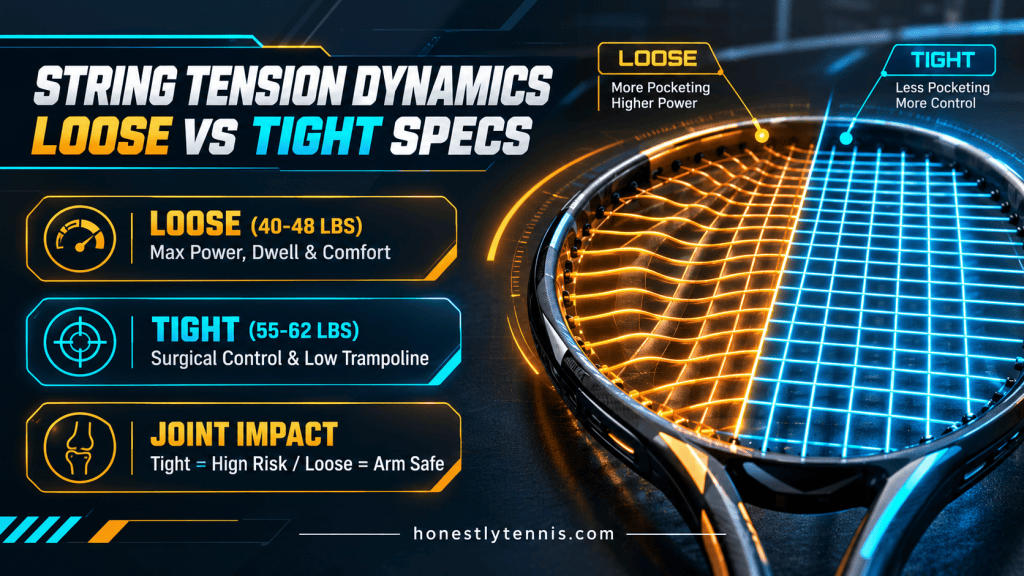
To see exactly how these mechanics play out across the entire spectrum, let us put the numbers side by side. Notice how the middle ground (49–54 lbs) acts as a transitional bridge depending on whether you use polyester or softer nylon-based strings.
| Performance Metric | Loose Tension (40–48 lbs) | Medium Tension (49–54 lbs) | Tight Tension (55–62 lbs) |
|---|---|---|---|
| Free Power & Depth | Maximum: High trampoline energy return gives effortless baseline depth. | Balanced: Good blend of pace on full swings and control on touch shots. | Minimum: Zero free help; player must supply 100% of racket head speed. |
| Sweet Spot Size | Large & Forgiving: Off-center hits near the upper hoop still carry over the net. | Moderate: Standard sweet spot size matching the frame’s head design. | Small & Punishing: Slight mishits lose massive pace and twist the frame. |
| Ball Dwell Time | Long: Deep ball pocketing; soft, plush sensation at impact. | Medium: Crisp contact with noticeable pocketing on hard hits. | Ultra-Short: Instant rebound; stiff, board-like feedback. |
| Directional Control | Lower on Flat Shots: Requires topspin to tame the higher launch angle. | High: Predictable trajectory for modern topspin and all-court strokes. | Surgical: Laser-like precision for flat hitters and net rushers. |
| Spin Potential | Very High (with Poly): Reduced string friction maximizes main string snapback. | High: Strong bite and consistent spin window for intermediate swings. | Low to Moderate: Crosses clamp down on mains, restricting snapback. |
| Arm Comfort | Excellent: Stringbed absorbs peak impact shock before it reaches tendons. | Good to Fair: Safe for multifilaments; upper limit for stiff polyester. | Harsh: High peak vibration transfers directly to wrist, elbow, and shoulder. |
| Launch Angle | Higher Trajectory: Naturally lifts the ball higher over the net strap. | Neutral Trajectory: True to swing path with moderate net clearance. | Flat Trajectory: Low exit angle; demands clean footwork and preparation. |
| String Durability | Longer Dynamic Life: Less initial static stress delays premature snapping. | Standard: Normal wear and notching rates across match play. | Shorter: High static tension accelerates notching and sudden breakage. |
Look closely at the Spin Potential row in the comparison of loose vs tight tennis string tension above, because it shocks almost every player I coach. Most players assume tighter strings bite the ball harder and create more spin. In reality, lower tension in a polyester setup reduces the clamping force between mains and crosses, allowing the strings to deflect farther and snap back faster—which generates noticeably heavier rotation.
The Tennis Elbow Factor: Stop Sacrificing Your Arm
Let us talk about the elephant on the court: lateral epicondylitis, universally known as tennis elbow. If you feel a sharp, burning stab on the outside knob of your elbow every time you shank a one-handed backhand or pick up a gallon of milk the morning after a match, your string tension is suspect number one. You do not fix tennis elbow with ibuprofen and a copper bracelet; you fix it by eliminating impact shock at the source.
When a tennis ball strikes your strings at 50 mph, it creates two distinct types of load on your arm: the initial impact shock wave and the subsequent frame vibration. Your forearm muscles—specifically the extensor carpi radialis brevis (ECRB) tendon that stabilizes your wrist at contact—absorb the brunt of that initial collision. When your strings are pulled tight, the stringbed refuses to cushion the blow, transmitting a violent force spike straight up the graphite shaft into that tiny tendon.
Searching for a lower string tension tennis elbow solution is the single smartest biomechanical adjustment an injured player can make. Dropping your tension by just 5 to 7 pounds reduces dynamic stringbed stiffness (measured in DT units on an ERT 300 diagnostic device) by roughly 15% to 20%. The strings act as shock absorbers, stretching at impact to spread the collision force over a longer millisecond window so your elbow tendon does not get hammered.
Last spring, a 4.0 league captain came to me ready to quit tennis for good because his elbow was throbbing after fifteen minutes of hitting. He was playing with a stiff 100-square-inch frame strung with 16-gauge polyester at 56 pounds—an absolute medieval torture device for human joints. I cut those strings out on the spot, strung his frame with a soft multifilament at 48 pounds, and watched him play two pain-free sets that same weekend.
Of course, string tension is only half of the arm-safety equation; the stiffness rating (RA) of your graphite frame is the other half. If you are stringing a stiff hollow frame with a 71 RA rating, even loose strings can only mask so much shock. If your elbow is already barking, pair a lower tension setup with one of the best tennis rackets for tennis elbow to protect your joints for the long haul.
For players who refuse to give up modern spin potential but need maximum tendon protection, frame flex technology has come a long way. A flexible frame bends backward at impact to complement the pocketing of a lower-tension stringbed. You can see exactly how frame flex and low-to-mid tension work together in my hands-on Wilson Clash 100 v2 review, where I break down why that frame saved dozens of my senior league players’ arms.
String Material Changes the Rules (Poly vs. Multi vs. Gut)
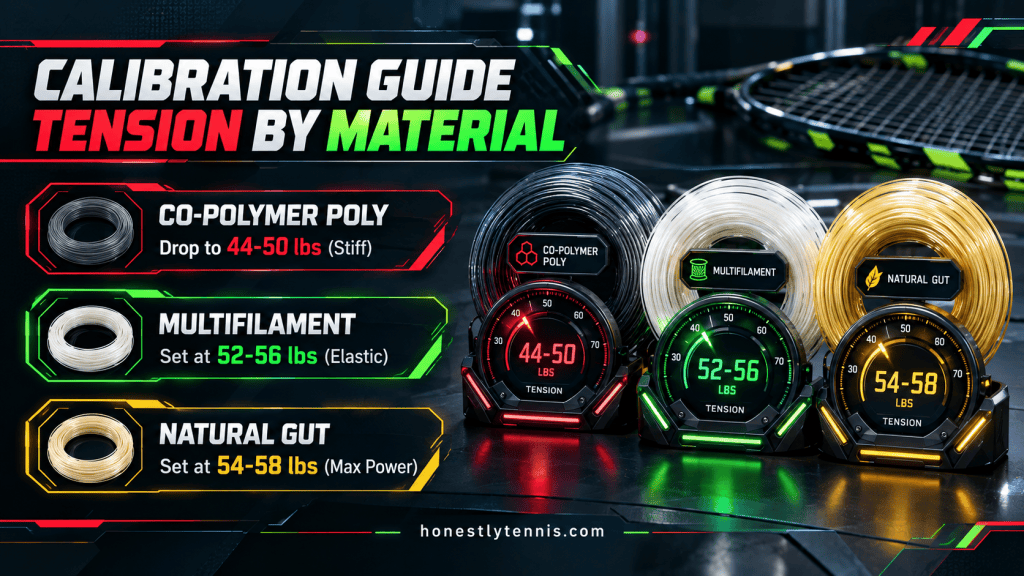
Whenever a student emails me asking, “what tennis string tension should i use,” my immediate reply is a counter-question: What string is in your racket? Asking for a tension number without specifying the string material is like asking how much air pressure to put in a tire without saying whether you are driving a road bike or a dump truck. Different materials have vastly different elastic moduli and tension retention curves.
Co-Polyester Monofilaments (Recommended: 42–50 lbs)
Polyester strings (like Luxilon ALU Power, Babolat RPM Blast, or Solinco Hyper-G) are extruded from single-core stiff polymers. They are engineered to stretch minimally under load, slide across each other with low friction, and snap back violently to create heavy topspin. Because their inherent material stiffness is already sky-high, they do not need high tension to provide control.
For 95% of recreational and club players, co-polyester should strictly live between 42 and 50 pounds. Within that window, the polymer has enough freedom to deflect on impact, pocket the ball, and save your arm from shock. Once you pull a 1.25mm or 1.30mm poly past 52 pounds, the string enters a dead plastic zone where it loses elasticity rapidly and feels like hitting a baseball with a lead pipe.
Multifilament Strings (Recommended: 52–57 lbs)
Multifilaments (like Wilson NXT, Tecnifibre X-One Biphase, or Head Velocity MLT) are constructed from hundreds or thousands of ultra-thin nylon or polyurethane microfibers twisted together like a miniature suspension bridge cable. Because these fibers are extraordinarily elastic and soft, multifilament strings generate massive free power and shock absorption.
If you string a lively multifilament at 45 pounds like you would a poly, your racket will play like a carnival trampoline. Every medium-paced rally ball will sail four feet past the baseline unless you bunt it over the net. To get clean directional control and crisp feedback from a multifilament, you need to string it 4 to 6 pounds tighter than polyester—typically right in the 52-to-57-pound sweet spot.
Synthetic Gut & Natural Gut (Recommended: 52–60 lbs)
Standard synthetic gut (solid nylon core wrapped in outer filament wraps) is the honest workhorse of recreational tennis. It offers a crisp, predictable response and sits right in the middle of the elasticity spectrum, performing best between 50 and 55 pounds for most 3.0 to 3.5 players. It gives you lively pop without the mushy feel that some multifilaments develop at lower tensions.
Natural gut, made from purified cow serosa collagen fibers, sits in a scientific league of its own. It is the only material on earth that retains elasticity and comfort even when pulled up to 60+ pounds, which is why touring pros blend it in hybrid setups. If you string a hybrid setup—putting poly in the mains for spin and synthetic gut or multifilament in the crosses for comfort—always string the softer cross string 2 to 3 pounds tighter than the poly mains (e.g., 47 lbs mains / 50 lbs crosses) to balance stringbed stiffness.
No matter which material you choose, tension is a ticking clock from the second the racket comes off the stringing clamps. Every hit stretches the polymer chains and permanently degrades your rebound efficiency. Make sure you read my complete guide on how often to restring a tennis racket so you are not playing with dead, tension-drained strings that wreck your timing and your elbow.
Coach Mitchell’s Starting Tension Chart
Still wondering “what tennis string tension should i use” for your next drop-off at the shop? I built the master reference chart below based on real NTRP club profiles, swing speeds, and string materials. Find the player profile that matches your honest on-court game—not the game you wish you played on television—and use that exact number as your baseline.
| Player Level & Style | Recommended String Type | Exact Tension Range | Coach Mitchell’s Setup Notes |
|---|---|---|---|
| 3.0–3.5 Flat Hitter | Synthetic Gut or Crisp Multi (16g) | 52–55 lbs | Keeps flat trajectories inside the baseline while giving reliable pop on compact swings. |
| 3.5–4.0 All-Court | Soft Co-Poly / Multi Hybrid | 48 lbs (M) / 51 lbs (C) | The ultimate club cheat code: poly spin bite in the mains softened by plush multi crosses. |
| 4.0–4.5 Topspin Grinder | Shaped Co-Polyester (16L or 17g) | 45–48 lbs | Maximizes main string snapback, heavy kick above shoulder height, and deep penetration. |
| Senior Doubles Touch | Premium Multi or Natural Gut | 50–53 lbs | Delivers effortless deep punch volleys, plush drop-shot touch, and zero joint vibration. |
| Power Baseliner (4.5+) | Firm Co-Polyester (1.30mm) | 50–53 lbs | Tames 80+ mph swing speeds so you can flatten out inside-out forehands without overhitting. |
| Tennis Elbow Sufferer | Polyurethane Multi or Natural Gut | 46–49 lbs | Maximum shock absorption and dwell time; completely eliminates harsh off-center vibration. |
| Junior Tour Grinder | Durable Co-Polyester (16g) | 47–50 lbs | Balances string life against heavy daily hitting while protecting still-growing growth plates. |
When using this tennis string tension guide chart to weigh loose vs tight tennis string tension, there is one behind-the-scenes stringing room secret you need to know: the type of machine matters. Not all 50-pound string jobs leave the shop at the same actual stiffness.
There are two main types of stringing machines in pro shops: mechanical lockout (crank) machines and electronic constant-pull machines. A lockout machine pulls the string until it hits 50 pounds and immediately locks the tension head in place, even as the string naturally relaxes a pound or two before the clamp goes on. An electronic constant-pull machine keeps pulling continuously to compensate for string stretch until the stringer clamps it off.
Because of that continuous pull, 50 pounds on an electronic constant-pull machine feels roughly 2 to 3 pounds tighter than 50 pounds on a crank machine. Whenever you switch stringers or move to a new club, always ask whether they use a crank or a constant-pull machine so you do not get blindsided by a sudden jump in stringbed stiffness.
External Variables: Weather, Altitude, and Ball Fluff
Your string tension does not exist in a vacuum. Even if you find your magic number—say, 48 pounds with a 17-gauge co-poly—the environment around the court will change how that setup plays from month to month. Smart tournament players adjust their tension by 2 to 3 pounds depending on the thermometer and the altitude.
Summer Heat vs. Winter Cold
Temperature alters both the elasticity of your strings and the internal air pressure of the tennis ball. When you step onto a black asphalt hard court in July and the surface temperature hits 115 degrees, the polymer molecules inside your strings warm up and become noticeably more pliable. At the exact same time, the heat increases the gas pressure inside the tennis ball, making it bounce higher and fly faster through the thinner warm air.
Playing in summer heat makes your setup feel 2 to 3 pounds looser than normal. Conversely, playing outdoors on a 45-degree November morning turns your strings into rigid cables and drops the internal pressure of the balls, making them feel like heavy, waterlogged rocks. I always tell my league players to string 2 pounds tighter in the dead heat of July and 2 pounds looser when winter league rolls around.
The Summer Car Trunk Warning
If you remember only one piece of equipment care advice from me, make it this: never leave your tennis racket in the trunk of your car during the summer. A closed car trunk parked in the sun easily reaches 140 to 150 degrees Fahrenheit within an hour. That extreme heat bakes the elasticity right out of your strings, causing rapid thermal creep and killing up to 8 pounds of tension overnight before you even hit a single ball.
Even walking from the parking lot to the courts in August heat or sitting through a three-hour team match in direct sunlight will warp unshielded strings. Protect your string investment by carrying your frames in a thermally insulated compartment inside a dedicated tennis racket bag. Those silver thermal foil linings are not cosmetic gimmicks—they keep your stringbed tension stable so your first frame and your backup frame actually play the same way in the third set.
High-Altitude Calibration and Court Surface
If you travel from sea level to play a tournament in Denver, Albuquerque, or Salt Lake City at 5,000+ feet of elevation, the air density drops significantly. With fewer air molecules pushing back against the fuzzy felt of the ball, shots fly markedly faster and farther through the court. Even with pressurized high-altitude balls, you should bump your string tension up by 3 to 4 pounds at elevation to keep your groundstrokes from sailing long.
Court surface speed plays a similar role in dialing in your poundage. When my players transition from fast, low-bouncing indoor hard courts to slow, gritty green Har-Tru clay courts in the spring, I drop their tension by 2 pounds. On slow clay, the court surface steals ball speed on every bounce, so a slightly looser stringbed gives you the extra depth and higher launch angle needed to push clay-court grinders behind the baseline.
Frequently Asked Questions (FAQ)
1. Will lower tension make me hit long all the time?
Only if you slap at the ball with a flat, open racket face and decelerate through contact. When players drop their tension by 4 or 5 pounds, the first ten minutes of hitting can feel slightly higher-launching because the ball pockets deeper. Once you trust your low-to-high swing path and brush up the back of the ball, the increased main string snapback generates extra topspin that dips the ball aggressively inside the baseline.
2. How do I know if my tension is too high?
Your body and your shot depth will tell you within four games. On the court, if your full-swing rally balls consistently land short around the service line and you have to muscle the frame just to reach the baseline, your strings are too tight. Physically, if the stringbed sounds like a high-pitched ping on contact, twists violently when you miss the center by half an inch, and leaves your wrist or elbow aching after a match, you are strung way past your optimal window.
3. Should the mains and crosses be strung at different tensions?
If you are using a hybrid setup—mixing two different string materials like a poly main and a multifilament cross—you should almost always string the softer cross string 2 to 3 pounds tighter to equalize dynamic stiffness across the bed. If you are stringing a full bed of the exact same string, most recreational players do great keeping mains and crosses at the exact same poundage.
4. How quickly does a racket lose tension after stringing?
Every string begins losing tension the literal second the stringer pulls the clamp off the frame, even if the racket sits untouched in your closet. Co-polyester strings suffer the steepest initial drop, routinely losing 8% to 12% of their static tension in the first 24 hours simply from polymer relaxation, followed by steady loss during the first two hours of hitting. Nylon multifilaments hold tension significantly better than poly.
5. What tension do modern pro tour players actually use?
Gone are the days when every pro on tour copied Pete Sampras at 65+ pounds. Today, the vast majority of ATP and WTA players using polyester strings play between 44 and 54 pounds. Carlos Alcaraz and Jannik Sinner routinely string in the high 40s to low 50s depending on court speed, Frances Tiafoe has dropped down into the low 40s, and Adrian Mannarino famously competes on the ATP Tour with his strings pulled down around a jaw-dropping 22 to 25 pounds.
Final Verdict: The 5-Pound Rule
When you strip away all the locker-room myths, settling the debate over loose vs tight tennis string tension comes down to honest self-awareness about your swing speed and string material. Tight tension (55+ lbs) gives surgical, flat-trajectory control to big hitters using soft strings, but it punishes off-center contact and hammers your joints. Loose tension (40–48 lbs) unlocks free baseline depth, expands your sweet spot, protects your elbow tendons, and lets modern polyester strings snap back the way engineers actually designed them to work.
Before you march into your local pro shop tomorrow and demand a 15-pound drop, respect what I call Coach Mitchell’s Adjustment Rule: Never change your string tension by more than 3 to 5 pounds at a single time. Your brain’s proprioception and muscle memory are calibrated to the exact launch angle and dwell time of your current setup, even if that setup is hurting you.
If you are currently playing with polyester at 55 pounds, do not jump straight to 42 pounds tomorrow morning or you will spray forehands for two weeks. Drop from 55 pounds down to 50 pounds on your next restring, play three matches to let your swing path adjust to the deeper pocketing, and then drop down to 46 or 47 pounds on the following restring.
Leave your ego in the parking lot, stop letting the outdated factory sticker on your racket throat dictate your game, and cut out that dead six-month-old poly today. Drop your tension by four pounds, let the stringbed trampoline do the heavy lifting, and enjoy hitting heavy, pain-free balls deep into your opponent’s corners.


Hi, I’m Coach Mitchell. With over a decade of experience on the tennis court, I created Honestly Tennis to share my passion for the game. Whether you are a beginner looking for your first racquet or an advanced player wanting to upgrade your gear, my goal is to provide honest reviews and helpful guides to elevate your game.