Disclosure: At Honestly Tennis, we independently test gear. As an Amazon Associate, we earn from qualifying purchases at no extra cost to you.
Let’s talk about the plateau. You know the one. You’ve been playing for two or three years, you can rally all day, and yet you’re stuck in the same 3.5 box league, launching balls into the side fence every time someone pushes you wide. Here’s the ugly truth most of your opponents already figured out: your beginner racket is the problem.
Most beginner frames weigh 9.2 to 9.7 ounces strung and are so powerful that any decent swing speed sends the ball sailing long. That’s fine when you’re learning contact. It’s a liability once you actually have swing speed. The fix isn’t a new forehand — it’s roughly 300 grams (10.6 oz) of properly weighted graphite that lets you swing big and keep the ball inside the lines.
That’s what this whole guide is about. I’ve hit with, strung, and — more importantly — coached behind every one of these five frames, and these are my honest picks for the best tennis rackets for intermediate players this year. No lab robots. No sponsored fluff. Just frames that make 3.5 players better faster.
Why You Should Trust Coach Mitchell
I’ve spent over a decade coaching on public hard courts and club programs, stringing somewhere north of 3,000 rackets, and running my Tuesday night 3.5 clinics every week, rain or shine. When players ask me for the best tennis rackets for intermediate players, this is the same shortlist I give them at the fence after practice. I buy every racket in my review pile with my own money — no brand loaners, no “pro player program” freebies — because the second a brand sends you a frame, your review turns into an ad. I break bumper guards, fry grommets on gritty Texas courts, and restring test frames until they die, then I tell you what actually happened. If a racket is overpriced junk, I’ll say so.
Coach’s Quick Matrix
Here’s the cheat sheet before we dig in:
- Babolat Pure Drive — Best for Raw Power
- Head Speed MP — Best All-Court Control
- Yonex EZONE 100 — Best for Comfort and Plush Feel
- Wilson Blade 100 v9 — Best for Precision
- Tecnifibre TF-X1 300 — Best Under-the-Radar Value
If you just want my overall pick and the fastest shortcut through the noise, this quick matrix is the honest answer to the “best tennis rackets for intermediate players” question — grab the Head Speed MP and move on with your life. Everyone else, keep reading.
Babolat Pure Drive
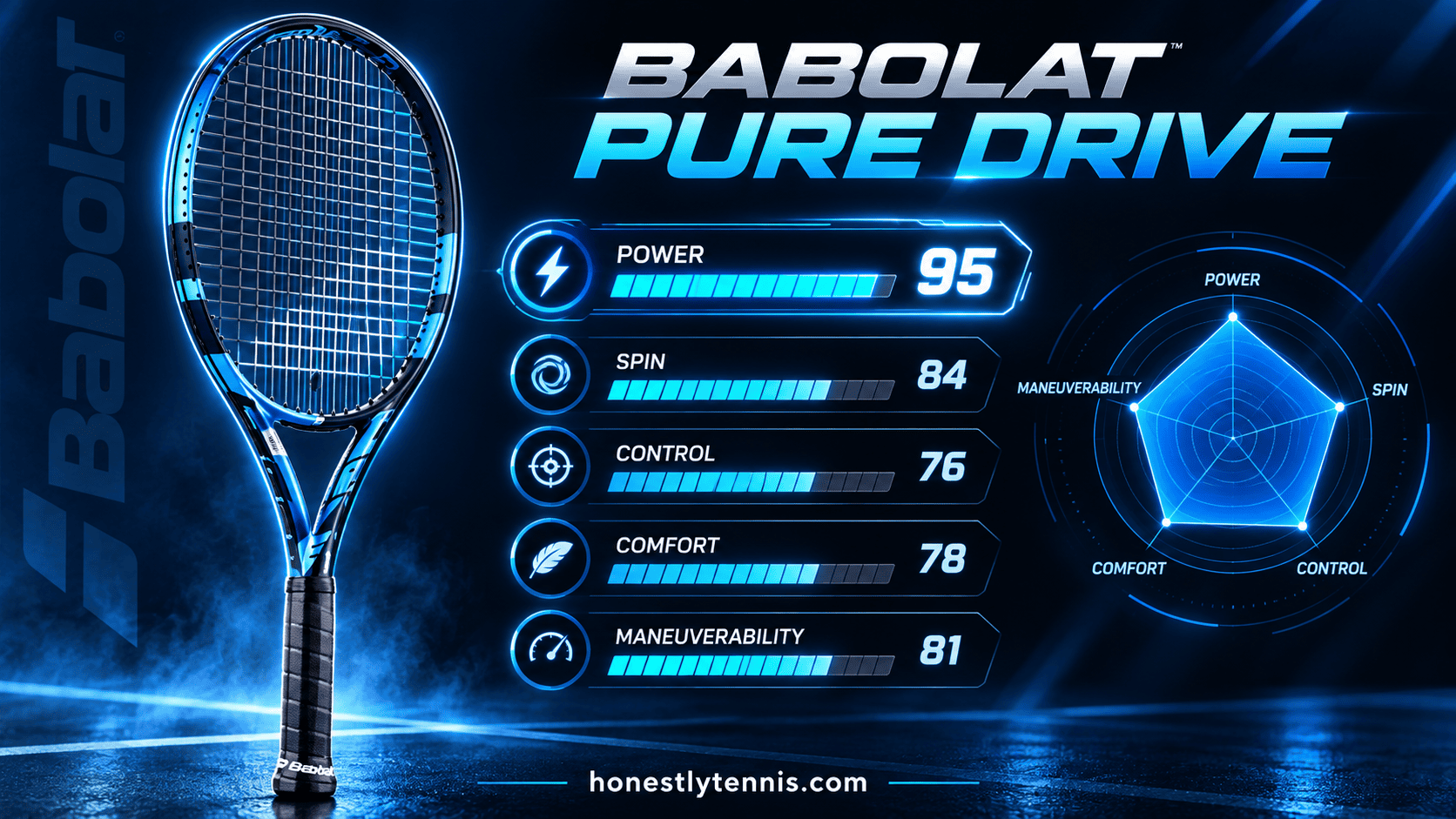
This is the frame everyone pictures when they hear “power racket,” and Babolat hasn’t messed it up. It’s around 300 grams unstrung, a 100-square-inch head, and a swingweight that gives you free pace you don’t deserve.
The On-Court Vibe
The first time you hit a return with this thing, you’ll understand the hype. I had a student — a strong 3.5 with a loopy takeback — use mine against a 4.0 buddy’s kick serve, and the ball came off the string bed so fast the returner barely had to add spin. On my own court time, second serves that used to sit up short were suddenly landing deep with heavy topspin, and my opponent’s shoulders were telling the story. It feels like a slingshot with a grip. That’s the whole appeal.
Tech That Actually Works
Babolat talks about their flax inserts and RMS dampening system, and half of it is marketing. What actually matters: the layup is stiffer and more torsionally stable than the older Pure Drives, so off-center hits don’t twist your wrist into next week like the 2015 version did. The grommet system genuinely boosts ball speed on serves. Translation: you get pop on serve and on return without selling your swing out.
Where It Bleeds
It’s stiff. Hit this thing cold with a stiff polyester at 55 pounds and your elbow will file a formal complaint by week two. It’s also honestly too much power for players with compact swings — I’ve watched too many clinic regulars sail balls three feet long for a month before they learned to tame it. The bumper guard scuffs fast too; after about 40 hours on gritty public courts, mine looked like it lost a fight with a belt sander.
Coach’s Stringing Secret
Do NOT string this with a full bed of firm poly. Go with a hybrid: Solinco Hyper-G in the mains at 50 pounds, Head Velocity MLT in the crosses at 52. You keep the free pace but save your arm. If you’re sensitive, string the whole thing with Velocity at 48 and thank me later. Budget for the string — it’s part of the real price of the racket.
Alternative Pick
If the Pure Drive feels like a cannon you can’t aim, the Wilson Ultra 100 v4 gives you similar power with a calmer, more controlled response.
Head Speed MP
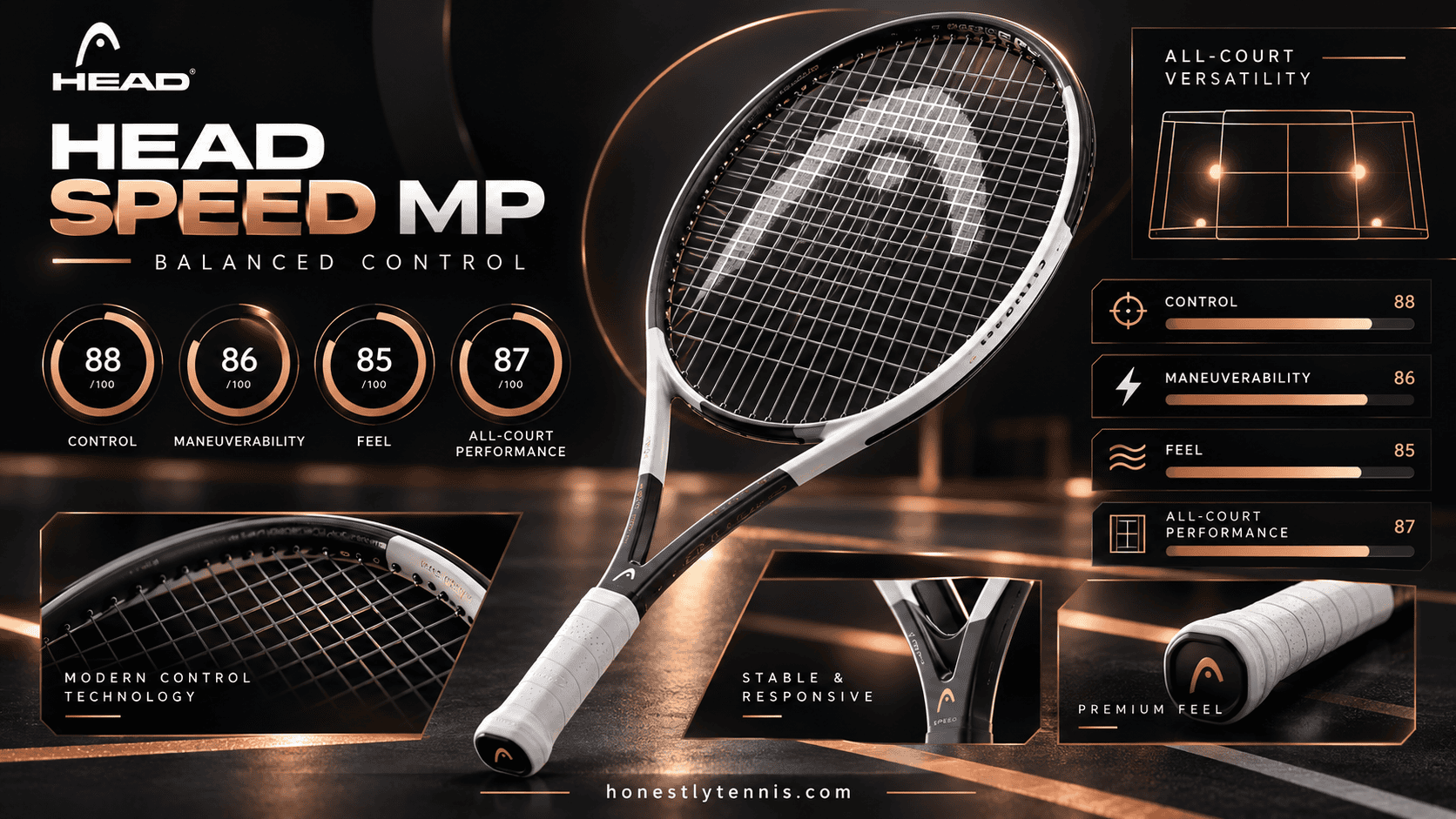
The Speed MP is the “responsible adult” of this list, and I mean that as a compliment. Around 300 grams, 100-square-inch head, and a feel that lets you actually decide where the ball goes instead of praying after contact.
The On-Court Vibe
This is the frame I hand to transitioning intermediates in my clinics, and the lightbulb moment usually comes around the third rally. Last month a student used one to block back a big 4.0’s first serve for a clean winner down the line — she said it felt like the racket “caught” the ball for her. The response is direct without being harsh, and when you swing out, the ball goes where you aimed, which for a 3.5 player is a genuinely novel experience. It’s also the most versatile frame here; serve, rally, volley, it does all of it at a B-plus or better.
Tech That Actually Works
Head’s “Auxetic” branding is mostly a vibe, but what’s real is the improved stability over the previous Speed generation and the slightly elongated head shape that adds a touch of spin without going full spin-monster. The 16×19 pattern is open enough for spin but dense enough that your strings don’t fly loose every nine games. It just plays cleaner than its spec sheet suggests.
Where It Bleeds
It’s not a power frame, and players coming from a beginner stick will feel a little flat on serve for the first few sessions. You have to supply your own pace, which is exactly the skill you’re supposed to be building — but it can feel like a demotion at first. And the cosmetic paint on the newer models chips at the throat faster than it should. Mine has a scab above the throat after one season of bag work.
Coach’s Stringing Secret
This frame loves a soft-ish poly. String it with Yonex Poly Tour Pro at 51 pounds and you get spin, control, and comfort in one setup. If you string tight because you break strings fast, drop two pounds — the Speed MP plays stiff as tension climbs.
Alternative Pick
If you want more free power with a similar feel, the Head Radical MP trades a little control for easier depth.
Yonex EZONE 100
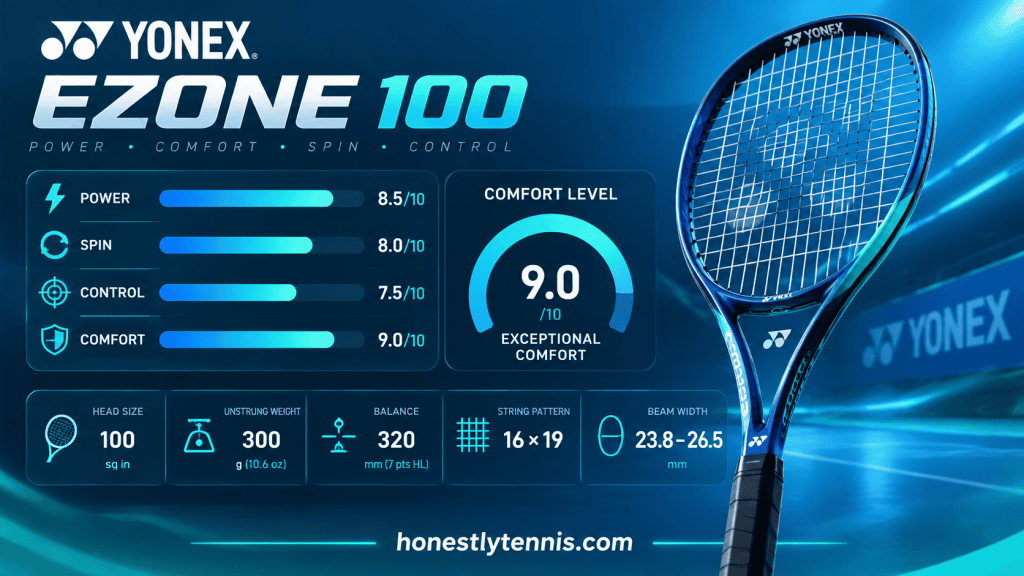
Yonex doesn’t advertise as loudly as the big two, but the EZONE 100 might be the most comfortable 300-gram frame ever made. If your arm has an opinion, listen to it.
The On-Court Vibe
Hitting with the EZONE feels like the ball stays on the strings half a beat longer, and that plush feel is addictive once you’re used to it. I logged a full month of sessions with this frame during our summer league, including two three-setters in 98-degree heat, and my arm felt fine — which is not something I can say about the Pure Drive weeks. The deeper I swung, the better it played, and kick serves kicked harder than with anything else on this list because of that slightly wider head shape.
Tech That Actually Works
Yonex’s isometric head shape isn’t a gimmick — a squarer hitting area means a bigger sweet spot side to side, and you feel it most on returns and defensive pokes. The VDM graphite in the handle genuinely filters vibration; that’s not marketing, that’s your wrist at hour three confirming it. It’s also one of the most forgiving 300-gram frames on mishits, which matters when you’re still dialing in contact.
Where It Bleeds
Two honest problems. First, the anisometric-looking Yonex head shape and isometric string pattern confuse some players visually — a few of my students just never warmed to the look. Second, it’s on the powerful side for a “control” frame, and heavy topspin players can push balls deep until they adjust. Also, Yonex grommets can be a pain to source if you crack them; order a set with the racket.
Coach’s Stringing Secret
The EZONE 100 loves a multi-hybrid for comfort: Tecnifibre X-One Biphase in the crosses with a soft poly main at 48 pounds. But for durability-minded intermediates, Solinco Hyper-G Soft full bed at 50 pounds is the sweet spot — soft enough to protect the arm, firm enough to keep the power honest.
Alternative Pick
If you want the Yonex comfort with a smaller, more precise head, the EZONE 98 is the same DNA in a sharper package.
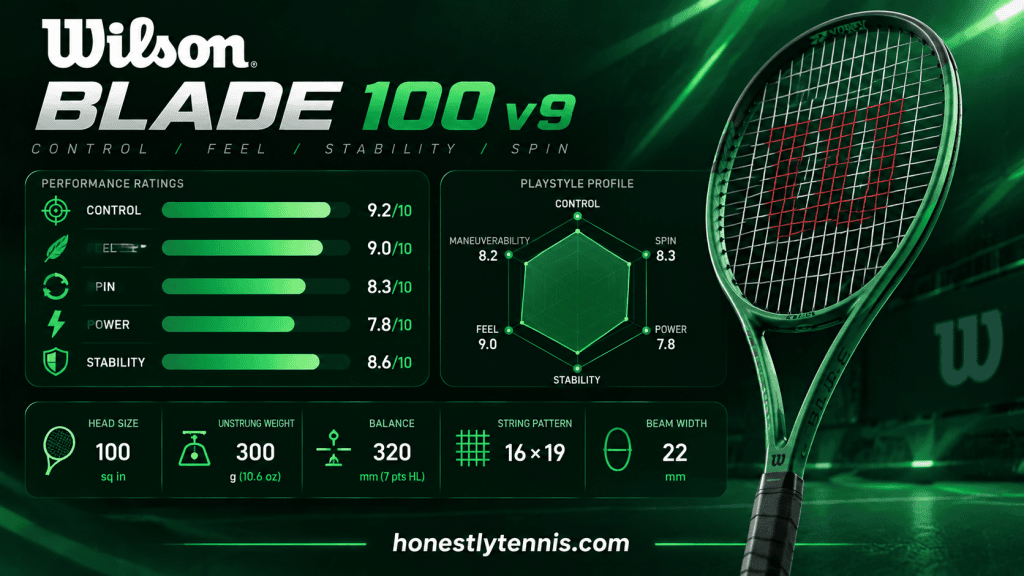
Wilson Blade 100 v9
The Blade is the thinking player’s frame, and the v9 version is the best Blade Wilson has made in years. If you’re a feel player who wins with placement instead of pace, start here.
The On-Court Vibe
This frame tells you the truth. Every mishit, every late contact, every lazy swing — you know immediately. That sounds like a punishment until you realize it’s how you actually improve. I used the v9 for six weeks of mixed doubles and my drop shots and low volleys got noticeably sharper because the frame gives you such a clear read on contact. Blocking back a heavy serve feels surgical; you can redirect pace flat and on a dime, which is a 3.5 superpower nobody talks about.
Tech That Actually Works
Wilson’s FORTYFIVE carbon layup is the real story — it softens the response at lower impact and firms up at higher impact, so volleys feel connected and groundstrokes don’t launch. It plays more stable than its weight class suggests, and the 100-square-inch head with 16×19 pattern gives enough spin without the ball sailing. Translation: precision you can feel in your hand, not a spec sheet promise.
Where It Bleeds
It’s demanding. Players with slow swing speed will hit short and hate it, and I’ve had two clinic students return it for exactly that reason. It’s also less forgiving on off-center hits than the EZONE — frame the ball on the edge and it stings and flies. And Wilson’s QC on some v9 batches ran a touch inconsistent early on; if yours feels dead, get it swapped.
Coach’s Stringing Secret
The Blade v9 rewards a softer poly. My setup: Head Lynx Tour at 50 pounds. It keeps the response clean and the arm happy. Do not string this frame at 55+ with stiff poly unless you enjoy elbow pain — this layup plays firm under tension.
Alternative Pick
If the Blade feels too demanding, the Wilson Clash 100 v2 gives you a much more forgiving arm-friendly path with similar control.
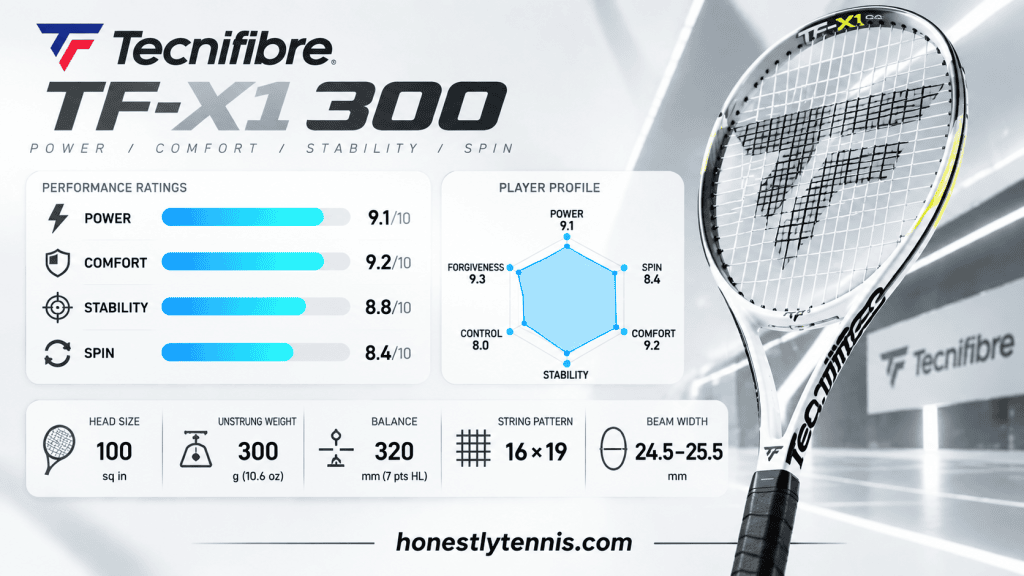
Tecnifibre TF-X1 300
Nobody at your club owns one, and that’s a shame. The TF-X1 300 is the value sleeper of this whole list and my dark horse in any conversation about the best tennis rackets for intermediate players — real performance for less money than the big brands charge.
The On-Court Vibe
I picked this up expecting a budget frame and got an education. The first session, I served with it in a doubles league match and was getting free pace I didn’t earn — the response is livelier than the “control frame” label suggests. By the third hit, what won me over was the comfort: it’s genuinely plush for a modern frame, and after two hours on hard court my elbow had nothing to say. When I fed balls to my Tuesday night 3.5 clinic with it, students kept asking what the “nice” racket was. That never happens with a Tecnifibre.
Tech That Actually Works
Tecnifibre’s X-Teller weave in the throat and their shock-absorbing layup do what they claim — the frame dampens harshness without going mushy. The ergo grip shape is slightly flattened and a lot of players find it more comfortable than a standard bevel setup. It’s stable on blocks, easy to swing, and the 16×19 pattern gives you spin when you ask. It simply does 90% of what the flagship frames do for noticeably less money.
Where It Bleeds
Brand recognition, mostly — resale value is weak and you can’t demo it at every club pro shop. Performance-wise, it gives up a little raw power to the Pure Drive and a hair of precision to the Blade. Also, the cosmetic finish picks up scuffs on the bumper guard faster than it should, same complaint I have with most modern frames on gritty courts.
Coach’s Stringing Secret
This frame plays slightly softer than spec, so don’t be scared of a mid-tension poly. Luxilion Element at 51 pounds is the perfect match — comfortable, controllable, and it’ll last a solid month of twice-a-week play. Add a fresh set of that string to your cart when you order; you’ll want it by week six.
Alternative Pick
If you want the Tecnifibre comfort from a brand with more court presence, the Head Speed MP is the obvious next stop.
How to Know You’re Ready for a “Player’s Frame”
This is where most of you are actually stuck, so let’s settle it. You’re ready for one of the best tennis rackets for intermediate players when three things are true. First, you can rally twenty balls in a row with consistent depth without the ball flying long. Second, you’re starting to miss because of placement, not because of contact. Third, your current racket feels like a trampoline you’re fighting. If that’s you, congratulations — you’ve outgrown your gear, and that’s a good problem.
Weight: the 300-gram club. Frames in the 295 to 305 gram range (10.4 to 10.7 oz unstrung) are the sweet spot for intermediates — heavy enough to provide stability against hard hitters, light enough that your shoulder survives a two-hour match. Go lighter and you’ll keep flinging balls; jump straight to a 320-gram player’s frame and your arm will pay rent before your game improves. Every racket on this list sits in that window for a reason.
Head size: 98 to 100 square inches. A 100-square-inch head gives you the forgiveness you still need on mishits, while a 98 rewards you with precision but punishes you for it. If you’re coming from an oversized beginner frame, take the 100. There’s no trophy for suffering with a smaller head a year too early.
Stiffness: the number nobody explains properly. Stiffness (measured in RA, roughly 55 to 70 on modern frames) is how much the frame flexes on impact — stiffer frames give more power and less arm comfort, softer frames give more feel and forgiveness on your joints. Intermediate players with any history of elbow trouble should look under 63 RA, and pair that with a soft string setup. If your elbow already talks to you, read my full guide on arm-friendly frames before you buy anything. Stiffness plus string choice is 80% of arm health; the racket brand is the other 20% of the marketing.
One more thing: budget for strings and a proper grip replacement. A $200 frame strung with dead $8 synthetic gut at 60 pounds plays worse than a $130 frame with a fresh soft poly at 50. The string setup is half your racket. Act accordingly.
Final Call: Pick One and Go Hit
Here’s the blunt version. If you want the most improvement per dollar of practice time: Head Speed MP. If your arm is precious: Yonex EZONE 100. If you live and die by the serve: Babolat Pure Drive. If you’re a placement player: Wilson Blade 100 v9. If you’re smart with money: Tecnifibre TF-X1 300.
Every one of these frames will do more for your game in a month than another six sessions with your starter racket. The intermediate plateau doesn’t break itself — you break it with better contact, better weight, and reps. Pick a frame from this list, string it right, and get back on the practice court. Your 4.0 self is waiting.


Hi, I’m Coach Mitchell. With over a decade of experience on the tennis court, I created Honestly Tennis to share my passion for the game. Whether you are a beginner looking for your first racquet or an advanced player wanting to upgrade your gear, my goal is to provide honest reviews and helpful guides to elevate your game.