Disclosure: At Honestly Tennis, we independently test gear. As an Amazon Associate, we earn from qualifying purchases at no extra cost to you.
Watch a few pro matches, and suddenly every club player wants the same small-headed, heavy tour racket. I see it every single week: a 3.5 player walks onto a blistering hot hard court with a $250 frame built for someone who hits thousands of balls a day.
Ten minutes later, they are late on the backhand, catching the ball near the frame, and blaming their strings. The racket looks great in the bag. It just isn’t helping them win.
Choosing a 98 vs. 100 sq inch tennis racket is one of the biggest gear decisions you will make. From what I have seen over the years, roughly 80% of club players get it completely wrong because they buy for the player they wish they were, not the player they actually are today.
Here is my rule: buy the racket that works when you are tired, rushed, and one break point down. Not the one that feels amazing on three perfect warm-up forehands.
Why Trust Coach Mitchell?
I have spent more than 12 years coaching on US public and private club hard courts. I’ve seen recreational players turn a fun Saturday match into a miserable fight with their equipment.
One pattern drives me crazy: a player buys a demanding 98 sq inch tour racket, then swings harder to cover up weak contact. Soon they are missing routine balls, squeezing the grip to death, and complaining about their elbow. A 98 isn’t a bad racket. It’s just a terrible shortcut to looking like an advanced player.
The Core Difference: Sweet Spot & Forgiveness
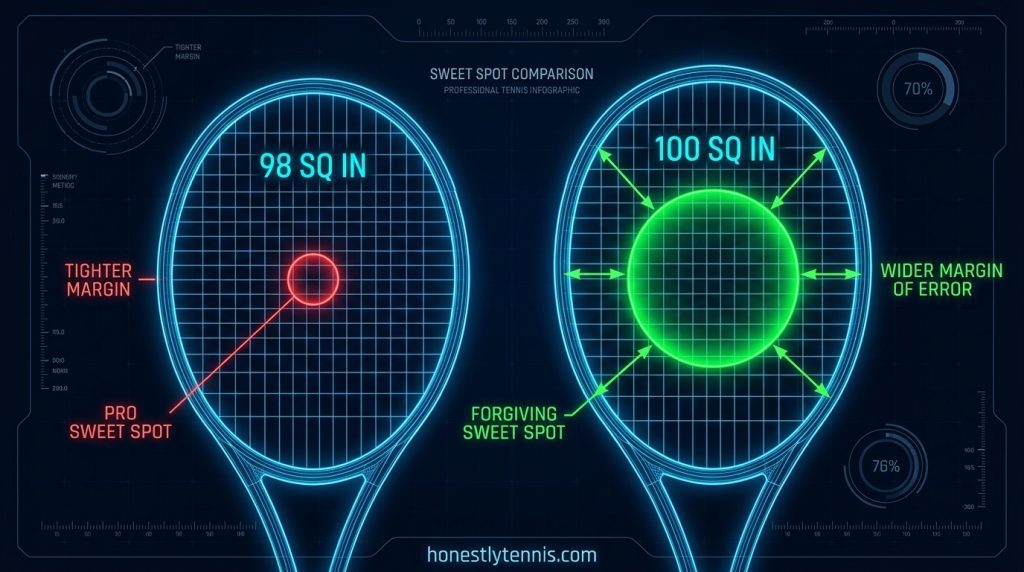
First, let’s clear up the math. A 100 square inch head has only two more square inches of string area than a 98. That’s about 2% more surface area, not some massive giant jump in head size.
But matches aren’t played on a spreadsheet.
The sweet spot is the part of the string bed where impact feels solid and the ball leaves with good speed. Outside it, you lose pace and may feel the racket face twist. A well-designed 100 sq inch frame gives you a little more room for those imperfect hits. That tiny margin matters a lot on tough returns and wide forehands.
Launch angle matters, too. Many 100s, especially open-pattern models, send the ball off the strings on a slightly higher path, making it much easier to clear the net and still reach deep in the court. So when I hear the 98 vs 100 sq inch tennis racket argument reduced to simply “control versus power,” I tell my students to go hit 20 rushed, defensive backhands with each one. The brutal truth shows up fast.
The 98 Sq Inch Trap (Who Is It Actually For?)
A good 98 can feel incredibly precise. You can drive a low ball and aim near the lines without feeling the racket steer it.
That control is real, but you have to earn it. You need extremely quick feet, early preparation, a full swing, and clean contact near the center of the strings every single time. When you are late and catch a ball toward the edge, the frame will twist in your hand. Your shot loses speed, lands short, or dives straight into the net.
For most players, I reserve a demanding 98 tour frame for strong 4.5+ tournament players who already produce their own massive pace and stay perfectly balanced under pressure. If you are considering a 98 vs 100 sq inch tennis racket, do not judge it by how it feels while feeding yourself slow balls. Judge it when someone makes you run.
The 100 Sq Inch Reality (Why You Probably Need One)
For most 3.5 to 4.5 players, a 100 sq inch frame is the smartest buy. They give you help without feeling like a trampoline.
You get free power. That means you do not need to swing out of your shoes to hit a deep neutral ball when your legs are completely dead. You also get a little more forgiveness. On a third-set stretch return, contact that misses the ideal spot may still send the ball past the service line instead of dropping it in the net.
Try this before paying $250: demo a 98 and a 100 with similar weight and string setups. Count how many shots land deep with a safe margin, not how many times you hit one perfect winner. If the 100 keeps more balls in play when you are rushed, you have your answer.
Coach’s Top 100 Sq Inch Recommendations
I don’t tell every student to buy the same racket. Pick the 100 that fits the ball you want to hit.
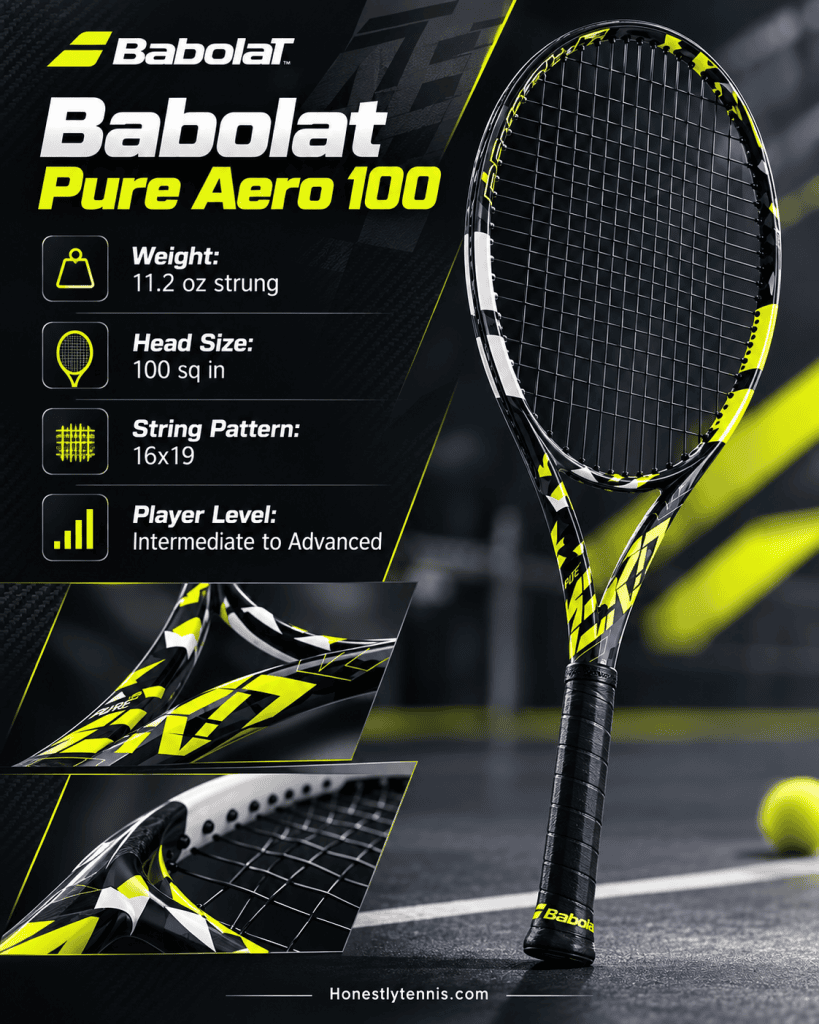
The Spin Machine: Babolat Pure Aero
If you want heavy topspin and a ball that jumps violently off the hard court, the 100 sq inch Pure Aero is my spin king. It rewards a fast, modern low-to-high swing. But do not buy it expecting the racket to create spin by itself. For the full breakdown, read my honest Babolat Pure Aero review.
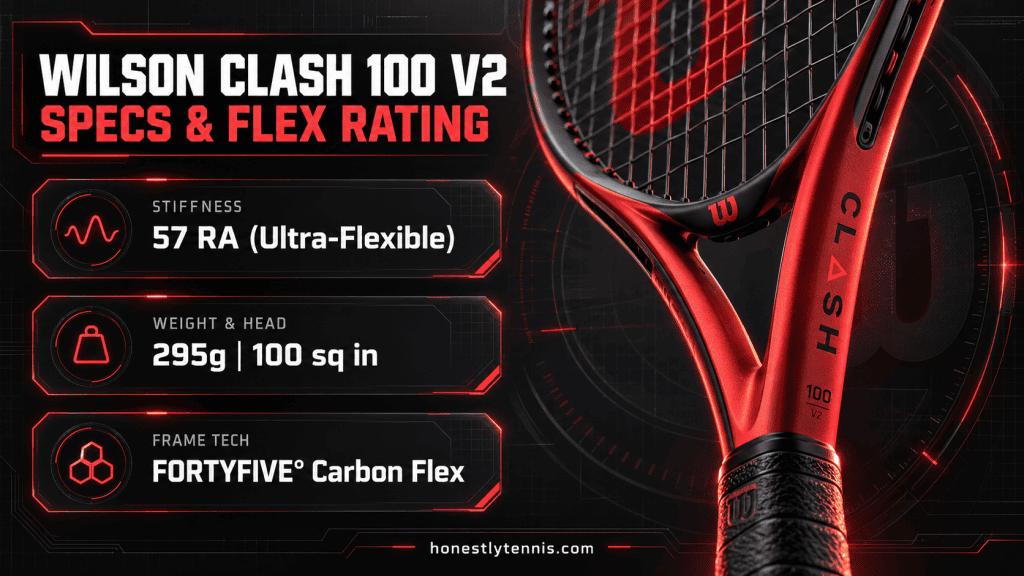
The Arm-Saver: Wilson Clash 100
If your elbow complains after long hard-court matches, start your demo list with the Clash 100. It is one of the softest-feeling mainstream 100s on the market, with an easy, flexible response on contact. See what I liked and didn’t like in my complete Wilson Clash 100 v2 review.
The Power & Feel: Yonex Ezone 100
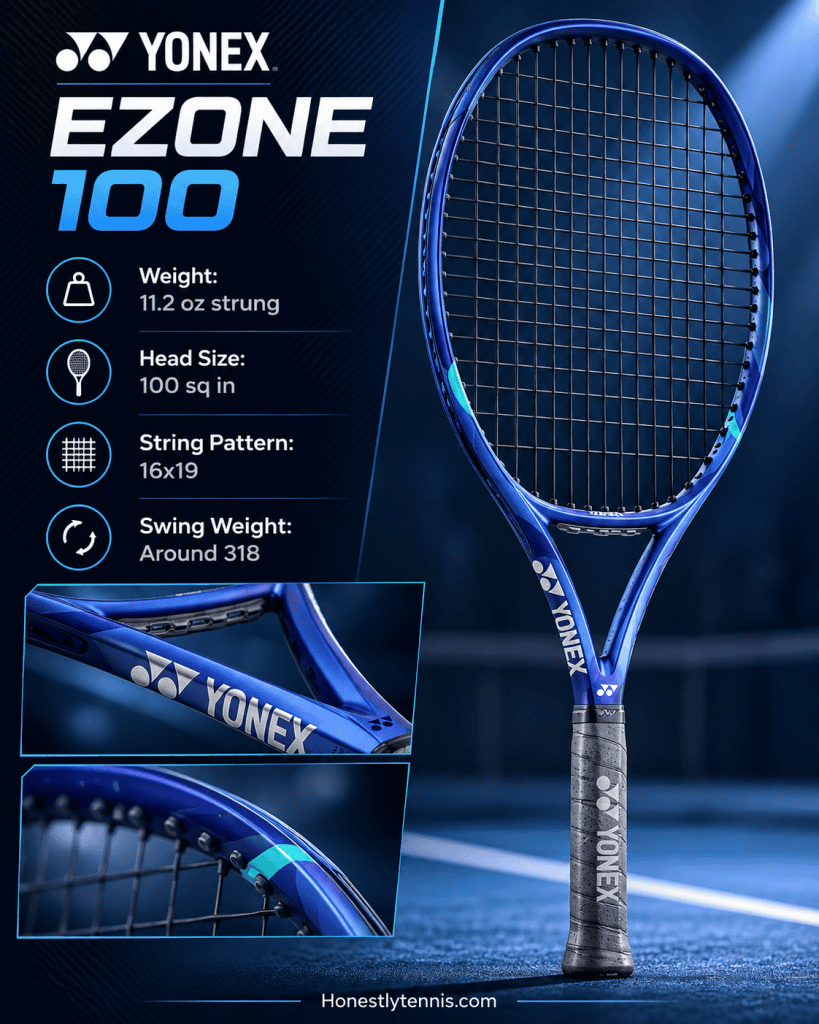
If you want easy depth with a crisp, solid feel, the Ezone 100 is hard to overlook. Its ISOMETRIC head shape is built to make more of the string bed useful. You will not need to force every shot just to reach the baseline. Read my detailed Yonex Ezone 100 review before you spend your money. You can also explore their full range on the Yonex Official Site.
Final Verdict: Drop Your Ego and Win More Matches
Here is the final answer to the 98 vs 100 sq inch tennis racket debate: unless you are getting paid to play, buy the 100.
Yes, some recreational players hit great tennis with a 98. If you can swing it cleanly under pressure and finish matches without fighting the frame, enjoy it. But do not confuse a smaller head with better tennis. Your opponents do not award style points because your racket looks like a pro’s.
On a hot Sunday afternoon, your footwork will get lazy. Your timing will slip, and the ball will catch the strings a little off-center. That is when the extra forgiveness of a good 100 sq inch frame helps you make one more return, one more deep rally ball, and one more passing shot. Those are the shots that win club matches.


Hi, I’m Coach Mitchell. With over a decade of experience on the tennis court, I created Honestly Tennis to share my passion for the game. Whether you are a beginner looking for your first racquet or an advanced player wanting to upgrade your gear, my goal is to provide honest reviews and helpful guides to elevate your game.