Disclosure: At Honestly Tennis, we research and compare gear using manufacturer specs and real player feedback. As an Amazon Associate, we earn from qualifying purchases at no extra cost to you.
This Head Speed MP review answers one question: is the latest generation of Head’s most balanced racket right for your game? For a 3.5 to 4.5 club player with a medium-full swing who wants control, spin, and an arm-friendly flex in one 300-gram package, it is one of the strongest picks in the 100 square inch class. The honest catch: a 329 swingweight asks for real timing, so it is not a frame for a short, tentative swing.
- How We Chose
- Head Speed MP at a Glance
- Frame Anatomy: What the Specs Actually Mean
- How It Plays, Shot by Shot
- String & Tension Matching
- Head Speed MP vs the Rivals
- Which Club Player Is It For?
- Watch: The Ultimate Guide to Choosing a Tennis Racket
- Final Verdict
- FAQ
How We Chose
No staged playtests — just the physics that governs every frame, the official specs of the latest generation, and the patterns we see week after week from 3.0 to 4.5 club players. Every claim in this Head Speed MP review traces back to a verified number: head size, weight, balance, stiffness, swingweight, or string pattern.
Head Speed MP at a Glance
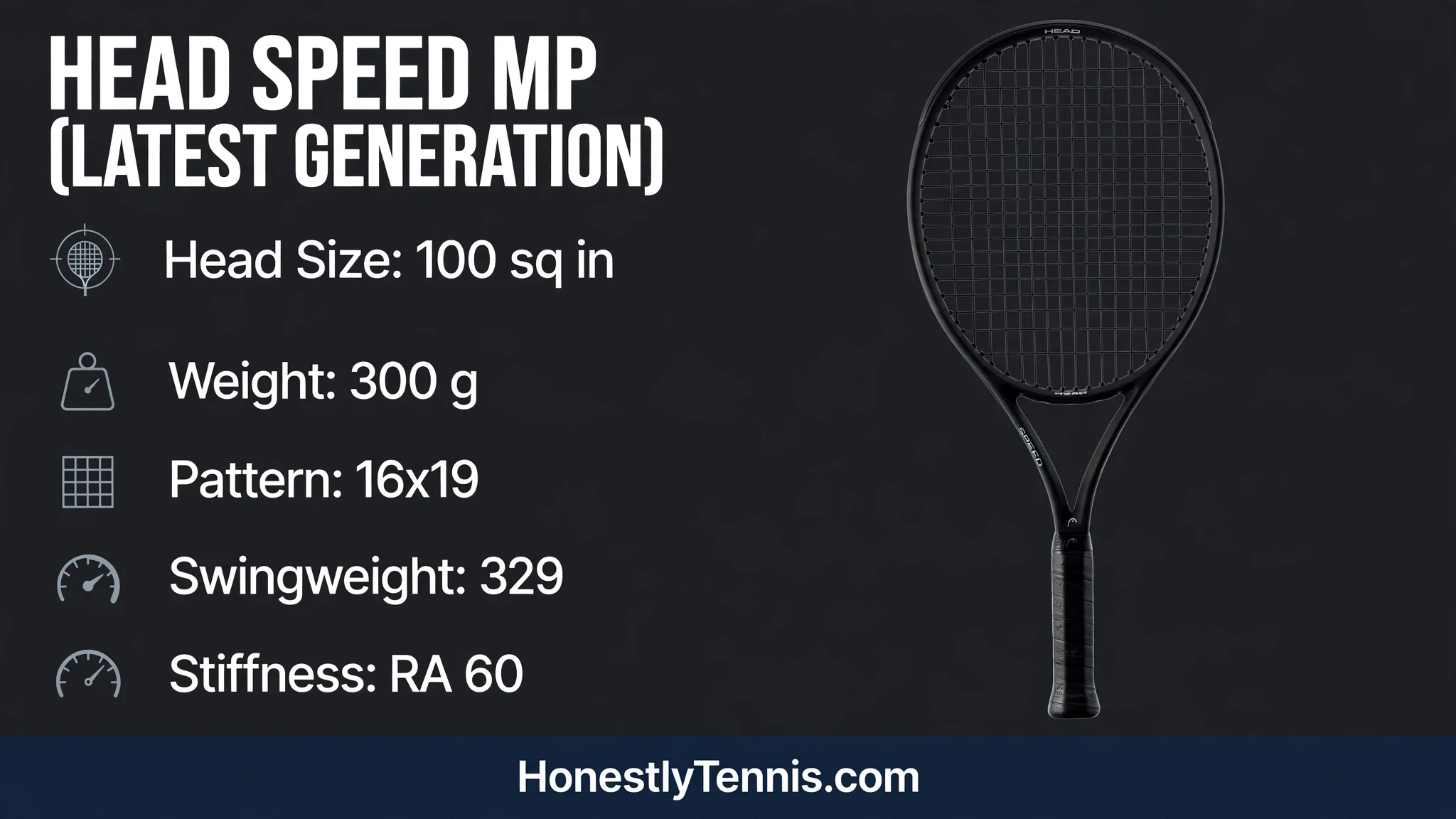
In this Head Speed MP review, the latest generation keeps the formula that made the Speed MP a club-player staple: a 100 square inch head, 300 grams unstrung, and a 16×19 pattern. What changed is inside the frame — Head’s new Hy-Bor material, a mix of high-end carbon fibers and boron built to add stability and feel. The cosmetic changed too: an all-black Legend paintjob, the cleanest look the line has had.
| Spec | Head Speed MP (latest generation) |
|---|---|
| Head Size | 100 sq in |
| Unstrung Weight | 300 g / 10.6 oz |
| Strung Weight | 318 g / 11.2 oz |
| Balance | 4 pts head-light |
| Swingweight | 329 (strung) |
| Stiffness (RA) | 60 |
| Beam Width | 23 mm constant box beam |
| String Pattern | 16×19 |
| Technology | Hy-Bor (carbon fibers + boron) |
| Cosmetic | All-black Legend |
Frame Anatomy: What the Specs Actually Mean
Three numbers decide how this racket plays, and any honest Head Speed MP review starts with them: a 60 RA flex, a 329 swingweight, and a 23 mm box beam. The 60 RA is the softest flex in the 100 square inch, 300-gram class — it bends at contact, pockets the ball, and sends less shock to your elbow than the stiffer power frames. The 329 swingweight is the other side of the deal: real mass through the ball, so the frame holds its line against heavy pace. The 23 mm constant box beam keeps the response predictable, and the 16×19 pattern gives heavy topspin without giving up a flat hitter’s control.
- Who It’s Best For: A 3.5–4.5 club player with a medium-full swing who wants one racket for every part of the court — topspin rallies, short balls, and a frame that stays stable against harder hitters.
- Who Should Skip It: A 3.0 player with a short, compact swing, or anyone who struggles to get a 300-gram frame around on fast balls. If you need the racket to supply the pace, a lighter or stiffer power frame will serve you better.
How It Plays, Shot by Shot
Baseline Groundstrokes
This is where the Head Speed MP review earns its keep. The 329 swingweight does the heavy lifting from the baseline: the frame stays stable through contact, so your rally ball lands deep even when your opponent hits hard. The 60 RA flex gives the ball pocketing time, which is why the frame feels comfortable on long rallies. The trade is timing — the same mass that adds stability asks you to set up early. A full-swing 4.0 baseliner will love the depth and spin; a player who arms the ball will fight it.
Serves
On serve, the Speed MP rewards a full, relaxed motion. The mass adds pace to a flat first serve, and the 16×19 pattern gives a kicker real bite. The flex absorbs some pace — this is not the biggest-serving frame in its class — but the control is honest: you can swing out on a second serve and trust the ball to drop in. A stiffer frame gives more free pace; this one is steadier for a rally-starting serve.
Volleys and Net Play
At the net, the 4 points head-light balance does quiet work: the frame gets into position fast for a 329 swingweight, and the stable hoop redirects pace instead of twisting. Drop volleys sit soft thanks to the 60 RA flex, and punch volleys stay firm. A player who moves forward with intent will find it solid and predictable.
Returns and Comfort
Blocked returns go deep with little effort, and the flex keeps the shock down when you catch one late. For a sore elbow, the 60 RA is the real story: among current 100 square inch performance frames, this is one of the softest, and it pairs well with a multifilament string and the right tension. If your arm aches after matches, read our guide to the best tennis rackets for tennis elbow before you buy anything.
String & Tension Matching
The right string turns this frame’s control into your control. Polyester is stiff and low-powered, so string it at 48–50 lbs — a soft, round co-poly keeps the spin without adding harshness to the 60 RA flex. Multifilament is softer and more powerful, so string it 2–4 lbs HIGHER than poly, at 51–53 lbs, if comfort is your priority. The hybrid done right puts the soft string in the mains: a multifilament main at 51–53 lbs with a smooth, round, soft co-poly cross 2–4 lbs lower gives comfort with control. Never pair a sharp or shaped poly with a multifilament — the shaped edges saw through the soft fibers.
That is the setup this Head Speed MP review recommends most for club players with sore arms. For the full tension picture, our loose vs tight string tension breakdown covers it all. You can compare string stiffness and energy return numbers in the Tennis Warehouse University String Performance Database.
Head Speed MP vs the Rivals
No Head Speed MP review is complete without the rivals: two direct rivals share its 100 square inch, 300-gram class, and the choice comes down to stiffness. The Babolat Pure Drive is the power pick: at 71 RA it is far stiffer, so it gives more free pace and a crisper feel, but it sends more shock to the arm. The Yonex EZONE 100 is the easy-power pick: at 68 RA it supplies depth with less effort, thanks to its firm flex and wide sweet spot. The Speed MP, at 60 RA, is the comfort and control pick — the softest of the three, the most stable through contact, and the one that asks the most of your swing.
Our how to choose a tennis racket guide and our 98 vs 100 square inch rackets guide cover the rest of the decision.
| Head Speed MP | Babolat Pure Drive | Yonex EZONE 100 | |
|---|---|---|---|
| Head Size | 100 sq in | 100 sq in | 100 sq in |
| Unstrung Weight | 300 g | 300 g | 300 g |
| Stiffness (RA) | 60 | 71 | 68 |
| Swingweight | 329 | 320 | 320 |
| String Pattern | 16×19 | 16×19 | 16×19 |
| Best for | Control + comfort | Free power | Easy depth |
Which Club Player Is It For?
So which club player should buy the Head Speed MP? Most players recognize themselves in one of these profiles.
- All-court 4.0, three times a week: This is the frame’s home. You rally with topspin, you come in on short balls, you want one racket that does everything without punishing your arm.
- Improving 3.5 with a full swing: If your swing is already medium-full and you are outgrowing a beginner frame, the Speed MP gives you control to grow into — our best tennis rackets for intermediate players guide rates this class top for exactly this player.
- Sore elbow, still competitive: The 60 RA flex plus a multifilament at 51–53 lbs is one of the kindest setups in the performance class. Drop the stiff poly until the arm is fully settled.
- Flat hitter who wants feel: The box beam and soft flex give you touch and pocketing, and the 329 swingweight keeps your flat ball heavy.
Watch: The Ultimate Guide to Choosing a Tennis Racket
The video below walks through the same five checks this Head Speed MP review uses to judge a frame — head size, weight, balance, and the mistakes to avoid before you pay.
Final Verdict
This Head Speed MP review comes down to a simple trade: the latest generation gives you control, spin, and arm-friendly comfort in one 300-gram frame, and it asks for real timing in return. With a medium-full swing, it is one of the best buys in its class — stable, pocketing, and kind to your elbow. Short swing or a need for free power? Look at the stiffer rivals first.
FAQ
Is the Head Speed MP good for intermediate players?
Yes — one of the best intermediate frames in the 100 square inch class. The 300-gram weight and 100 square inch head are forgiving, and the 60 RA flex is kind to the arm. The one demand is timing: the 329 swingweight suits a 3.5–4.5 player with a medium-full swing, not a beginner with a short swing.
What string and tension should I use in the Head Speed MP?
For control and spin, a soft polyester at 48–50 lbs. For comfort, a multifilament at 51–53 lbs. For both, the hybrid: a multifilament main at 51–53 lbs with a smooth, round, soft co-poly cross 2–4 lbs lower. Never pair a sharp or shaped poly with a multifilament — the shaped edges saw through the soft fibers.
Head Speed MP vs Pure Drive — which should I buy?
Pick the Speed MP if you want control and comfort: its 60 RA flex is far softer than the Pure Drive’s 71 RA, so it pockets the ball and spares your arm, with more stability through contact. Pick the Pure Drive if you want maximum free power and a crisper feel, and your arm handles a stiff frame. Both are 100 square inch, 300-gram frames — the difference is flex, not size.


Hi, I’m Coach Mitchell. With over a decade of experience on the tennis court, I created Honestly Tennis to share my passion for the game. Whether you are a beginner looking for your first racquet or an advanced player wanting to upgrade your gear, my goal is to provide honest reviews and helpful guides to elevate your game.