

- How We Chose
- Wilson Blade 98 v10 vs Head Gravity MP: Specs at a Glance
- Court-Scenario Battles
- Wilson Blade 98 16×19 v10: The Crisp Control Frame
- Head Gravity MP: The Buttery Comfort Frame
- Which One Should You Buy?
- FAQ
- Final Verdict
If you want the short answer: the Blade 98 v10 is the crisper, more precise frame, and the Gravity MP is the softer, more forgiving one. Both swing at almost the same weight — swingweight 322 against 323 — so the difference is not power, it is feel. The Blade’s 61 RA gives a firmer response for a full, fast swing. The Gravity’s 57 RA pockets the ball longer and asks less of your arm. Pick the Blade for flat, precise driving. Pick the Gravity if your arm or your consistency needs a softer hand. This wilson blade 98 v10 vs head gravity mp comparison breaks down the specs, the scenarios, and the player each frame fits.
How We Chose
Every number in this wilson blade 98 v10 vs head gravity mp comparison comes from Tennis Warehouse’s published strung specs and lab measurements. We checked both frames against the same sources: head size, strung weight, balance, swingweight, RA, beam, string pattern, and tension range. Then we matched those numbers to what they mean on court for 3.0–4.5 club players. For a second opinion on the Blade, see the Tennis Warehouse Blade 98 16×19 v10 review.
Wilson Blade 98 v10 vs Head Gravity MP: Specs at a Glance
This wilson blade 98 v10 vs head gravity mp table is the whole comparison in one place. Two numbers matter first: the RA gap (61 against 57) and the head size (98 against 100).
| Spec | Wilson Blade 98 16×19 v10 | Head Gravity MP |
|---|---|---|
| Head size | 98 sq in | 100 sq in |
| Unstrung weight | 305 g | 295 g |
| Strung weight | 323 g | 312 g |
| Balance (strung) | 4 pts head-light | 3 pts head-light |
| Swingweight | 322 | 323 |
| Stiffness (RA) | 61 | 57 |
| String pattern | 16×19 | 16×20 |
| Beam | 21.5 / 21.5 / 20.5 mm (tapered) | 22 mm (constant) |
| Tension range | 47–57 lbs | 48–57 lbs |
| Colorway | Metallic dark green, red accent | Black, stellar blue accents |
Read the table this way: the Blade is 10 g heavier unstrung and 11 g heavier strung, with a slightly more head-light balance, so it feels quicker through the air. The swingweights are effectively identical (322 against 323), so neither frame gives you free plow-through — what you feel is the flex and the head size, not the weight. Twistweight, 13.5 for the Blade against 14.7 for the Gravity, is why the Gravity holds its line better on volleys caught wide of center. If the 98-versus-100 question is new to you, our 98 vs 100 sq inch tennis racket guide explains what head size alone does.
Court-Scenario Battles
Baseline: Control and Spin
On groundstrokes, the wilson blade 98 v10 vs head gravity mp split is about launch angle and margin. The Blade’s 16×19 pattern and firmer 61 RA give you a flatter, more driving ball — you aim at a spot and the ball goes there, with less arc to bail you out. A 4.0 baseliner with a full, fast swing will love that precision. The Gravity’s 16×20 pattern is denser, so it grips the ball longer and sends it out with a higher, safer arc — but the 57 RA flex means a slow swing can land short. Spin is close: the Blade’s open pattern edges heavy topspin; the Gravity’s teardrop head puts more sweet spot high up, where topspin forehands meet the ball. Neither frame is a spin machine — if spin is your whole game, our Babolat Pure Aero vs Pure Drive comparison covers the frames built for it.
Arm Comfort: The RA Gap That Matters
The Gravity MP wins on arm comfort, by a clear margin. RA 61 against RA 57 is a real gap — four points of flex that your elbow feels on every mishit. The Gravity is one of the softest modern player’s frames you can buy: the ball pockets, the shock stays in the frame, and players coming back from elbow trouble keep naming it as the frame that let them play again. The Blade is no arm-wrecker at 61 RA, but it is the firmer of the two — a 3.5 player who arms the ball with a stiff poly at high tension will feel it by the third set. If your arm is the deciding factor, the Gravity wins this battle outright, and our best tennis rackets for tennis elbow guide lists five frames that protect the joint. String choice matters too: a soft co-poly at 48–50 lbs in the Blade, or a multifilament at 51–55 lbs in the Gravity, keeps both frames comfortable — and polyester loses tension fastest, so restring on schedule.
Serve and Return
On serve, the two frames in this wilson blade 98 v10 vs head gravity mp matchup trade strengths. The Blade’s extra 11 g strung gives it more mass behind a flat first serve — the ball skids and stays low, and the 16×19 pattern lets you shape a slice serve wide. The Gravity serves with more spin and margin: the lighter 312 g strung weight whips through faster, and the teardrop head gives you a bigger target high in the hoop. On return, the Gravity’s higher twistweight (14.7 against 13.5) shows up — blocked returns stay on line instead of twisting the frame. The Blade returns with more precision on a full cut, but it asks you to meet the ball cleanly; late on a fast serve, the smaller head punishes you more.
Net Play and Volleys
At net, the Gravity MP is steadier and the Blade 98 v10 is punchier — and the difference shows on the balls you do not quite catch. The Blade is quick — 4 pts head-light strung, 322 swingweight — and its firmer face gives you a crisp, punchy volley that stays low. The Gravity is steadier: the bigger head and higher twistweight mean off-center volleys still find the court, and the soft flex absorbs pace. A doubles player who lives at net will take the Gravity’s forgiveness; a singles player who comes in behind a big approach shot will take the Blade’s punch.
Wilson Blade 98 16×19 v10: The Crisp Control Frame
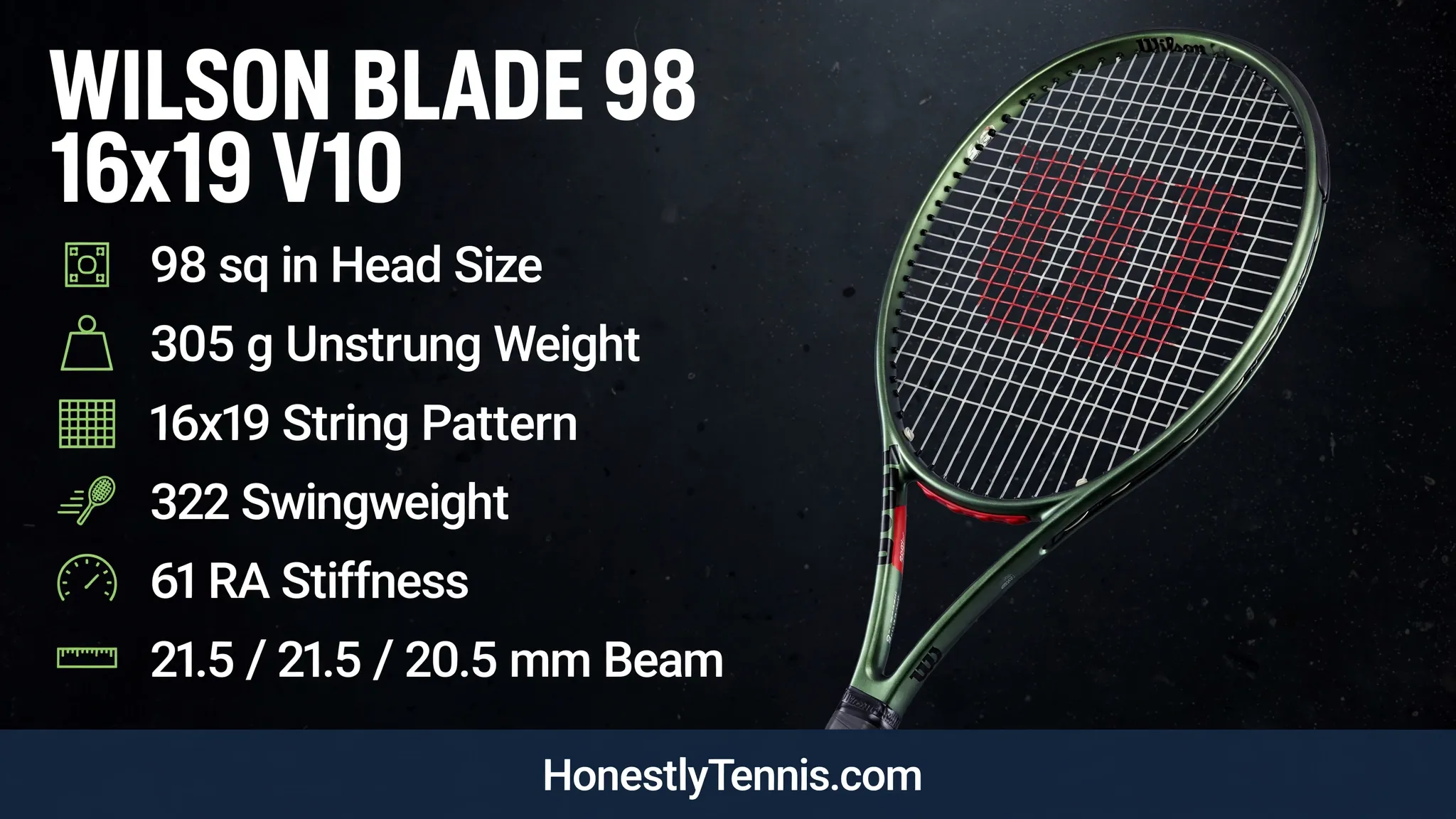
The Blade 98 16×19 v10 is Wilson’s control frame, refined rather than reinvented. The v10’s new tapered beam — thicker at tip and midsection, thinner at the throat — adds power and stability without giving up the connected feel that made the line famous. At 305 g unstrung with a 61 RA, it suits intermediate and advanced players: stable against pace, soft enough to feel the ball, precise enough that a full swing goes where you aimed. The 16×19 pattern keeps spin accessible — the most versatile Blade 98 Wilson has built. In a wilson blade 98 v10 vs head gravity mp decision, the Blade is the pick for the player who already owns their pace.
- Who It’s Best For: A 4.0 baseliner with a full, fast swing who drives the ball flat and wants pinpoint placement — and a 3.5 player moving up with a complete stroke.
- Who Should Skip It: A 3.0 player with a short, compact swing who needs the racket to supply power — and anyone whose arm is already barking.

Head Gravity MP: The Buttery Comfort Frame
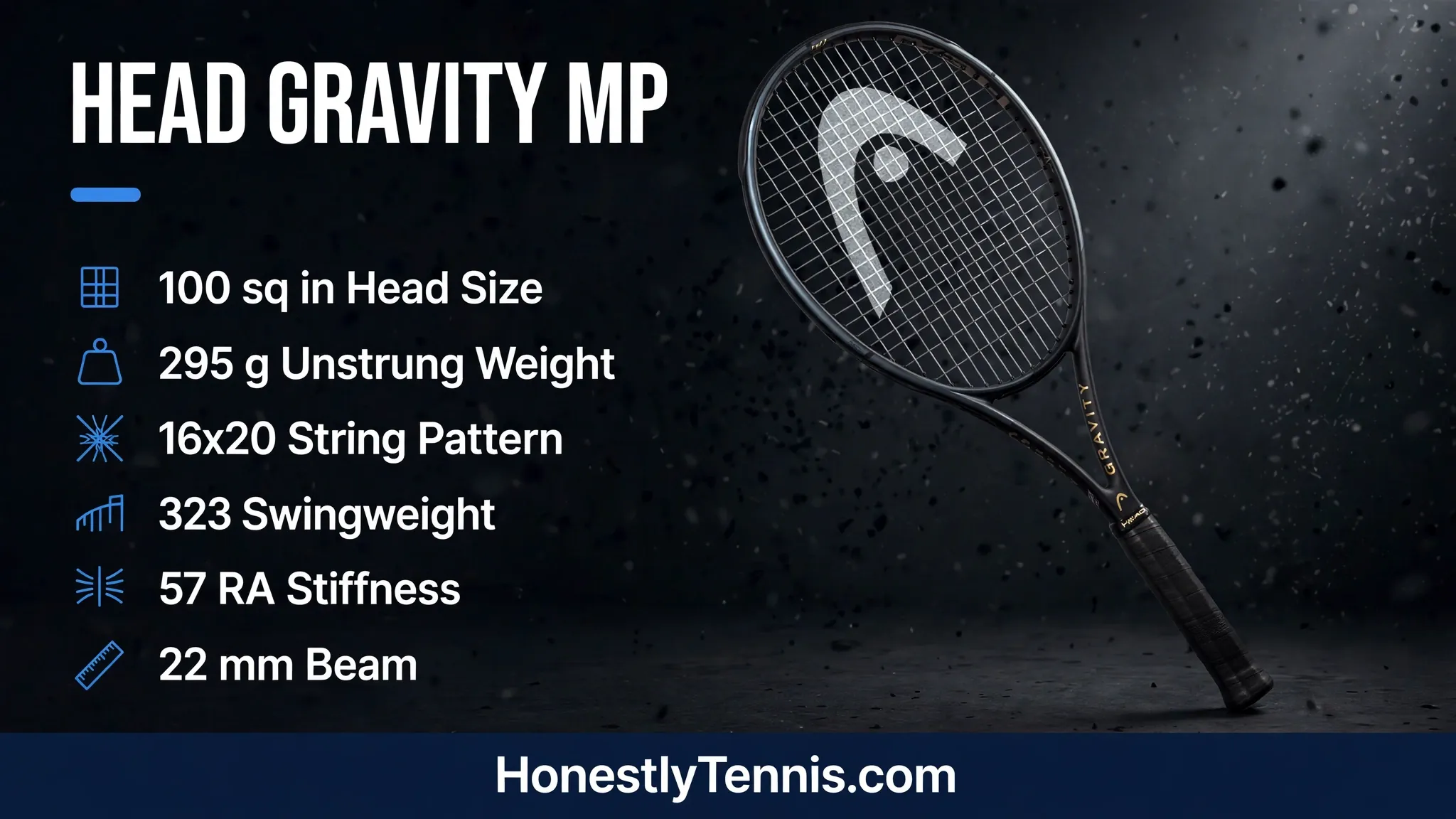
The Gravity MP is the frame for the player who wants control without the punishment. At 57 RA it is one of the softest player’s frames on the market: the ball sinks into the strings, stays a beat longer, and leaves with a soft, pocketed feel stiffer frames cannot fake. The teardrop head pushes the sweet spot high, where topspin forehands and serves meet the ball, and the 100 sq in head forgives the shots you catch late. At 295 g unstrung it is 10 g lighter than the Blade, so it swings easier through a long match — and it takes lead tape well. The 16×20 pattern keeps the launch angle honest — control and direction without the ball sailing. In the same wilson blade 98 v10 vs head gravity mp decision, the Gravity is the pick for the player who wants control without the cost.
- Who It’s Best For: A 3.5–4.0 all-courter who wants a soft, arm-friendly frame with a big sweet spot — and a player coming back from elbow trouble.
- Who Should Skip It: A flat hitter who wants the ball to skid low and fast — the soft flex can feel too floaty — and a big server who wants maximum free power from the frame.
Which One Should You Buy?
The wilson blade 98 v10 vs head gravity mp decision comes down to your swing and your arm. Full, fast swing and flat hitting? Take the Blade — it puts the ball where you aimed, and the extra mass steadies your shots against pace. Swing still developing, or your arm has ever complained? Take the Gravity — the softer flex and bigger head keep you on court longer, and the control is real, not a compromise. A 3.5 baseliner who plays three times a week and wants to rally without pain: Gravity. A 4.0 all-courter who attacks the net behind a big forehand: Blade. A doubles specialist who lives on volleys: Gravity, for the twistweight. Still unsure? Our how to choose a tennis racket guide walks through weight and head size, and the Yonex EZONE 100 vs Wilson Clash 100 v2 breakdown shows a power-versus-comfort pair with a bigger trade-off.
FAQ
Which is better for tennis elbow, the Blade 98 v10 or the Gravity MP?
The Gravity MP, by a clear margin. Its 57 RA is four points softer than the Blade’s 61, and that flex absorbs shock before it reaches your arm. The Blade is still flexible by modern standards — but if your elbow decides, the Gravity is the answer in this wilson blade 98 v10 vs head gravity mp comparison.
Can a 3.5 player handle the Blade 98 v10?
Yes, if your swing is complete. The Blade 98 v10 needs a full, medium-fast to fast swing — a 3.5 player with a developed stroke will find it precise. If your swing is short or you arm the ball, the smaller head and firmer face will punish mishits — the lighter Gravity MP is the better first step.
Is the Gravity MP powerful enough for an advanced player?
Yes — with the right setup. The Gravity MP’s 323 swingweight gives it real plow-through, and its lab power actually edges the Blade (31.3% against 30.5% in Tennis Warehouse University’s rebound test). Advanced players add a little lead at 3 and 9 for stability, and a crisp co-poly at 48–50 lbs keeps the soft frame from feeling too elastic. It will not hand you free power like a stiff 100 sq in frame, but it rewards a full swing with depth and control.
Final Verdict
The wilson blade 98 v10 vs head gravity mp choice is not about which frame is better — it is about which player you are. The Blade is the crisper tool: heavier, firmer, more precise, built for the player who generates pace and wants the ball exactly where it was aimed. The Gravity is the kinder tool: softer, lighter, more forgiving, built for the player who wants control without paying for it in arm pain or mishits. Both swing at the same weight. Both are control frames. The difference is feel — and feel is the one thing a spec sheet cannot decide for you. Demo both if you can; if you cannot, trust your arm and your swing: full and fast goes Blade, developing or tender goes Gravity.
- Full, fast swing and flat drives? Blade.
- Arm-sensitive or consistency-first? Gravity.
- Doubles and blocked returns? Gravity, for the twistweight.
- Precision above all else? Blade.



Hi, I’m Coach Mitchell. With over a decade of experience on the tennis court, I created Honestly Tennis to share my passion for the game. Whether you are a beginner looking for your first racquet or an advanced player wanting to upgrade your gear, my goal is to provide honest reviews and helpful guides to elevate your game.