

Two Babolat rackets dominate club courts, and they look like twins on paper. The Babolat Pure Aero vs Pure Drive question comes down to one thing: how you swing, not what the spec sheet says.
Both frames are 100 square inch, 300 gram rackets with a 16×19 pattern and a 320 swingweight. Yet they play like different tools — one whips the ball with heavy topspin, the other fires it flat and deep.
This guide compares the current models — the Pure Aero (Gen 9) and the Pure Drive Gen 11 — with real manufacturer specs, honest trade-offs, and a clear pick for each type of club player.
Table of Contents
- Quick Verdict
- How We Chose
- Babolat Pure Aero vs Pure Drive Specs at a Glance
- Why These Two Rackets Look Identical on Paper
- Babolat Pure Aero (Gen 9): The Spin Machine
- Babolat Pure Drive Gen 11: The Raw Power Pick
- How to Choose Between Them
- Watch: Best Tennis Rackets for Power and Spin
- Final Verdict
- FAQ
Quick Verdict
Short on time? Here is the bottom line.
Buy the Pure Aero if you swing fast with heavy topspin and want the ball to dip inside the baseline.
Buy the Pure Drive if you want free power and depth with a flatter, simpler swing.
Both are 300g, 100 square inch frames — pick by your swing, not by the spec sheet.
How We Chose
No made-up test scores here. These picks come from official Babolat specifications, Tennis Warehouse strung measurements, frame physics, and consistent feedback from 3.0 to 4.5 club players. Where specs and marketing disagree, the specs decide.
Babolat Pure Aero vs Pure Drive Specs at a Glance
| Spec | Pure Aero (Gen 9) | Pure Drive Gen 11 |
|---|---|---|
| Head Size | 100 sq in | 100 sq in |
| Unstrung Weight | 300 g | 300 g |
| Strung Weight | 318 g | 318 g |
| Balance | 4 pts head-light | 4 pts head-light |
| Swingweight | 320 | 320 |
| Stiffness (RA) | 66 | 71 |
| String Pattern | 16×19 | 16×19 |
| Beam Width | 23 / 26 / 23 mm | 23 / 26 / 23 mm |
| Length | 27 in | 27 in |
| Recommended Tension | 46–55 lbs | 50–59 lbs |
Look at that table twice: almost every number matches. The real differences hide in the stiffness, the beam shape, and the string spacing — and in how each frame feels when you swing it. Our guide to the best tennis rackets for power and spin puts both frames in the wider power-spin class.
Why These Two Rackets Look Identical on Paper
Put the two frames side by side and the spec sheet shrugs. Same 100 square inch head, same 300 gram unstrung weight, same 4 points head-light balance, same 320 swingweight, same 16×19 pattern, same 23/26/23 beam. If you bought on numbers alone, you could flip a coin — and plenty of club players do.
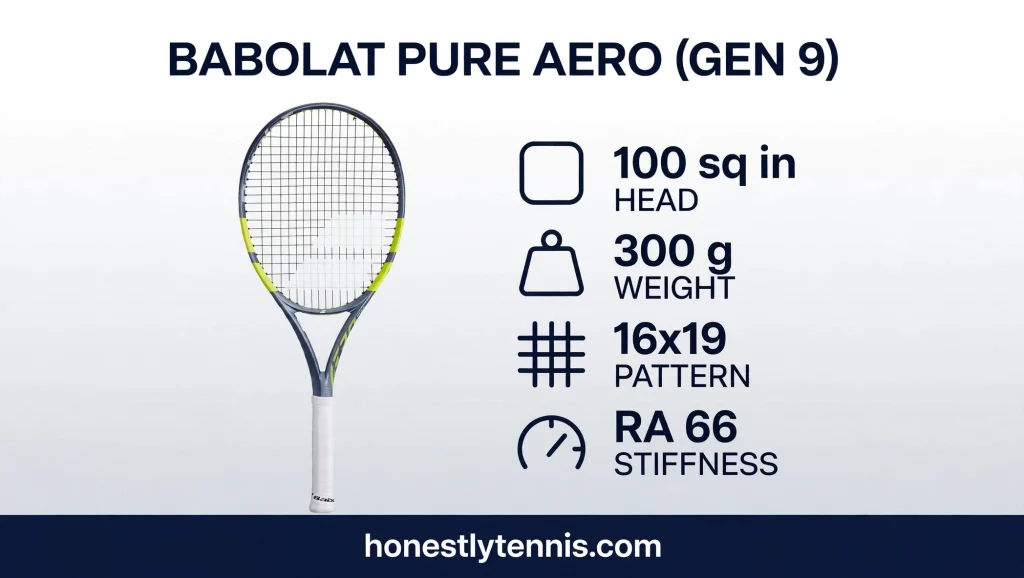
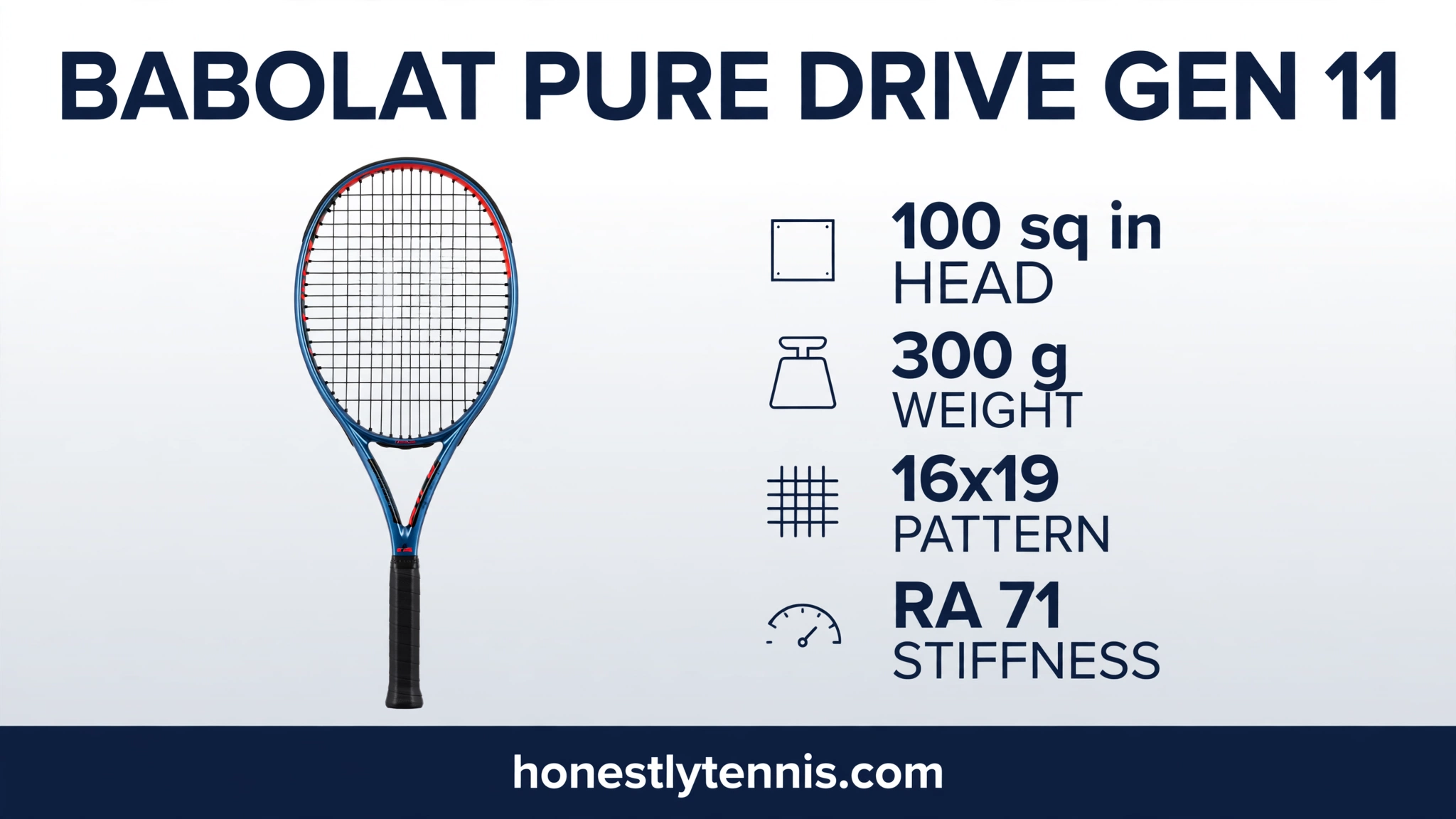
The first real split is stiffness. The Pure Drive measures 71 RA on Tennis Warehouse’s strung average (Babolat lists 72 ±3), which makes it a genuinely stiff frame: more free power, a crisper feel, and more shock on mishits. The Pure Aero measures 66 RA on the same strung average, though independent measurements run 66–69 — softer than the Drive, but still a firm frame, not a comfort frame. Neither racket is built for a sore elbow.
The second split is shape. The Aero’s AeroModular 3 beam is built to cut through the air, so the same 320 swingweight feels quicker on a full topspin swing. The Drive’s Elliptic frame and HTR System are built for stability and energy return, so the same swingweight feels solid and direct. String spacing adds the last twist: the Aero’s FSI Spin opens the pattern in the sweet spot for bite, while the Drive’s FSI Power opens it higher up the bed for launch.
Both frames meet the ITF Rules of Tennis for size and string pattern, and both are 100 square inch heads — if you are torn between head sizes, our 98 vs 100 square inch rackets guide explains what those two inches actually change.
Babolat Pure Aero (Gen 9): The Spin Machine
The Pure Aero is the spin racket of the pair, and the Gen 9 keeps that identity with a new look: dark grey with bright yellow striping, a sharp change from the bright yellow previous generation frame. Under the paint, the formula is familiar — a 100 square inch head, an aerodynamic beam, and an open 16×19 pattern built to grab the ball. NF²-Tech 2.0 flax fibers in the frame filter vibration, which softens the feel without taking away the spin.
What the Aero does best is simple: it lets a fast swing turn into heavy topspin that drops inside the baseline. The aerodynamic shaft cuts drag, so the head comes through quicker than the 320 swingweight suggests. That is why topspin baseliners reach for it on big points — the ball clears the net with margin and still lands deep. Our full Babolat Pure Aero review covers the Gen 9 in more depth.
Babolat Pure Aero Pros
- Heavy, easy topspin from the aerodynamic beam
- Fast through the air despite the 320 swingweight
- Flax dampening softens the feel for a spin frame
- Big sweet spot that forgives off-center hits
- Strong on serves that need kick and slice
Babolat Pure Aero Cons
- High launch angle can send flat balls long
- Still a firm frame — not built for sore elbows
- Control players may find it too lively
- Open pattern eats strings faster than a dense bed
Who It’s Best For
- Best for a 3.5–4.5 topspin baseliner who swings fast and full, especially on clay or slow hard courts where heavy spin pushes opponents back. It suits a western or semi-western grip and a player who would rather shape the point than end it early.
Who Should Skip It
- Skip it if you hit flat and through the ball: a compact, flat swing will send too many balls long off the high launch angle, and a 3.0 player still building a full swing will find the power hard to tame.
Coach’s Stringing Secret: string the Aero with a soft co-poly like Yonex Poly Tour Pro at 48 to 50 lbs. In a Tuesday night 3.5 singles match, that softer bed keeps the launch angle under control on a second-serve return. If your elbow complains, hybrid it the right way: put a multifilament like Tecnifibre NRG2 in the mains at 50 to 52 lbs and the Poly Tour Pro in the crosses at 46 to 48 lbs — 2 to 4 lbs lower than the mains.
If the Aero’s spin is more than you need, the Pure Drive below gives you the same easy depth with a flatter, heavier ball. Control seekers can look at the Pure Aero 98, the 98 square inch version with a denser 16×20 pattern.

Babolat Pure Drive Gen 11: The Raw Power Pick
The Pure Drive is the power racket of the pair, and the Gen 11 wears it openly: metallic blue with red trim, a frame built to hit through the court. The recipe is the same 100 square inch head and 300 gram weight as the Aero, but the stiffer 71 RA beam and the Elliptic frame turn the same swing into a heavier, flatter ball. NF²-Tech 2.0 flax sits in the throat to filter vibration, though it does not turn a stiff frame into a soft one.
What the Drive does best is free power. A medium swing produces deep balls without much effort, and serves pick up easy pace. That is why it suits the 3.5 player who wants depth without a huge swing — the frame does the work. The trade is feel: mishits sting more than on a softer frame, and flat hitters who already generate their own pace can overhit. Our full Babolat Pure Drive review covers the Gen 11 in more depth, and our Pure Drive vs Wilson Clash comparison shows what you give up — and gain — against a comfort frame.
Babolat Pure Drive Pros
- Free power and depth with a medium swing
- Crisp, direct feel with a solid sweet spot
- Easy pace on serves and put-away shots
- Stable on hard-hit balls thanks to the HTR System
- Forgiving 100 square inch head for club players
Babolat Pure Drive Cons
- Stiff 71 RA beam — the firmest frame in this guide
- Mishits send more shock to the arm
- Can overhit for players with a big flat swing
- Less spin shape than the Aero on heavy topspin
Who It’s Best For
- Best for a 3.5–4.0 all-court player with a medium, compact swing who wants free depth without swinging harder — especially on fast hard courts, where the extra pace turns defense into attack. It suits a player who wins points by pushing opponents back, not by out-spinning them.
Who Should Skip It
- Skip it if your elbow already hurts after matches, or if you hit with a big flat swing and already struggle to keep the ball in: this frame adds power you may not need, and the stiff beam will not forgive a sore arm.
Coach’s Stringing Secret: string the Drive with a soft co-poly like Yonex Poly Tour Pro at 50 to 52 lbs — the stiffer frame needs a touch more tension than the Aero to keep the power in court. In a 3.5 doubles match, that setup keeps the return deep without sailing long. For a softer arm, put Tecnifibre NRG2 in the mains at 52 to 54 lbs with Poly Tour Pro crosses at 48 to 50 lbs.
If the Drive feels too stiff or too wild, the Pure Aero above gives you the same 300 gram package with more spin shape and a softer feel. Players who want control with power can look at the Pure Drive 98, the 98 square inch version with a denser 16×20 pattern.

How to Choose Between Them
Both rackets are excellent — the wrong pick is the one that fights your swing. In the Babolat Pure Aero vs Pure Drive choice, three questions settle it.
Spin vs Power
If your forehand already has heavy topspin, the Aero turns that shape into a weapon: the ball dips late and bounces high. If your swing is flatter and you want depth for free, the Drive’s stiffness does the work for you. The honest check is your miss: if your balls land long, you need spin shape; if they land short, you need free power.
Arm Comfort
Neither frame is an arm-friendly pick — both are firm, and the Drive at 71 RA is the stiffer of the two. If your elbow is already sore, a softer frame and a softer string will help more than either Babolat here. Between the two, the Aero’s lower stiffness and flax dampening make it the kinder choice, but the gap is small. String choice matters as much as the frame: a soft poly at lower tension, or a multifilament hybrid, takes real shock out of both rackets.
String Setup
Both rackets reward a soft poly at moderate tension: 48 to 50 lbs in the Aero, 50 to 52 lbs in the Drive. Polyester loses tension fastest of any string type, so restring on time — dead poly in a stiff frame is the harshest setup in club tennis. If you hybrid, always put the soft string in the mains and the smooth round poly in the crosses, 2 to 4 lbs lower.
Watch: Best Tennis Rackets for Power and Spin
The video below from our channel walks through the best rackets for power and spin — and the checks to run before you buy any frame in this class.

Final Verdict
For most topspin players, the Pure Aero is the smarter buy. It turns a fast swing into heavy, dipping balls that stay in, and the Gen 9 frame is the quickest of the two through the air.
The Pure Drive is the buy if you want power without the work. A medium swing produces deep, heavy balls, and serves come alive. It is the easier racket to play with on an average day — as long as your elbow is healthy and your swing is not already too big.
The honest truth is that either frame wins matches in the right hands. Both are 300 gram, 100 square inch rackets with the same swingweight — the difference is feel, not quality. If you can, hit with both before you buy: five minutes of rallying tells you more than any spec sheet.
Whichever of the Babolat Pure Aero vs Pure Drive pair you pick, string it soft, restring it on time, and match the frame to your swing — not to the pro who endorses it.
FAQ
Which is better for beginners, the Pure Aero or the Pure Drive?
The Pure Drive, for most beginners — its free power gives depth with a shorter swing, which helps while technique is still developing. The Aero rewards a full topspin swing that most beginners are still building.
Is the Pure Aero or Pure Drive better for tennis elbow?
Neither is an arm-friendly frame — both are firm, and the Drive at 71 RA is stiffer than the Aero at 66 RA. Between the two, the Aero is the kinder pick, but a sore elbow needs a softer frame and softer strings more than either racket here.
What tension should I string a Pure Aero or Pure Drive at?
The Aero’s recommended range is 46 to 55 lbs and the Drive’s is 50 to 59 lbs. A good starting point is a soft poly at 48 to 50 lbs in the Aero and 50 to 52 lbs in the Drive. Multifilaments go on 2 to 4 lbs tighter than a poly bed.
What is the real difference between the Pure Aero and the Pure Drive?
In the Babolat Pure Aero vs Pure Drive comparison, almost nothing on paper — same head, weight, balance, swingweight, beam, and pattern. In play, the Aero is built for spin with an aerodynamic beam and wider string spacing in the sweet spot, while the Drive is built for power with a stiffer beam and an elliptical frame. The Aero shapes the ball; the Drive fires it.



Hi, I’m Coach Mitchell. With over a decade of experience on the tennis court, I created Honestly Tennis to share my passion for the game. Whether you are a beginner looking for your first racquet or an advanced player wanting to upgrade your gear, my goal is to provide honest reviews and helpful guides to elevate your game.