

The Babolat Pure Drive has spent decades building one of the strongest reputations in tennis. Walk into almost any public court or club league and you will see that familiar blue frame swinging around. It is the racket people associate with easy power, crushing serves, and aggressive baseline tennis.
The marketing machine loves this racket because “more power” is an easy sell. Tennis brands know players want the feeling that a new frame will solve their problems. They want to believe the next $250 purchase will magically add ten miles per hour to their serve and turn defensive forehands into winners.
That is not how tennis works.
The Babolat Pure Drive is not a magic wand. It is a powerful tool. If you have good mechanics, fast racket-head speed, and a willingness to attack, this racket can help you hit a heavier ball. If your technique is sloppy, your footwork is lazy, or you are just arming the ball around the court, this racket will happily launch your shots into the next county.
That is the uncomfortable truth about power frames. They give you more of what you already have. Good technique gets rewarded. Bad technique gets amplified.
This Babolat Pure Drive review is not about repeating the usual marketing lines about “explosive performance” and “next-level confidence.” We are talking about what the racket actually does when a real 3.5 NTRP player takes it onto a hard court.
The Pure Drive is one of the most famous modern tennis rackets for a reason. But famous does not mean perfect for everyone.
Why Trust This Breakdown
I have spent years around club players, league competitors, and recreational tennis players who spend more time shopping for rackets than fixing their backhand.
The problem in tennis equipment is that manufacturers sell dreams. They highlight technology names, paint jobs, and vague promises about performance. They rarely explain the boring stuff that actually matters: stiffness, swing weight, beam thickness, and how those factors affect your arm and your ball flight.
A racket is not a personality upgrade. It is not going to turn a defensive pusher into an aggressive baseliner overnight.
The job of a good coach is to understand why equipment behaves the way it does and match it with the player using it.
The Babolat Pure Drive review question is simple: does this racket help your actual game, or does it just look like the type of racket you wish you played with?
The Brutal Truth: Specs That Actually Matter
The Pure Drive has always been built around one philosophy: give players accessible power without making the racket impossible to use. The standard model comes in around 300 grams unstrung, uses a 100 square inch head, and features the thick beam and stiff construction that made this line famous.
Here are the numbers that actually matter.
| Specification | Babolat Pure Drive (Standard) | What It Means On Court |
| Unstrung Weight | 300g (10.6 oz) | Manageable weight with solid plow-through without causing swing fatigue. |
| Head Size | 100 sq in | Large, forgiving sweet spot ideal for modern aggressive baseline rallies. |
| Beam Width | 23-26-23 mm | Dual-taper thick beam creates massive stiffness, stability, and power. |
| Stiffness Rating | ~71-72 RA | High energy transfer into the ball; transmits noticeable vibration on off-center hits. |
| Swingweight | ~290 unstrung (~320 strung) | Fast through the air while offering plenty of mass on aggressive swings. |
| Balance | ~320 mm (4 pts HL unstrung) | Keeps the racket fast and maneuverable at the net and during quick returns. |
| String Pattern | 16×19 | Open pattern that provides easy launch angle and heavy topspin bite. |
| Main Strength | Explosive Power & Serves | Easy depth and free mph on flat and slice serves. |
| Main Drawback | Arm Comfort & Flat Control | High stiffness is unforgiving for tennis elbow or flat-ball strikers. |
The Pure Drive’s personality does not come from one specification. It comes from the combination.
A 300-gram racket alone is not extreme. A 100 square inch head alone is not extreme. A stiff frame alone is not automatically a problem.
But combine a moderate weight with a thick beam and high stiffness, and you get a racket designed to transfer energy efficiently into the ball. That is why the Pure Drive has such a strong reputation.
The 300g Weight
The 300-gram unstrung weight is one reason the Pure Drive appeals to intermediate players.
It sits in the sweet spot between beginner-friendly lightweight frames and heavier traditional player rackets.
The benefit is stability. When someone hits a heavy ball at you, the racket does not feel like a cheap aluminum stick getting pushed backward.
The downside is that players sometimes underestimate what happens after strings and accessories are added.
Once you add polyester strings, an overgrip, and possibly a dampener, the racket becomes noticeably heavier. That is not a problem for strong players, but it exposes poor timing.
A late swing with a powerful racket is still a late swing.
The 100 Square Inch Head
The 100 square inch head size is the modern “safe choice.”
It provides enough forgiveness for the reality of club tennis, where nobody is hitting the center of the strings every single shot.
You get a larger sweet spot, better stability on off-center contact, and easier depth when defending.
But there is a common mistake here.
Players think forgiveness means the racket will fix their contact issues. It will not.
A larger head gives you a bigger margin. It does not replace preparation, spacing, or footwork.

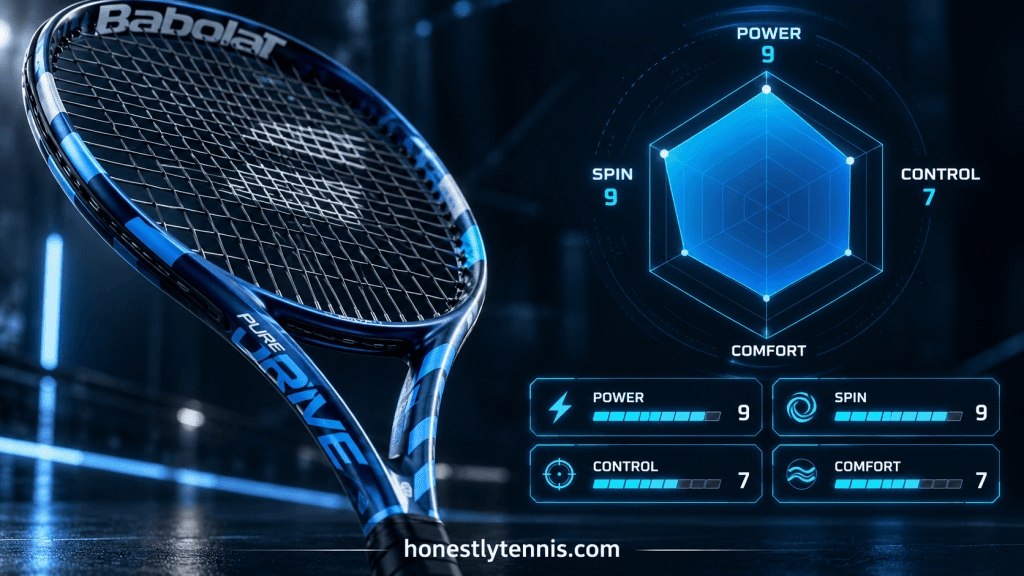
The RA Stiffness Rating: The Elephant in the Room
The Pure Drive’s stiffness is the part that deserves the most attention.
Depending on generation and measurement method, the frame has commonly been measured around the low 70s RA range. Current specifications list stiffness around 72 RA with a tolerance range.
What does that mean?
A stiff racket bends less at impact. Less energy is absorbed by the frame, meaning more energy goes into the tennis ball.
That creates the famous Pure Drive feeling:
“Wow, this thing hits hard.”
The downside is that flexible rackets generally provide more impact absorption and a softer response.
The Pure Drive is not designed to be a plush, buttery control frame. It is designed to produce speed.
That tradeoff is the entire point.
The Thick Beam Reality
The thick beam is another major piece of the puzzle.
Older-school players often talk about thin beams like they are automatically superior. They are not. They simply create a different response.
A thin flexible beam gives more pocketing and traditional feel.
The Pure Drive’s thick beam gives stability and power.
When you swing aggressively, the racket feels like it wants to explode through contact.
When you are trying to guide a soft touch shot, it can feel less delicate.
This is not a flaw. It is a design choice.
On-Court Performance
Groundstrokes: Explosive Power With a Warning Label
The baseline is where the Pure Drive earns its reputation.
The racket makes depth easy. Players who struggle to push the ball beyond the service line often immediately notice that their normal swing produces a heavier shot.
That confidence can be useful.
A player who previously played too defensively may start stepping in and attacking because the racket gives them more penetration.
But here comes the trap.
Power is addictive.
A lot of 3.5 players buy a Pure Drive and immediately start swinging harder because the racket feels exciting. Then they wonder why every third forehand is sailing long.
The racket is not broken. The physics are working perfectly.
A powerful frame requires a player who can control launch angle and spin.
If you hit with heavy topspin, the Pure Drive can be a monster. The open 16×19 pattern helps create spin, allowing players to swing aggressively while keeping the ball inside the court.
If you hit flat with a short, stiff-arm motion, you may have problems.
Flat hitters need precision. A powerful racket gives them less room to miss.
Volleys & Net Play: Stability Wins
The Pure Drive performs very well when blocking and punching volleys.
The stability is one of its best features.
When an opponent rips a passing shot at your feet, you want a racket that stays solid. The Pure Drive does not get bullied easily.
This is especially useful in doubles.
Most recreational doubles points are not won with beautiful touch volleys. They are won by putting a firm racket face on the ball and making the opponent play another shot.
The Pure Drive excels there.
The downside is finesse.
Players who love soft hands and classic touch may find the response a little too immediate. The racket wants to react quickly.
For aggressive net players, that is a benefit. For artists, it can feel blunt.
Serves: Why It Became a Serving Weapon
The Pure Drive and serve performance have been connected for years.
The reason is simple: power and maneuverability.
A player who generates decent racket speed can get serious pace from this frame.
Flat serves come off fast. Slice serves get easy penetration. Kick serves benefit from the combination of acceleration and spin potential.
This is why many competitive recreational players love it.
A serve is one area where free power actually matters because there is less incoming pace to control.
However, the racket does not create a technically sound serve.
A bad motion is still a bad motion.
You cannot buy a better toss, better shoulder rotation, or better contact point.
The racket helps good mechanics. It does not replace them.
Comfort & Arm Health: The Part Nobody Wants to Discuss
Here is where the marketing gets quiet.
The Pure Drive is stiff.
That stiffness is why it produces power.
It is also why players with arm problems need to be careful.
Tennis elbow is rarely caused by one single thing. Technique, frequency of play, grip size, string choice, and physical condition all matter.
But equipment choices matter too.
A stiff racket combined with stiff polyester strings at high tension is a common recipe for discomfort.
The biggest mistake recreational players make is copying professional setups without understanding the difference.
A touring professional has access to medical staff, physical trainers, perfect technique, and years of adaptation.
Your Saturday morning doubles group does not.
If your elbow already hurts, there are more comfortable options available.
The Pure Drive is built for performance first.
The Coach’s Stringing Setup
Putting cheap string into a Pure Drive is a crime.
You are buying a high-performance frame and then choking it with a terrible string setup.
Strings completely change how this racket behaves.
The Pure Drive already provides power. Your strings should help control that power.
For intermediate players, I generally prefer softer polyester options at moderate tensions.
Do not chase ridiculous tension numbers because you saw a professional player using them.
Higher tension can reduce power, but it also reduces comfort and can make spin production harder.
A softer co-poly string in a mid-to-low tension range usually creates a better balance.
Players who need even more comfort should consider hybrids.
The goal is simple: tame the racket without removing what makes it special.
For more details on string choices, check: Best Tennis Strings for Intermediate Players
The Pure Drive is already bringing the horsepower. Your string setup decides whether that horsepower is usable or just chaos.
Babolat Pure Drive vs. Wilson Clash
The Pure Drive and Wilson Clash represent two completely different approaches.
The Pure Drive is the aggressive power machine.
It is stiff, explosive, and designed for players who want the racket to help create pace.
The Wilson Clash takes almost the opposite approach.
It focuses on flexibility and comfort, making it appealing to players who want easier feel and a softer response.
The Pure Drive rewards players who attack.
The Clash tends to reward players who prioritize comfort and control.
Neither design is magic.
The mistake players make is buying the racket they imagine themselves using instead of the racket that matches their actual game.
For a deeper comparison, check: Babolat Pure Drive vs. Wilson Clash
If you hit heavy topspin, attack short balls, and like taking control from the baseline, the Pure Drive makes sense.
If you have arm concerns or prefer touch and feel, you should look elsewhere.
Final Verdict: Who Should Actually Buy This?
The Babolat Pure Drive review conclusion is straightforward.
This is one of the most effective power rackets available because it does exactly what it was designed to do.
It gives aggressive players easy depth, strong stability, and one of the best serving platforms in modern tennis.
The ideal Pure Drive player is an aggressive baseliner.
You want this racket if you:
- Hit with topspin.
- Accelerate through contact.
- Attack short balls.
- Want easier depth.
- Like a powerful serve.
- Prefer a lively, responsive frame.
A strong 3.5 player moving toward 4.0 tennis can absolutely benefit from this racket.
Now for the players who should think twice.
If you already have tennis elbow, this is probably not where you start.
If you hit extremely flat and rely on precision rather than spin, the power may work against you.
If you are hoping a new racket will fix poor technique, save your money and book a lesson instead.
The Pure Drive is not a shortcut.
It is a machine.
A skilled player can use it to create serious pressure. A sloppy player can use it to hit faster mistakes.
That is the difference.
The Babolat Pure Drive review verdict: buy this racket if you want more power and you have the technique to control it. Avoid it if you need the racket to hide weaknesses it was never designed to fix.
Why Trust This Breakdown
I have spent years around club players, league competitors, and recreational tennis players
who spend more time shopping for rackets than fixing their backhand.
The problem in tennis equipment is that manufacturers sell dreams. They highlight
technology names, paint jobs, and vague promises about performance. They rarely explain
the boring stuff that actually matters: stiffness, swing weight, beam thickness, and how
those factors affect your arm and your ball flight.
A racket is not a personality upgrade. It is not going to turn a defensive pusher into an
aggressive baseliner overnight.
The job of a good coach is to understand why equipment behaves the way it does and match
it with the player using it.
The Babolat Pure Drive review question is simple: does this racket help your actual game, or
does it just look like the type of racket you wish you played with?
The Brutal Truth: Specs That Actually Matter
The Pure Drive has always been built around one philosophy: give players accessible power
without making the racket impossible to use. The standard model comes in around 300
grams unstrung, uses a 100 square inch head, and features the thick beam and stiff
construction that made this line famous.
Here are the numbers that actually matter.
Specification Babolat Pure Drive
(Standard)
What It Means On Court
Unstrung Weight 300g (10.6 oz) Manageable weight with
solid plow-through without
causing swing fatigue.
Head Size 100 sq in Large, forgiving sweet spot
ideal for modern aggressive
baseline rallies.
Beam Width 23-26-23 mm Dual-taper thick beam
creates massive stiffness,
stability, and power.
Stiffness Rating ~71-72 RA High energy transfer into
the ball; transmits
noticeable vibration on off-
center hits.
Swingweight ~290 unstrung (~320
strung)
Fast through the air while
offering plenty of mass on
aggressive swings.
Balance ~320 mm (4 pts HL
unstrung)
Keeps the racket fast and
maneuverable at the net
and during quick returns.
String Pattern 16×19 Open pattern that provides
easy launch angle and heavy
topspin bite.
Main Strength Explosive Power & Serves Easy depth and free mph on
flat and slice serves.
Main Drawback Arm Comfort & Flat Control High stiffness is unforgiving
for tennis elbow or flat-ball
strikers.
The Pure Drive’s personality does not come from one specification. It comes from the
combination.
A 300-gram racket alone is not extreme. A 100 square inch head alone is not extreme. A stiff
frame alone is not automatically a problem.
But combine a moderate weight with a thick beam and high stiffness, and you get a racket
designed to transfer energy efficiently into the ball. That is why the Pure Drive has such a
strong reputation.
The 300g Weight
The 300-gram unstrung weight is one reason the Pure Drive appeals to intermediate
players.
It sits in the sweet spot between beginner-friendly lightweight frames and heavier
traditional player rackets.
The benefit is stability. When someone hits a heavy ball at you, the racket does not feel like
a cheap aluminum stick getting pushed backward.
The downside is that players sometimes underestimate what happens after strings and
accessories are added.
Once you add polyester strings, an overgrip, and possibly a dampener, the racket becomes
noticeably heavier. That is not a problem for strong players, but it exposes poor timing.
A late swing with a powerful racket is still a late swing.
The 100 Square Inch Head
The 100 square inch head size is the modern “safe choice.”
It provides enough forgiveness for the reality of club tennis, where nobody is hitting the
center of the strings every single shot.
You get a larger sweet spot, better stability on off-center contact, and easier depth when
defending.
But there is a common mistake here.
Players think forgiveness means the racket will fix their contact issues. It will not.
A larger head gives you a bigger margin. It does not replace preparation, spacing, or
footwork.
The RA Stiffness Rating: The Elephant in the Room
A stiff racket bends less at impact. Less energy is absorbed by the frame, meaning more
energy goes into the tennis ball.
That creates the famous Pure Drive feeling:
“Wow, this thing hits hard.”
The downside is that flexible rackets generally provide more impact absorption and a softer
response.
The Pure Drive is not designed to be a plush, buttery control frame. It is designed to
produce speed.
That tradeoff is the entire point.
The Thick Beam Reality
The thick beam is another major piece of the puzzle.
Older-school players often talk about thin beams like they are automatically superior. They
are not. They simply create a different response.
A thin flexible beam gives more pocketing and traditional feel.
The Pure Drive’s thick beam gives stability and power.
When you swing aggressively, the racket feels like it wants to explode through contact.
When you are trying to guide a soft touch shot, it can feel less delicate.
This is not a flaw. It is a design choice.
On-Court Performance
Groundstrokes: Explosive Power With a Warning Label
The baseline is where the Pure Drive earns its reputation.
The racket makes depth easy. Players who struggle to push the ball beyond the service line
often immediately notice that their normal swing produces a heavier shot.
That confidence can be useful.
A player who previously played too defensively may start stepping in and attacking because
the racket gives them more penetration.
But here comes the trap.
Power is addictive.
A lot of 3.5 players buy a Pure Drive and immediately start swinging harder because the
racket feels exciting. Then they wonder why every third forehand is sailing long.
The racket is not broken. The physics are working perfectly.
A powerful frame requires a player who can control launch angle and spin.
If you hit with heavy topspin, the Pure Drive can be a monster. The open 16×19 pattern
helps create spin, allowing players to swing aggressively while keeping the ball inside the
court.
If you hit flat with a short, stiff-arm motion, you may have problems.
Flat hitters need precision. A powerful racket gives them less room to miss.
Volleys & Net Play: Stability Wins
The Pure Drive performs very well when blocking and punching volleys.
The stability is one of its best features.
When an opponent rips a passing shot at your feet, you want a racket that stays solid. The
Pure Drive does not get bullied easily.
This is especially useful in doubles.
Most recreational doubles points are not won with beautiful touch volleys. They are won by
putting a firm racket face on the ball and making the opponent play another shot.
The Pure Drive excels there.
The downside is finesse.
Players who love soft hands and classic touch may find the response a little too immediate.
The racket wants to react quickly.
For aggressive net players, that is a benefit. For artists, it can feel blunt.
Serves: Why It Became a Serving Weapon
The Pure Drive and serve performance have been connected for years.
The reason is simple: power and maneuverability.
A player who generates decent racket speed can get serious pace from this frame.
Flat serves come off fast. Slice serves get easy penetration. Kick serves benefit from the
combination of acceleration and spin potential.
This is why many competitive recreational players love it.
A serve is one area where free power actually matters because there is less incoming pace
to control.
However, the racket does not create a technically sound serve.

A bad motion is still a bad motion.
You cannot buy a better toss, better shoulder rotation, or better contact point.
The racket helps good mechanics. It does not replace them.
Comfort & Arm Health: The Part Nobody Wants to Discuss
Here is where the marketing gets quiet.
The Pure Drive is stiff.
That stiffness is why it produces power.
It is also why players with arm problems need to be careful.
Tennis elbow is rarely caused by one single thing. Technique, frequency of play, grip size,
string choice, and physical condition all matter.
But equipment choices matter too.
A stiff racket combined with stiff polyester strings at high tension is a common recipe for
discomfort.
The biggest mistake recreational players make is copying professional setups without
understanding the difference.
A touring professional has access to medical staff, physical trainers, perfect technique, and
years of adaptation.
Your Saturday morning doubles group does not.
If your elbow already hurts, there are more comfortable options available.
The Pure Drive is built for performance first.
The Coach’s Stringing Setup
Putting cheap string into a Pure Drive is a crime.
You are buying a high-performance frame and then choking it with a terrible string setup.
Strings completely change how this racket behaves.
The Pure Drive already provides power. Your strings should help control that power.
For intermediate players, I generally prefer softer polyester options at moderate tensions.
Do not chase ridiculous tension numbers because you saw a professional player using them.
Higher tension can reduce power, but it also reduces comfort and can make spin production
harder.
A softer co-poly string in a mid-to-low tension range usually creates a better balance.
Players who need even more comfort should consider hybrids.
The goal is simple: tame the racket without removing what makes it special.



Hi, I’m Coach Mitchell. With over a decade of experience on the tennis court, I created Honestly Tennis to share my passion for the game. Whether you are a beginner looking for your first racquet or an advanced player wanting to upgrade your gear, my goal is to provide honest reviews and helpful guides to elevate your game.