

Finding the best tennis racquets for power and spin sounds simple until you actually start hitting with them. Every brand claims their racquet gives you “explosive power,” “maximum spin,” and “effortless control.” Most of that is marketing noise.
A racquet doesn’t magically fix a weak swing. It won’t turn a weekend hacker into a tournament player overnight. But the right frame can absolutely help you hit heavier balls, create more topspin, and survive those brutal baseline rallies without your arm feeling like it went through a wood chipper.
I’ve tested dozens of racquets over the years, and I’ve learned one thing: the racquet that looks amazing on paper can feel completely wrong after 30 minutes on court.
Some frames give you that satisfying thump when you crush a forehand. Others feel like you’re hitting with a frying pan tied to a stick.
For this guide, I focused on racquets that actually help aggressive players generate pace and spin without sacrificing too much control.
Quick Verdict: Best Tennis Racquets for Power and Spin
Category | Racquet | Weight | Head Size | Best For | Price Range |
Best Overall | Babolat Pure Aero 100 | 11.2 oz strung | 100 sq in | Heavy topspin attackers | Premium ($200+) |
Best Control + Spin | Wilson Blade 98 V9 | 11.5 oz strung | 98 sq in | Advanced baseline players | Premium ($200+) |
Best Spin Power Combo | Head Extreme MP 2024 | 11.2 oz strung | 100 sq in | Modern aggressive players | Premium ($200+) |
Best Power for Intermediate Players | Yonex EZONE 100 | 11.2 oz strung | 100 sq in | Intermediate competitors | Premium ($200+) |
Best Budget Pick | Prince Ripstick 100 | 11.1 oz strung | 100 sq in | Developing players | Mid-range ($100–$200) |
Babolat Pure Aero 100

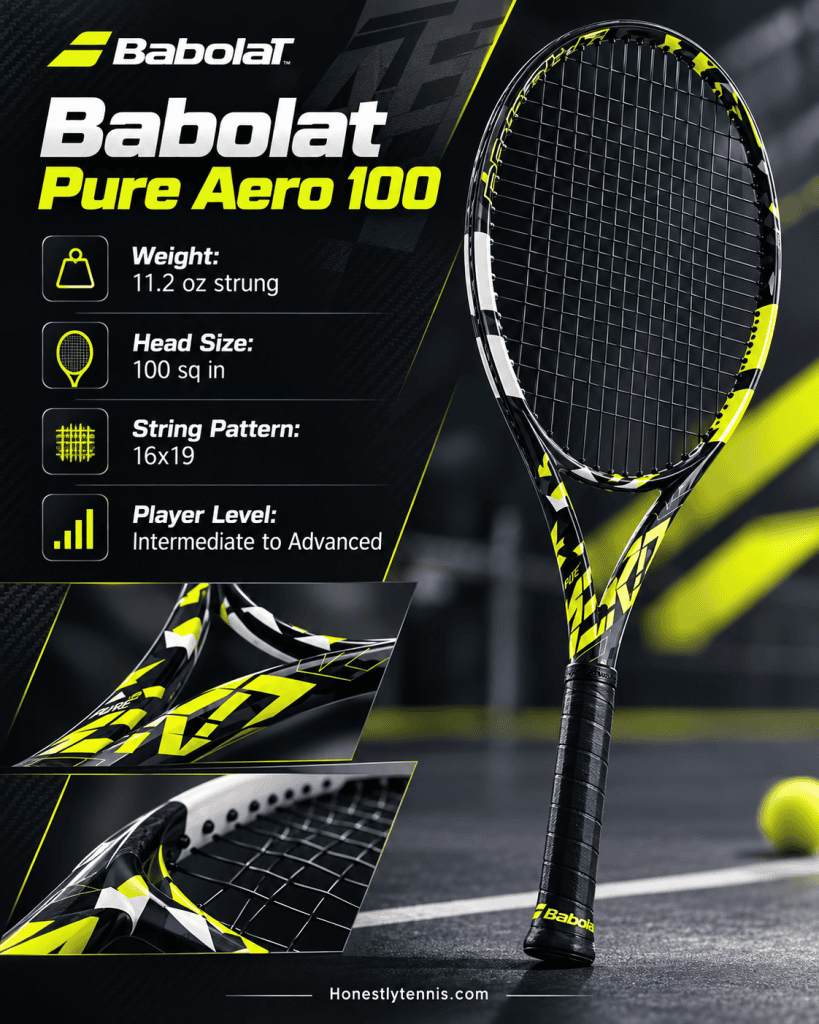
Exact Product Name: Babolat Pure Aero 100
If you ask me which racquet changed the modern baseline game, I’d point straight at the Pure Aero line.
The Babolat Pure Aero 100 is built for players who love attacking with topspin. This thing wants you to swing fast and rip the ball. If you’re the type of player who stands five feet behind the baseline and rolls soft shots back, this probably isn’t your dream racquet.
But if you like stepping into the court, whipping your forehand, and watching the ball jump off the court after it lands, pay attention.
During testing, I spent several sessions drilling heavy cross-court forehands. The first thing I noticed was how easy it was to create racket-head speed. The aerodynamic frame moves quickly through the air, and the open string pattern grabs the ball nicely.
I had a student named Mark who usually struggles to get enough height on his forehand. I handed him the Pure Aero during a practice session, and within fifteen minutes his shots were clearing the net with more margin. Was he suddenly Rafael Nadal? Obviously not. But the racquet helped him produce a more aggressive ball without forcing his swing.
The power is impressive, but here’s the catch — this racquet rewards proper technique.
Players with compact swings might find it a little wild. The ball can fly if your timing is late. I’ve seen beginners blame the racquet after launching three balls over the fence when the real problem was their contact point.
The feel is crisp. Not harsh, but definitely lively. Players who prefer a softer, buttery response might find it too energetic.
This is a racquet that wants you to attack.
Who Should Buy It vs. Who Should Avoid It
Buy it if you:
- Love heavy topspin forehands
- Play aggressive baseline tennis
- Generate your own racket speed
- Want extra spin without extreme technique changes
- Prefer a lively response
Avoid it if you:
- Have a short beginner swing
- Prefer old-school control racquets
- Have arm sensitivity and dislike stiff frames
- Mostly play doubles with quick reaction shots
Key Specs Breakdown
- Head Size: 100 sq in
- Strung Weight: Around 11.2 oz
- String Pattern: 16×19
- Balance: Head light
- Beam Width: Around 23-26 mm
- Swing Weight: Around 320
- Player Level: Intermediate to advanced
What I Loved
- Ridiculous spin potential
- Fast racket-head acceleration
- Huge confidence on aggressive forehands
- Excellent performance from the baseline
- Large enough sweet spot for match situations
What Drove Me Crazy
- Can launch balls when technique breaks down
- Not the most comfortable option for sensitive arms
- Beginners may struggle with control
Look, I’ll level with you — if you only play once every two weeks, save your money. You probably won’t unlock what this racquet offers.
But if you’re grinding three times a week and want a weapon for topspin-heavy tennis, this is one of the easiest recommendations I can make.
Wilson Blade 98 V9
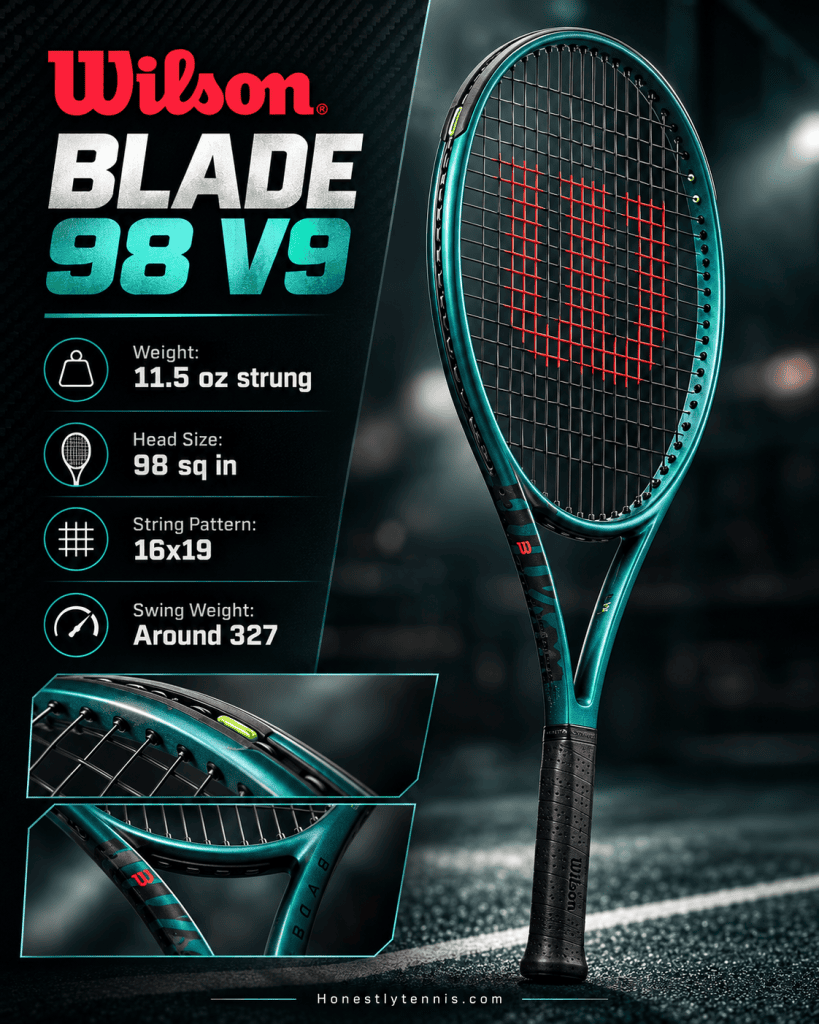
Exact Product Name: Wilson Blade 98 V9
The Wilson Blade 98 V9 is the opposite personality of the Pure Aero.
The Pure Aero screams, “hit harder.”
The Blade quietly says, “hit smarter.”
This racquet is made for players who already understand their game. It doesn’t throw power at you like a beginner-friendly frame. Instead, it gives you the feedback needed to shape points, attack angles, and control aggressive rallies.
During testing, I used the Blade 98 V9 during longer match sessions where consistency mattered more than free power. The first thing I noticed was the connection.
When you hit the sweet spot, the racquet gives you that clean, satisfying feeling — the kind where you immediately know the ball is going exactly where you intended.
I tested it during a two-hour baseline session with a local club player named Ryan. He usually sprays forehands when pressured. After switching to the Blade, his pace dropped slightly, but his shot placement improved dramatically.
That’s the trade-off.
The Blade won’t hand you free power. You need to bring your own acceleration. But when you do, this racquet gives you serious control.
The 98 square-inch head makes it less forgiving than 100 sq inch frames. Mishits are punished more. Late contact feels ugly.
Honestly, that’s why I like it.
Too many modern racquets hide mistakes. The Blade tells you the truth.
Sometimes that truth hurts.
The feel is softer compared to many stiff power frames. Long rallies are comfortable, and advanced players will appreciate the stability.
Who Should Buy It vs. Who Should Avoid It
Buy it if you:
- Play competitive club tennis
- Want baseline control
- Create your own pace
- Like attacking with placement
- Value feel over free power
Avoid it if you:
- Need maximum easy power
- Are a beginner
- Have inconsistent contact
- Want a huge sweet spot
Key Specs Breakdown
- Head Size: 98 sq in
- Strung Weight: Around 11.5 oz
- String Pattern: 16×19
- Balance: Head light
- Beam Width: 21 mm
- Swing Weight: Around 327
- Player Level: Advanced intermediate to advanced
What I Loved
- Fantastic control during rallies
- Excellent feel at contact
- Stable against heavy hitters
- Great for attacking angles
- Comfortable for long sessions
What Drove Me Crazy
- Smaller sweet spot
- Requires cleaner technique
- Less free power than modern 100 sq in frames
If you’re still developing your swing, don’t buy this because a YouTube reviewer said it’s “pro level.” That’s how people end up with expensive equipment collecting dust.
The Blade 98 V9 is brilliant — but only if your game is ready fo
Head Extreme MP 2024
Lorem ipsum dolor sit amet, consectetur adipiscing elit. Ut elit tellus, luctus nec ullamcorper mattis, pulvinar dapibus leo.
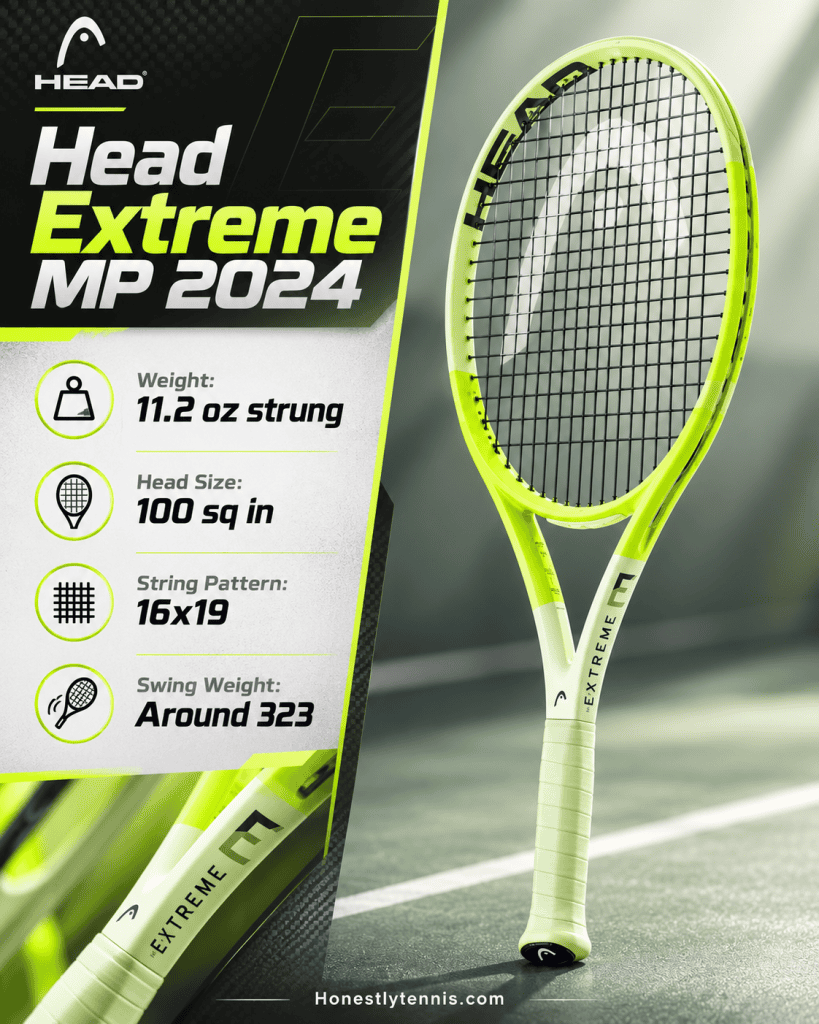
Exact Product Name: Head Extreme MP 2024
The Head Extreme MP 2024 sits in an interesting spot. It’s not as wild as some spin machines, but it gives you enough help to attack the ball aggressively without feeling like you’re fighting the racquet.
I’ve always liked racquets that let you swing freely. The problem with many power frames is that they give you so much rebound that you spend half your match trying to control your own equipment.
The Head Extreme MP 2024 avoids that trap better than most.
During testing, I spent several sessions hitting heavy topspin drills from the baseline. The first thing I noticed was the launch angle. The ball jumps off the strings with a noticeable kick, especially when using a modern windshield-wiper forehand.
You know that annoying opponent who hits a ball that looks harmless but suddenly jumps shoulder-high after bouncing? This racquet helps create that kind of shot.
The open string pattern works with aggressive swings. When you brush up the back of the ball, you can feel the strings grabbing and releasing the ball.
I tested this racquet with a college-level player during a weekend hitting session. He normally uses a control-oriented frame and complained that he struggled to create enough depth when tired. After switching to the Extreme MP, his defensive shots became much easier because the racquet added some free pace.
That said, it’s not perfect.
The extra power can become a problem when you’re trying to flatten out a forehand. I noticed some balls flying long during fast exchanges when my swing path became too horizontal.
This racquet wants spin.
It’s like a sports car that prefers open highways. Push it into the wrong situation, and it reminds you who is in charge.
The comfort is solid, but players who prefer a classic soft feeling may not love the response. It has a modern, energetic feel.
Who Should Buy It vs. Who Should Avoid It
Buy it if you:
- Use heavy topspin
- Play aggressive baseline tennis
- Want easy depth from defensive positions
- Need help creating racket-head speed
- Are an intermediate or advanced player
Avoid it if you:
- Prefer flat hitting
- Want maximum precision
- Like traditional flexible racquets
- Already hit very powerful shots naturally
Key Specs Breakdown
- Head Size: 100 sq in
- Strung Weight: Around 11.2 oz
- String Pattern: 16×19
- Balance: Slightly head light
- Beam Width: Around 23-26 mm
- Swing Weight: Around 323
- Player Level: Intermediate to advanced
What I Loved
- Excellent topspin production
- Easy depth on defensive shots
- Fast through the air
- Comfortable power level
- Great for modern baseline tennis
What Drove Me Crazy
- Can launch flat shots
- Less traditional feel
- Not ideal for players who want surgical control
Here’s the honest wallet talk: if your main problem is getting the ball deep enough, this racquet can help. If your main problem is keeping the ball inside the lines, look somewhere else.
The Head Extreme MP 2024 is designed for players who attack with spin, not players who are afraid of missing.
Yonex EZONE 100
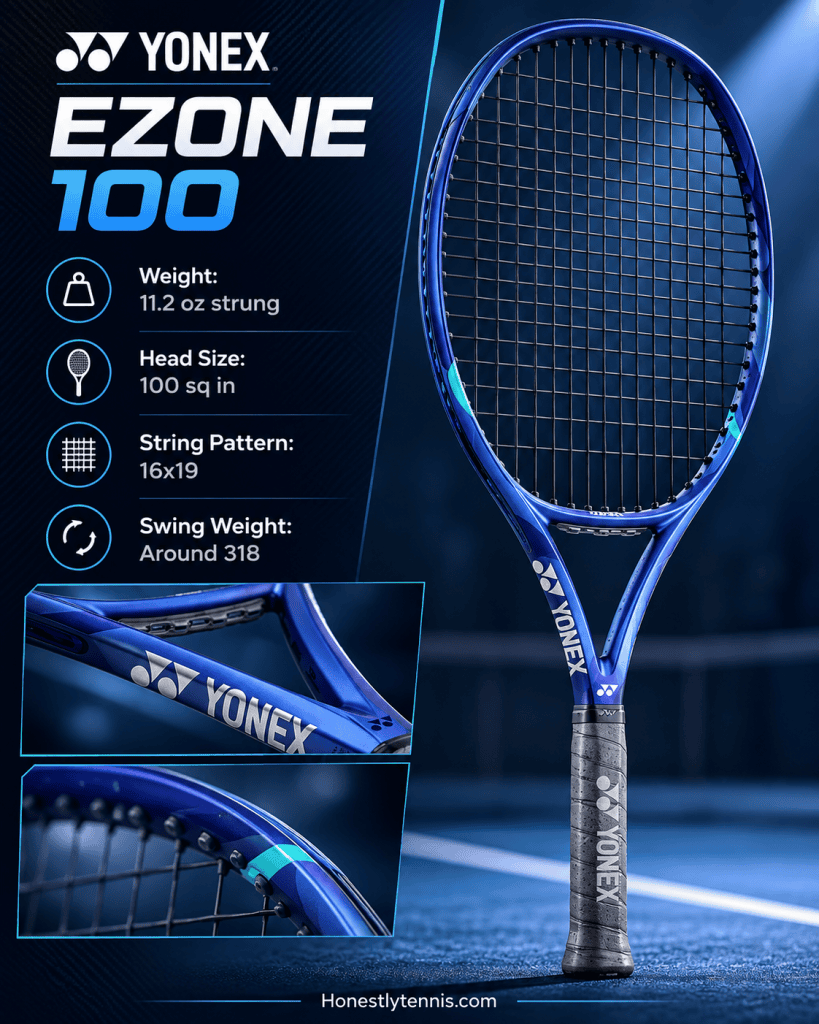
Exact Product Name: Yonex EZONE 100
The Yonex EZONE 100 is one of those racquets that surprises people.
When players talk about power and spin, they usually jump straight toward Babolat or Head. But Yonex quietly built one of the most user-friendly attacking racquets available.
This is the racquet I often recommend to intermediate players who want more power but don’t want something completely uncontrollable.
The biggest strength of the EZONE 100 is forgiveness.
That extra forgiveness matters because tennis isn’t played in a laboratory. Your feet aren’t always perfect. Sometimes you’re stretched wide, late, and just trying to survive the point.
During testing, I purposely played defensive drills where I started several feet behind the baseline. The EZONE 100 handled those uncomfortable situations extremely well.
The sweet spot feels generous. Even when contact wasn’t perfect, the racquet still produced a respectable ball.
I remember using it during an evening match after a long coaching day. My legs were tired, my timing wasn’t sharp, and honestly, my forehand was ugly.
The EZONE helped me.
Not because it magically fixed my technique, but because it gave enough stability and power that my weaker swings still produced useful shots.
That’s where this racquet shines.
It’s practical.
The downside? Advanced players looking for a surgical response might find it slightly too friendly. The extra power means you need to pay attention when attacking short balls.
Players who love hitting flat winners may also want something with a lower launch angle.
The feel is comfortable, the response is lively, and the overall package makes sense for a wide range of players.
If you want a deeper dive into exactly how this frame holds up during heavy match play, including serve performance and string setups, check out my full, hands-on Yonex EZONE 100 review. I break down every detail on why it’s become my ultimate go-to recommendation for club players.
Who Should Buy It vs. Who Should Avoid It
Buy it if you:
- Are an intermediate player improving quickly
- Want easy power
- Need a forgiving sweet spot
- Play singles and doubles
- Want comfort during long matches
Avoid it if you:
- Demand maximum precision
- Are an advanced player looking for surgical control
- Prefer very low-powered frames
- Love old-school player racquets
Key Specs Breakdown
- Head Size: 100 sq in
- Strung Weight: Around 11.2 oz
- String Pattern: 16×19
- Balance: Head light
- Beam Width: Around 23.5-26.5 mm
- Swing Weight: Around 318
- Player Level: Beginner advanced, intermediate, advanced
What I Loved
- Massive sweet spot
- Comfortable feel
- Easy power generation
- Good spin potential
- Excellent all-around performance
What Drove Me Crazy
- Less precision on aggressive flat shots
- Some players may outgrow the power
- Not the most connected feel
I’ll be honest — this is probably the racquet I’d hand to the largest number of recreational competitors.
Not because it’s flashy.
Because it works.
Most players don’t need a demanding professional-style frame. They need something that helps them play better tennis today.
Prince Ripstick 100
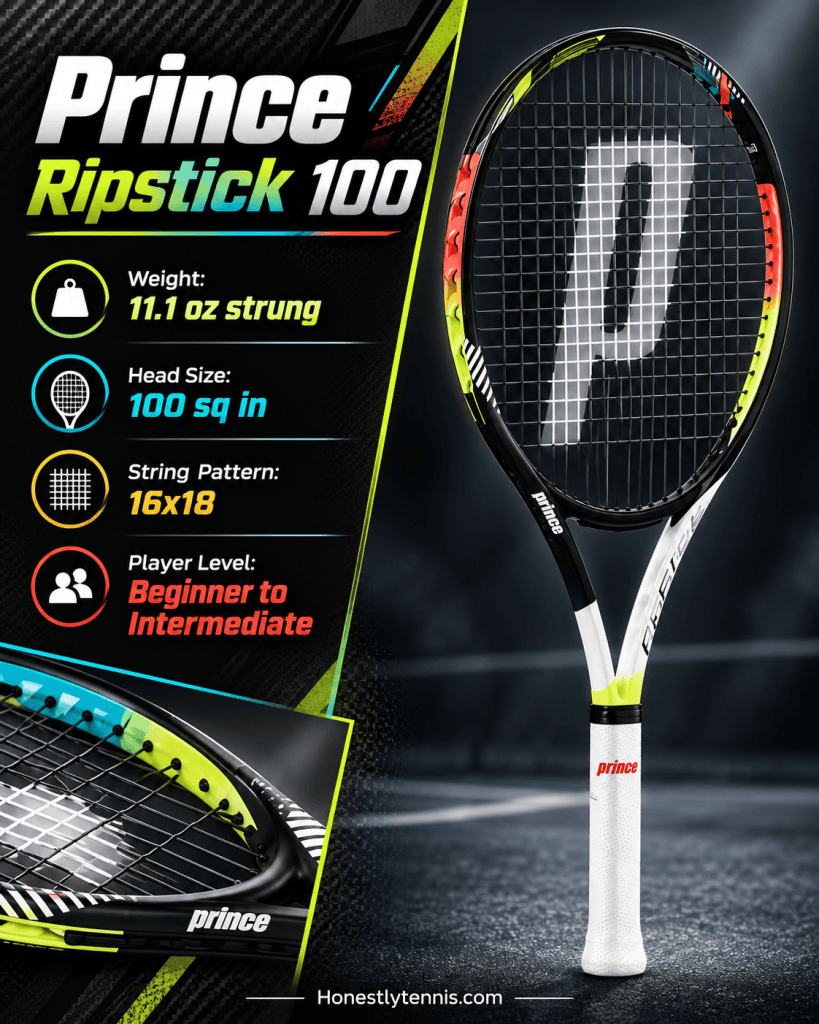
Exact Product Name: Prince Ripstick 100
The Prince Ripstick 100 is the budget option that deserves more attention.
Tennis equipment pricing has become ridiculous. Some racquets are pushing past the $300 mark, and honestly, not every player needs to spend that much.
The Ripstick 100 proves you can get serious performance without emptying your wallet.
During testing, I expected it to feel like a compromise. I was wrong.
The first thing I noticed was the easy access to spin. The unusual string spacing and aerodynamic design help the racquet move quickly and create aggressive rotation.
I tested this with a newer club player who was still learning topspin mechanics. His old racquet produced flat, inconsistent shots. The Ripstick helped him create more shape over the net.
Was his forehand suddenly perfect? No.
But the margin improved.
And in tennis, margin keeps you alive.
The power level is generous. Defensive shots are easier. Returns don’t feel like you’re trying to hit a baseball with a wooden paddle.
However, there are compromises.
The feel isn’t as refined as premium racquets. Advanced players who obsess over feedback may notice the difference immediately.
The frame also has a unique appearance. Some players love the aggressive look. Others think it looks like a science experiment escaped from a tennis lab.
Personally? I don’t care what it looks like if it performs.
Your opponent doesn’t care about your paint job after you hit a winner.
Who Should Buy It vs. Who Should Avoid It
Buy it if you:
- Want strong value
- Need more power and spin
- Are improving your technique
- Play recreational or league tennis
- Want a forgiving frame
Avoid it if you:
- Want premium feel
- Play high-level competitive tennis
- Prefer traditional racquet designs
- Need maximum control
Key Specs Breakdown
- Head Size: 100 sq in
- Strung Weight: Around 11.1 oz
- String Pattern: 16×18
- Balance: Head light
- Beam Width: Around 26 mm
- Swing Weight: Around 318
- Player Level: Beginner to intermediate
What I Loved
- Great spin for the money
- Easy power
- Comfortable sweet spot
- Good option for developing players
- Excellent value
What Drove Me Crazy
- Feel isn’t premium
- Design isn’t for everyone
- Advanced players may want more control
If your budget is under control and you’re searching for a racquet that won’t punish you while learning aggressive tennis, the Ripstick 100 makes a lot of sense.
Save your money for court time, lessons, and fresh tennis balls.
Those improve your game more than an expensive logo ever will.
The Real-World Buying Guide: How to Choose the Best Tennis Racquets for Power and Spin
Buying a tennis racquet is where many players make expensive mistakes.
They see a professional using a certain frame, watch a few YouTube reviews, read “maximum power and spin” on a product page, and click buy.
Then the racquet arrives.
The first match feels terrible.
Why?
Because tennis racquets are not magic sticks. They are tools. A chainsaw is great for cutting trees, but you wouldn’t use one to carve a wooden spoon.
The same logic applies here.
The best tennis racquets for power and spin depend on your swing style, strength, skill level, and how you actually play points.
Here’s what I look at before recommending any frame.
1. Weight: More Stability vs. More Speed
Racquet weight changes everything.
A heavier racquet usually gives:
- More stability against fast shots
- Better plow-through
- Heavier ball speed
- Less twisting on off-center hits
But there’s a price.
A heavy frame can become exhausting after an hour of serving. Your shoulder starts complaining. Your preparation gets slower. Suddenly that “pro-level” racquet becomes a 12-ounce mistake sitting in your bag.
For most intermediate players:
- 10.5–11.3 oz strung: Great balance of speed and power
- 11.3–12 oz strung: Better for stronger advanced players
- Below 10.5 oz: Easier handling but less stability
My opinion?
Most recreational players should stop chasing heavy racquets. A lighter frame that you can swing confidently will beat a heavy frame you’re late with.
2. Head Size: Sweet Spot Matters
Head size directly affects forgiveness.
Common sizes:
98 sq in
Best for:
- Advanced players
- Precision hitters
- Players who create their own pace
The sweet spot is smaller.
Miss the center, and you’ll know immediately.
100 sq in
This is the sweet spot for many modern players.
You get:
- Good power
- Better forgiveness
- Strong spin potential
- Easier depth
Most racquets on this list use a 100 sq in head because it works for a wide range of players.
105+ sq in
Usually designed for:
- Beginners
- Older players
- Players needing maximum comfort
The downside?
Control can suffer.
3. String Pattern: The Spin Factory
String pattern is one of the biggest factors in spin production.
Open String Pattern (16×19, 16×18)
Advantages:
- More string movement
- Easier topspin
- More power
- Higher launch angle
Disadvantages:
- Strings break faster
- Less control on flat shots
Dense String Pattern (18×20)
Advantages:
- Better precision
- Lower launch angle
- More predictable response
Disadvantages:
- Requires stronger technique
- Less natural spin
If your game is built around heavy topspin, I usually lean toward open patterns.
4. Swing Weight: The Hidden Number Most Players Ignore
Swing weight tells you how heavy the racquet feels while moving.
Two racquets can have the same static weight but feel completely different.
A higher swing weight gives:
- More power
- More stability
- Heavier shots
But:
- Requires better timing
- Can fatigue your arm faster
A racquet with a swing weight around 315–325 is comfortable for many intermediate players.
Above 330?
You better know what you’re doing.
5. Power vs. Control: Know Your Problem
Ask yourself:
“What happens when I miss?”
If your shots constantly land short:
You probably need more power.
Look at:
- Yonex EZONE 100
- Babolat Pure Aero 100
- Head Extreme MP 2024
If your shots fly long:
You probably need more control.
Look at:
- Wilson Blade 98 V9
- More controlled string setups
Buying more power when your problem is control is like adding more horsepower to a car with bad brakes.
6. Don’t Ignore Strings
A $250 racquet with the wrong strings can feel awful.
A properly setup $150 racquet can feel incredible.
For power and spin:
Polyester Strings
Great for:
- Aggressive players
- Heavy topspin
- Control
Examples:
- Babolat RPM Blast
- Solinco Hyper-G
Multifilament Strings
Great for:
- Comfort
- Arm-friendly performance
- Players needing easier power
A common mistake?
Players copy professional string setups without having professional swings.
A 55-pound polyester setup might feel amazing for a touring player and miserable for a weekend competitor.
FAQ: Best Tennis Racquets for Power and Spin
What is the best tennis racquet for power and spin?
The Babolat Pure Aero 100 is one of the strongest options for players who want heavy topspin and aggressive baseline power. It offers excellent spin production with enough control for intermediate and advanced players.
Are heavier tennis racquets better for power?
Generally, yes. Heavier racquets provide more stability and can produce heavier shots. However, a racquet that is too heavy can slow your swing and reduce consistency.
What racquet is best for intermediate players who want more spin?
The Yonex EZONE 100 and Head Extreme MP 2024 are strong choices for intermediate players because they combine forgiveness, easy power, and spin-friendly designs.
Final Thoughts
If you’re still stuck choosing, I’d keep it simple.
Most aggressive baseline players should start with the Babolat Pure Aero 100 because it delivers the spin and power combination that modern tennis demands.
If you’re an intermediate player who wants help without fighting your racquet, grab the Yonex EZONE 100.
If you already have strong technique and want precision, the Wilson Blade 98 V9 is the smarter choice.
Don’t buy the most expensive racquet. Buy the one that lets you play your best tennis when your legs are tired, your opponent is hitting hard, and the match gets ugly.


Hi, I’m Coach Mitchell. With over a decade of experience on the tennis court, I created Honestly Tennis to share my passion for the game. Whether you are a beginner looking for your first racquet or an advanced player wanting to upgrade your gear, my goal is to provide honest reviews and helpful guides to elevate your game.