
Walking into a tennis pro shop or browsing online equipment catalogs can feel overwhelming. With hundreds of frames hanging on display walls, covered in confusing technical jargon—swingweight, balance points, beam width, carbon layups, and string patterns—it is easy to feel paralyzed by choice. Grab the wrong frame, and you risk developing nagging tendonitis, losing confidence on the court, or struggling to keep basic groundstrokes inside the lines.
Quick Answer: To master how to choose a tennis racket, match the frame’s weight, head size, and stiffness to your current skill level and swing style. Beginners should choose a lightweight frame (9.5–10.2 oz) with an oversized head (100–105 sq. in.) for effortless power and forgiveness. Intermediate and advanced players require heavier frames (10.6–11.5+ oz) with midplus head sizes (97–100 sq. in.) to maximize directional control, swing stability, and ball precision.
Whether you are stepping onto the court for your first coaching clinic or preparing for competitive league matches, understanding the engineering behind modern frames will transform your game. Here is the comprehensive, step-by-step roadmap on how to choose a tennis racket that complements your biomechanics and elevates your performance.
1. The Core Specifications Explained (The Anatomy of a Racket)
Every tennis racket performs according to the laws of physics. Before looking at specific brands or paint jobs, you must understand the five primary technical specifications defined by governing bodies like the International Tennis Federation (ITF).

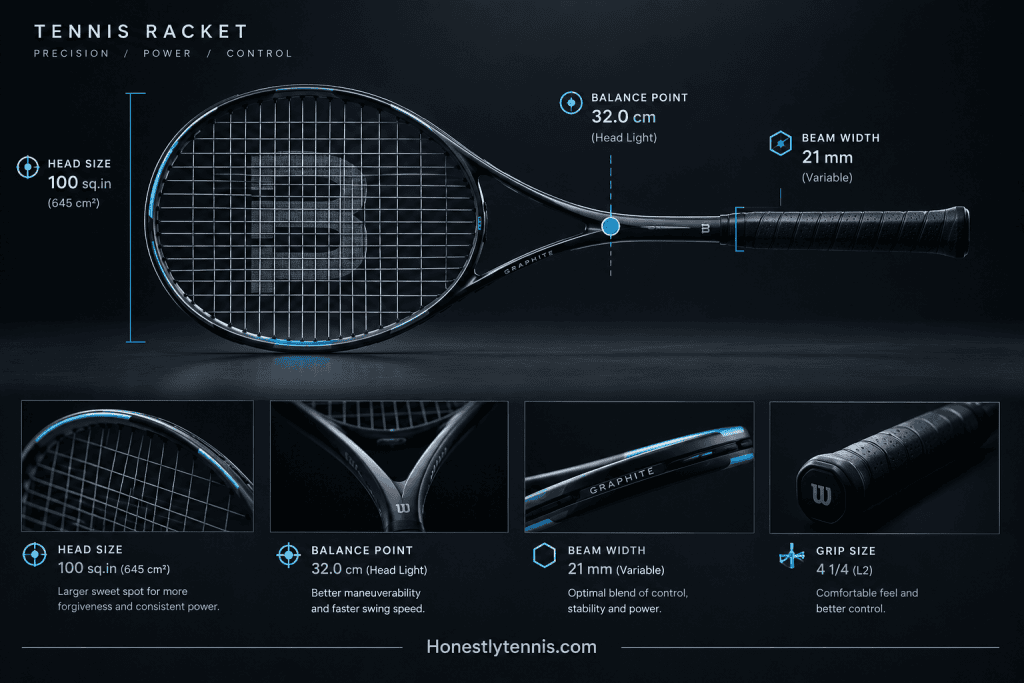
A. Head Size: Power vs. Precision
The head size refers to the total surface area of the string bed:
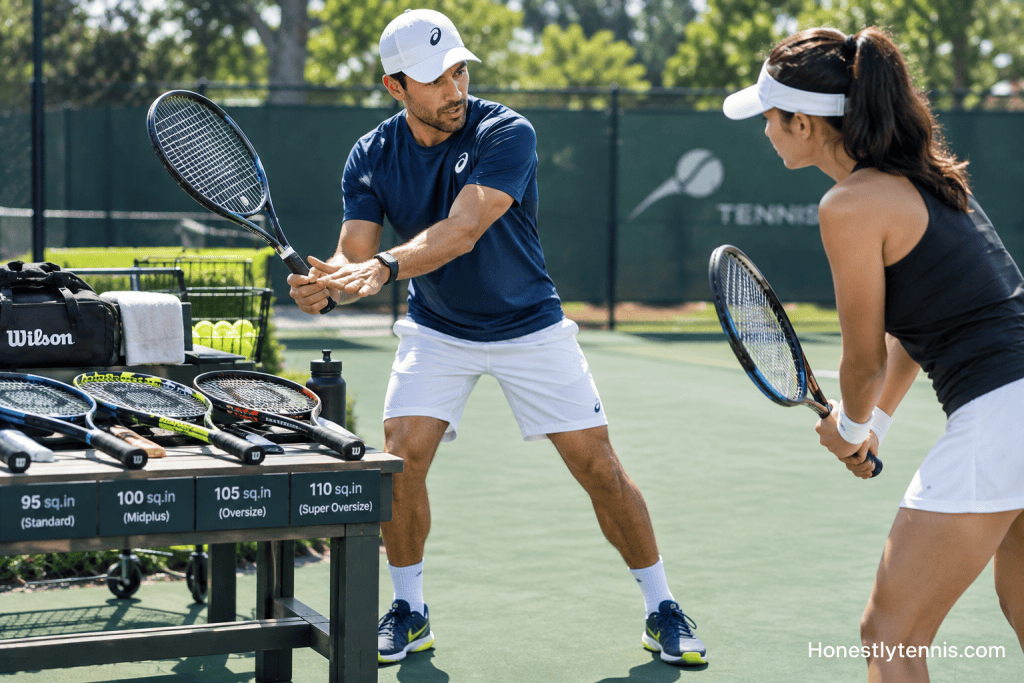
- Oversize (105 sq. in. and above): Provides a massive sweet spot and trampoline-like rebound. Ideal for beginner players and senior doubles specialists who need effortless ball depth with short, compact swings.
- Midplus (98 to 102 sq. in.): The contemporary industry standard. Offers an optimal balance of power, maneuverability, and control.
- Midsize (95 to 97 sq. in. and below): Engineered strictly for advanced tournament players. It yields surgical precision and pinpoint control, but demands exceptional footwork and consistent center-face contact.
B. Static Weight: Stability vs. Maneuverability
A racket’s static weight determines how much mass collides with the oncoming ball:
- Lightweight (Under 10 oz / 285g): Effortless to swing, rapid at the net, but prone to twisting on heavy incoming shots.
- Midweight (10.1 to 10.8 oz / 286g–305g): The versatile sweet spot for developing recreational and intermediate competitors.
- Heavyweight (10.9 oz to 12+ oz / 310g–340g+): Absorbs shock effectively, plows through heavy topspin, and delivers heavy balls, but demands strong shoulder conditioning and sound stroke mechanics.
C. Balance: Where the Mass Lives
Racket balance dictates where the weight is concentrated along its length:
- Head-Heavy (HH): Weight sits toward the tip of the frame. Common in ultra-light rackets to generate punching power from the baseline without adding overall bulk.
- Even Balance (EB): Equal distribution throughout the frame, offering all-court versatility.
- Head-Light (HL): Mass is concentrated toward the handle. Most tournament-level and performance frames are 4 to 8 points head-light, enabling rapid racquet head acceleration and lightning-fast reflex volleys.
Expert Insight Box:
Many beginners mistakenly believe the lightest possible racket is best for joint health. In reality, a frame that is too light lacks the mass required to withstand ball collision, forcing your wrist and elbow to absorb the shock. An 10.5 oz (approx. 300g) frame with a head-light balance often protects the arm far better than a featherlight 9.2 oz frame.
D. Frame Stiffness (RA Rating) and Flex
Stiffness is measured on the Babolat RDC (RA) scale:
- Flexible (Under 63 RA): The frame bends slightly upon impact, pocketing the ball, extending dwell time, and dampening harsh vibrations. Highly recommended for players with a history of tennis elbow.
- Medium (64 to 67 RA): Balanced blend of modern pop and arm-friendly comfort.
- Stiff (68+ RA): Deflects minimally, transferring maximum kinetic energy directly back into the ball for explosive power, but transmits noticeable shock into the player’s arm.
E. String Pattern: Open vs. Dense
- Open (16×19): Fewer string intersections allow strings to snap back dynamically, yielding higher ball trajectories, extra spin, and greater launch angle.
- Dense (18×20): More string contact points create a firmer string bed, flattening out trajectory and maximizing laser-guided directional control.
2. How to Choose a Tennis Racket by Player Skill Level
Choosing the right equipment requires an honest self-assessment of your technical ability, physical strength, and swing frequency.
Level 1: The Beginner (NTRP 1.0 – 2.5)
- Primary Objective: Consistency, learning the sweet spot, developing clean swing fundamentals.
- Recommended Specs:
- Head Size: 100 – 105 sq. in.
- Weight: 9.5 – 10.2 oz (270g – 290g)
- Balance: Even to slightly Head-Heavy
- Beam Width: 24mm – 26mm (thicker, stiffer beam for free power)
- Strategic Advice: As you master footwork and baseline rallying, prioritize a forgiving sweet spot. Avoid demanding, vintage-style frames that punish off-center hits.
Level 2: The Intermediate (NTRP 3.0 – 4.0)
- Primary Objective: Developing weaponized groundstrokes, generating personal swing speed, and mastering directional depth.
- Recommended Specs:
- Head Size: 98 – 100 sq. in.
- Weight: 10.4 – 11.1 oz (295g – 315g)
- Balance: 3 to 5 points Head-Light
- Beam Width: 21mm – 24mm
- Strategic Advice: At this stage, your swing speed naturally increases. You no longer need the frame to generate all your depth; instead, you need a balanced frame capable of producing topspin and controlled aggression. A modern versatile standard like the Yonex Ezone 100 review highlights how modern intermediate frames seamlessly bridge the gap between explosive baseline power and arm-friendly comfort.
Level 3: The Advanced & Tournament Player (NTRP 4.5 – 6.0+)
- Primary Objective: Surgical precision, plow-through stability against heavy pace, and pinpoint serve placement.
- Recommended Specs:
- Head Size: 97 – 98 sq. in.
- Weight: 11.2 – 12+ oz (315g – 340g+)
- Balance: 6 to 9 points Head-Light
- String Pattern: 16×19 or 18×20 (depending on spin preference)
- Strategic Advice: Advanced ball strikers generate immense natural racket head speed and require a heavier static mass that will not flutter during fast-paced exchanges. Highly demanding frames require disciplined fitness and consistent full-body kinetic chaining.
3. Matching Your Racket to Your Playing Style
Every competitor approaches the tennis court with a unique tactical philosophy. Your frame should naturally enhance your strengths rather than fight against them.
Playing Archetype | Tactical Strategy | Optimal Racket Profile | Key Characteristic Needed |
|---|---|---|---|
Aggressive Baseliner | Dictates rallies with heavy topspin, hits blistering winners from deep. | 100 sq. in., aerodynamic frame, 16×19 open string pattern. | Maximum spin potential and explosive ball exit velocity. |
Counterpuncher / Defender | Chases down every ball, relies on deep court positioning and consistency. | 100 sq. in., forgiving sweet spot, maneuverable swingweight. | High forgiveness on running, off-balance shots. |
All-Court Tactician | Mixes drop shots, approaches the net, utilizes slice variations. | 98 sq. in., moderate beam, balanced stiffness (62–66 RA). | Touch, volleys maneuverability, and feel. |
Serve-and-Volleyer | Attacks behind booming serves, finishes points swiftly at the net. | 97–98 sq. in., headlight balance (6+ pts HL), dense string bed. | Rapid reflex handling and firm volley stability. |
4. Racket Technology and Evolution: How Far We’ve Come
To appreciate modern racket performance, consider how equipment engineering transformed throughout history. According to historical records preserved by organizations like the United States Tennis Association (USTA), tennis was played exclusively with small, laminated wood frames (measuring roughly 65 square inches) until the late 1970s.
In 1976, Howard Head patented the oversized Prince Classic aluminum frame, initiating a technological revolution. By the early 1980s, manufacturers transitioned to graphite composites, introducing vibration-dampening elastomers, aerodynamic throat geometries, and carbon-fiber mapping.
Understanding this evolution explains why today’s players can generate heavy topspin angles that were mechanically impossible during the wood-racket era. For more deep dives into the game’s equipment culture and rich background, explore the comprehensive guides on Honestly Tennis.
(Placeholder: YouTube Video – Suggested Query: “How to Choose a Tennis Racket – Complete Tennis Equipment Guide”)
5. Step-by-Step Checklist: Testing Before You Buy
Before committing your budget to a new racket, implement this foolproof five-step testing process:
- Utilize a Demo Program: Never purchase a performance frame based solely on online reviews or color schemes. Most local pro shops and specialized tennis retailers offer demo programs allowing you to playtest 2–3 rackets side-by-side for a small fee.
- Playtest in Real Match Conditions: Hitting casual groundstrokes in a warm-up feels different from hitting under the pressure of a tiebreaker. Test how the racket behaves when you are stretched wide on defense, lunging for low volleys, or hitting second serves.
- Verify String Setup: Ensure the demo frames are strung with neutral synthetic gut or multifilament strings at mid-range tension. Overly dead or excessively loose strings will distort your impression of the racket’s true characteristics.
- Listen to Your Body: If you experience any forearm stiffness, tingling in your fingers, or elbow twinges within 30 minutes of play, set the frame aside immediately—no matter how impressive your winners were.
- Account for Long-Term Development: If you are practicing several days per week, select a frame that allows you to grow your game over the next 18 to 24 months, rather than one you will outgrow in three months.
Frequently Asked Questions (FAQ)
What is the most common grip size for adult tennis players?
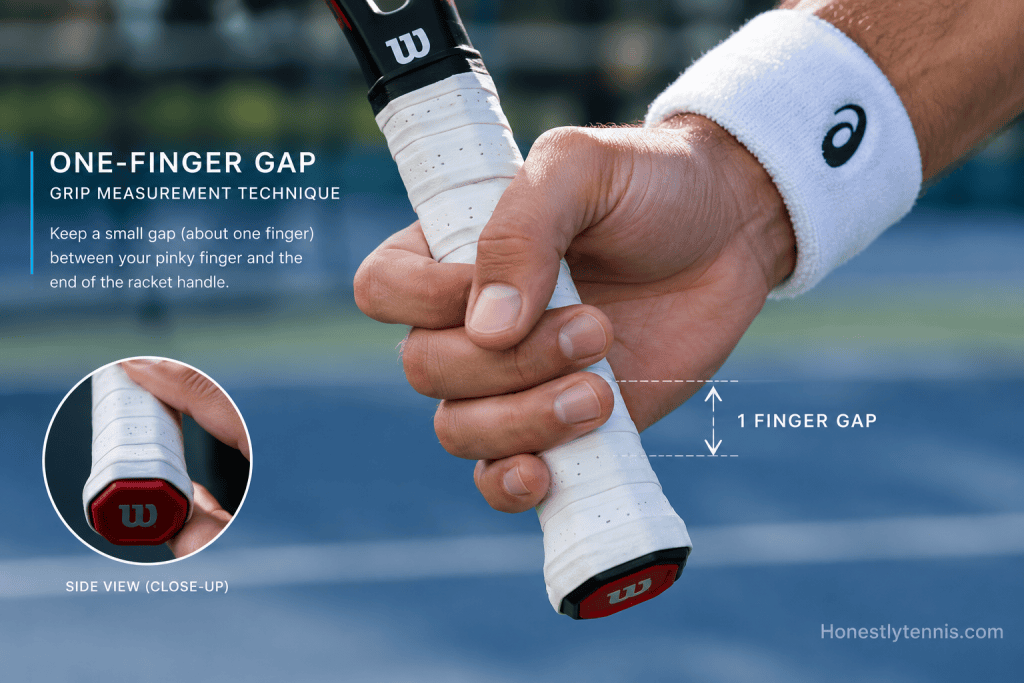
For men, the most common grip sizes are 4 3/8 inches (Grip Size 3) and 4 1/2 inches (Grip Size 4). For women, the most common sizes are 4 1/4 inches (Grip Size 2) and 4 3/8 inches (Grip Size 3). When in doubt, it is always best to choose the smaller size, as an overgrip can easily increase the handle circumference by 1/16th of an inch.
How often should I string my new tennis racket?
A standard rule of thumb followed by club stringers is to string your racket as many times per year as you play in an average week. If you hit three times weekly, you should restring every four months. Remember that strings gradually lose their elasticity, shock absorption, and tension over time—even when sitting unused inside your tennis bag.
Can a beginner use an advanced player’s tennis racket?
While it is technically possible, using an advanced, heavy frame (like a tour-weight player’s racket) will drastically hinder a beginner’s progression. Advanced rackets feature small sweet spots and heavy swingweights that cause mishits, late contact, and rapid muscle fatigue for developing players.
What is the difference between strung and unstrung weight?
Unstrung weight represents the bare frame as manufactured. Standard tennis string adds approximately 0.5 to 0.6 ounces (15g to 18g) to the total static weight and alters the balance point by approximately 3 to 4 points toward the head. Always confirm whether advertised specifications reflect strung or unstrung values.



Hi, I’m Coach Mitchell. With over a decade of experience on the tennis court, I created Honestly Tennis to share my passion for the game. Whether you are a beginner looking for your first racquet or an advanced player wanting to upgrade your gear, my goal is to provide honest reviews and helpful guides to elevate your game.