

Yonex EZONE 100 vs Wilson Clash 100 v2 is the matchup every 3.5 club player asks about. Same 100 square inch head. Near-identical weight, around 300 grams. Same price class. So why do they play nothing alike?
The answer is one number: stiffness. The EZONE 100 is a firm, modern power frame that does the heavy lifting for you. The Clash 100 v2 is one of the softest frames on the market, built to protect your arm and reward a full, relaxed swing.
Pick wrong and you will either fight a sore elbow for six months or watch flat put-away balls sail long. This breakdown compares the real specs, the on-court trade-offs, and exactly who should buy which frame, so you spend your money once and spend it right.
Table of Contents
- Quick Verdict
- How We Chose
- Yonex EZONE 100 vs Wilson Clash 100 v2 Specs Side by Side
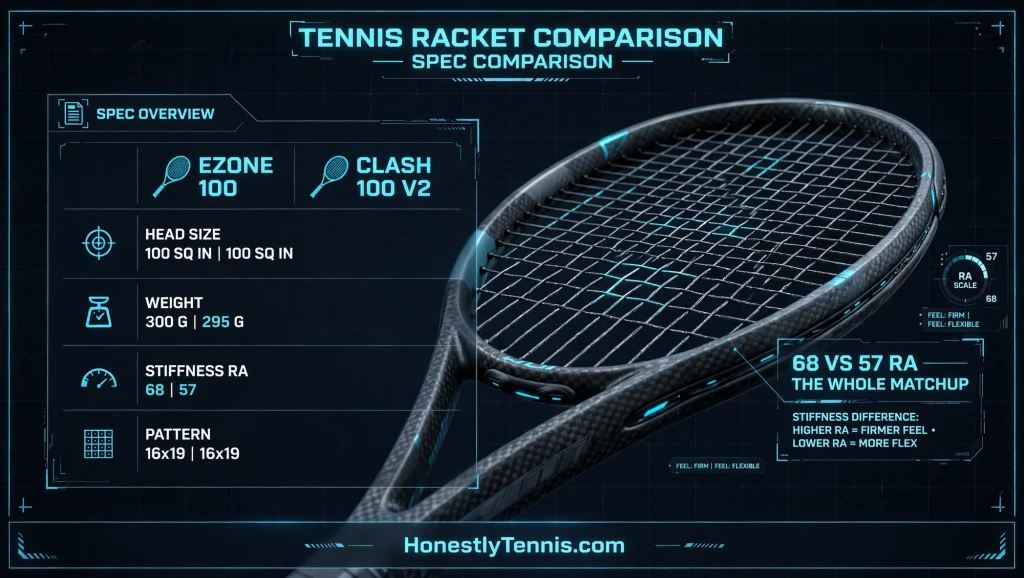
- The Stiffness Gap: 68 RA vs 57 RA
- Yonex EZONE 100 Deep Dive
- Wilson Clash 100 v2 Deep Dive
- On Court: Power, Serve, Spin, and Net Play
- Who Should Buy Which?
- Final Verdict
- FAQ
Quick Verdict
Here is the bottom line.
Buy the Yonex EZONE 100 if you want easy power and depth without swinging out of your shoes. It is the safer pick for most 3.0 to 4.0 players who want free pace and a big sweet spot.
Buy the Wilson Clash 100 v2 if your elbow talks back after matches, or if you already generate your own pace and want plush feel. It asks more of your swing and gives more back to your arm.
How We Chose
No made-up test scores here. This comparison uses official manufacturer specifications (weight, head size, balance, beam width, string pattern), published stiffness and swingweight figures, frame physics, and consistent feedback from club players at the 3.0 to 4.5 level. Where the two frames disagree, the specs decide.
Yonex EZONE 100 vs Wilson Clash 100 v2 Specs Side by Side
| Spec | Yonex EZONE 100 | Wilson Clash 100 v2 |
|---|---|---|
| Head Size | 100 sq in | 100 sq in |
| Unstrung Weight | 300 g / 10.6 oz | 295 g / 10.4 oz |
| Strung Weight | 318 g / 11.2 oz | 309 g / 10.9 oz |
| Balance (strung) | 4 pts head light | 7 pts head light |
| Swingweight (strung) | ~315 | ~312 |
| Stiffness (RA) | 68 | 55–57 |
| Beam Width | 24.5 / 26.5 / 23 mm | 24.5 mm flat |
| String Pattern | 16×19 | 16×19 |
| Length | 27 in | 27 in |
| Tension Range | 45–60 lbs | 50–60 lbs |
| Best For | Easy power, big sweet spot | Arm comfort, plush feel |
Look closely and the table tells the real story. Same head size, same string pattern, five grams of weight between them, three swingweight points apart. The frames are near-twins on paper, and then stiffness splits them wide open. Neither frame comes close to the legal size limits in the ITF Rules of Tennis (Appendix II). If head size still confuses you, our 98 vs 100 square inch guide explains the difference.

The Stiffness Gap: 68 RA vs 57 RA
RA measures how much a frame bends on impact. A higher number means a stiffer frame that returns more energy to the ball. A lower number means a softer frame that bends, pockets the ball longer, and sends less shock into your arm.
The EZONE 100 sits around 68 RA. That is firm modern power territory. The frame barely gives at contact, so your rally ball gets pace even when your swing is short or late. What you give up is feel: off-center contact sends more vibration down to your wrist and elbow.
The Clash 100 v2 sits around 55 to 57 RA, one of the lowest stiffness ratings in any current performance frame. Wilson’s FORTYFIVE carbon mapping lets the frame bend in more than one direction, so the ball sinks into the strings and leaves soft. The Clash flips that deal: the frame absorbs energy instead of returning it, so flat shots need your full swing. An 11-point RA gap is huge. It is the whole matchup.

Yonex EZONE 100 Deep Dive
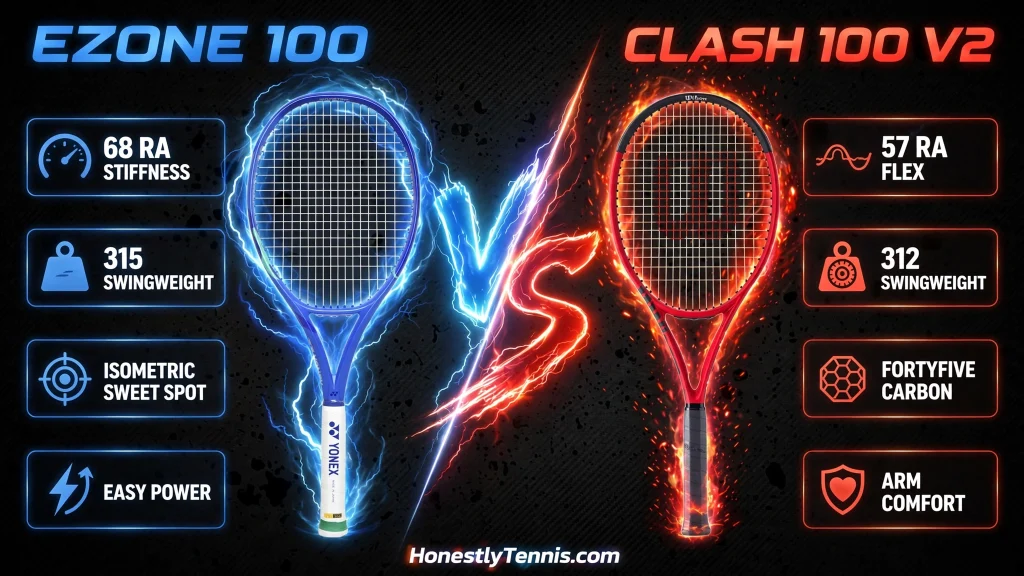
The EZONE 100 is the easy-power pick. Yonex pairs a firm 68 RA frame with its Isometric head shape, which squares off the top of the hoop and stretches the sweet spot wider than a round head allows. Off-center hits still travel. That is the frame’s best trick, and it is why so many 3.5 players find instant depth with it.
The beam tells the same story. It runs thick through the upper hoop at 26.5 mm, which adds stability and pop where most players actually make contact. Yonex adds Minolon fibers and a Vibration Dampening Mesh to take the edge off the firm response. It works, up to a point. The EZONE 100 feels muted for a power frame, but it is still a 68 RA frame, and your arm will know it after a long three-setter. Read the full breakdown in our full Yonex EZONE 100 review.
Yonex EZONE 100 Pros
- Free, easy power from the baseline with a compact swing
- Huge sweet spot thanks to the Isometric head shape
- Stable and solid against heavy incoming pace
- Strong serving frame, with easy pace on flat first serves
- Muted, comfortable feel for a firm power frame
Yonex EZONE 100 Cons
- 68 RA stiffness can punish a sore elbow over a long match
- Less connected feel on touch shots than a soft flex frame
- Power can turn into long balls if your swing is already fast and flat
Who Should Buy the EZONE 100, and Who Should Skip It
Buy it if you are a 3.0 to 4.0 baseliner who wants depth without perfect timing, if you play mostly hard courts, or if your current frame leaves your rally ball landing short. Skip it if your elbow already complains after matches, or if you hit flat and hard and already struggle to keep the ball inside the lines.
Coach’s Stringing Secret: do not string this frame with stiff polyester at high tension. A 68 RA frame plus tight poly is how elbows start barking in a long third set. A soft poly like Yonex Poly Tour Pro or Solinco Hyper-G near 50 to 52 lbs keeps the power usable, and a poly hybrid with Tecnifibre NRG2 or Wilson NXT in the crosses softens the response further for players who already feel it in the elbow after club matches. If the EZONE 100 still feels too firm for your arm, the Clash 100 v2 below is the direct swap.
Wilson Clash 100 v2 Deep Dive
The Clash 100 v2 is the comfort pick, and it is not close. At 55 to 57 RA, this is the softest mainstream performance frame you can buy. The frame bends, the ball pockets, and the impact feels like catching the ball in a glove instead of slapping it with a board.
That flex comes with a real cost. The Clash gives you very little free power. Your swing supplies the pace, and lazy swings produce short balls that sit up for your opponent. The head-light balance (7 points strung) keeps the frame fast through the air, so generating racket-head speed is easy. But if your swing path is flat and compact, the flexible response can launch the ball higher than you expect. Topspin is not optional with this frame. It is the steering wheel. Read the full breakdown in our full Wilson Clash 100 v2 review.
Wilson Clash 100 v2 Pros
- Best-in-class arm comfort at 55–57 RA
- Plush pocketing and soft feel on every shot
- Fast, head-light handling for quick swings and spin
- Kind to shoulders and elbows during long sessions
- Great touch on drop shots and angled volleys
Wilson Clash 100 v2 Cons
- Very little free power; your swing does the work
- Flat shots can launch long without enough topspin
- Less stable than heavier frames against big pace
- Muted feedback can feel vague to players who like a crisp response
Who Should Buy the Clash 100 v2, and Who Should Skip It
Buy it if your arm hurts after matches, if you already swing fast with heavy topspin, or if feel and comfort matter more to you than free pace. Skip it if you hit flat, if you want the frame to add pace to a short swing, or if you rely on a big flat first serve to win cheap points.
Coach’s Stringing Secret: the Clash needs spin to control its launch angle, so string choice matters more here than on most frames. A soft poly like Solinco Hyper-G or Yonex Poly Tour Pro near 52 to 54 lbs gives you the bite to keep the ball down in a 3.5 rally, and a full bed of Tecnifibre NRG2 or Wilson NXT is the kinder option if your arm is tender after back-to-back matches. Never leave dead poly in this frame. If you want Clash comfort with more free power, the EZONE 100 above is the natural trade.
Watch: Power vs Comfort on Court
The video below from our channel breaks down the same power-vs-comfort question with the Clash 100 v2 against a stiff power frame. Watch it to see the flex difference in action.

On Court: Power, Serve, Spin, and Net Play
Power and Baseline Play
The EZONE 100 wins the power question clearly. A firm frame, a thick upper beam, and a slightly higher swingweight add up to free depth. Short swings still produce deep balls, and defensive flicks from behind the baseline still clear the net.
The Clash asks you to earn every mile per hour. With a full topspin swing it produces heavy, deep balls. With a short or late swing it produces sitters. If raw power is your top priority, see how the Clash holds up against the stiffest power frame in our Babolat Pure Drive vs Wilson Clash breakdown.
Serves: Free Pace vs Placement
Serving shows the stiffness gap as plainly as any shot. The EZONE 100 adds easy pace to flat first serves and keeps kick serves jumping. The Clash serves well for placement and spin, and its light, fast handling makes kick and slice serves easy to shape. Flat bombs are the weakness. Expect to lose a few miles per hour against a firm frame, and plan to win service points with placement instead of speed.
Spin and Launch Angle
An open 16×19 pattern is shared by both frames, so heavy topspin is on tap either way. The difference is what happens when spin drops off. The EZONE 100 stays deep and penetrating even on flatter swings. The Clash, with its soft flex and higher launch, punishes flat swings by sending the ball long. If you hit with a steep, brushy swing path, the Clash is a joy. If you hit flat, it will test your patience.
Volleys and Net Play
At net the two frames trade strengths again. The EZONE 100 is stable and firm on punch volleys. Block the ball and it goes deep. Touch shots take a softer hand because the firm frame does not absorb pace for you. The Clash is the reverse: drop volleys and angled touch shots feel soft and precise, while firm punch volleys against heavy pace need full commitment, or the ball floats short.
Who Should Buy Which?
Still torn? Answer these two questions honestly.
- Does your arm hurt after matches? If yes, buy the Clash 100 v2. No power advantage is worth months of elbow trouble.
- Do you need help generating pace? If yes, buy the EZONE 100. It is the frame that meets a compact swing halfway.
If you answered no to both, pick by feel: the EZONE 100 for crisp, easy power, the Clash 100 v2 for soft, connected comfort. Still unsure? Walk through our guide on how to choose a tennis racket before you pay.
Final Verdict
For most club players weighing the Yonex EZONE 100 vs Wilson Clash 100 v2 decision, the EZONE 100 is the smarter buy. It gives you power, forgiveness, and a big sweet spot without asking for a perfect swing, and it helps the widest range of 3.0 to 4.0 players win more points from the first match.
The Wilson Clash 100 v2 is the better buy for a smaller group: players with sore arms, players who already generate big racket-head speed, and players who value feel above free pace. For them, no other mainstream frame feels this kind.
Buy the frame that fixes your actual problem. Short balls and a tired swing mean the EZONE 100. A barking elbow and a frame that feels like a board mean the Clash 100 v2.
FAQ
Which is better for tennis elbow, the EZONE 100 or the Clash 100 v2?
The Clash 100 v2, by a wide margin. Its 55 to 57 RA flex absorbs far more shock than the EZONE 100 at 68 RA. Pair it with a soft string at a moderate tension, and cut out dead polyester early.
Does the Yonex EZONE 100 have more power than the Wilson Clash 100 v2?
Yes. The firmer frame, thicker upper beam, and slightly higher swingweight give the EZONE 100 more free power on groundstrokes and serves. The Clash needs a full swing to match that depth.
Is the Wilson Clash 100 v2 good for intermediate players?
Yes, for 3.0 to 4.0 players with a full topspin swing. It is light, fast, and kind to the arm. Flat hitters should be careful, because the soft flex can launch flat shots long.
What string tension is best for the Clash 100 v2?
Wilson lists a 50 to 60 lbs range. A soft poly near 52 to 54 lbs, or a multifilament for tender arms, gives the best mix of spin, control, and comfort.
Can a beginner use the EZONE 100 or Clash 100 v2?
A committed beginner can start with either frame. The EZONE 100 offers easier power and a forgiving sweet spot, while the Clash 100 v2 is lighter and kinder to the arm. Check your grip size first, and read our guide on how to choose a tennis racket before buying.



Hi, I’m Coach Mitchell. With over a decade of experience on the tennis court, I created Honestly Tennis to share my passion for the game. Whether you are a beginner looking for your first racquet or an advanced player wanting to upgrade your gear, my goal is to provide honest reviews and helpful guides to elevate your game.