Disclosure: At Honestly Tennis, we research and compare gear using manufacturer specs and real player feedback. As an Amazon Associate, we earn from qualifying purchases at no extra cost to you.
Flat feet change the job a tennis shoe has to do. A normal arch stiffens on push-off and softens on landing; a flat arch does neither, so the foot rolls inward on every hard cut and the ankle, knee, and lower back pick up the slack. On a hard court, where every stop is abrupt, the wrong shoe turns a fun match into sore feet by the second set. This guide to the best tennis shoes for flat feet sticks to hard courts and to shoes with real structure: a rigid midfoot, a wide stable base, and a durable rubber outsole. Four picks, verified against official specs — no lab-coat claims, no invented tests.
- How We Chose
- Top Picks at a Glance
- ASICS Gel-Resolution X: Top Pick
- adidas Barricade 14: Best Stability
- K-Swiss Ultrashot 4: Best Arch Support
- New Balance 806 V1: Best Motion Control
- How to Choose the Right Pair
- Final Verdict
- FAQ
How We Chose
No staged playtests — just flat-foot physics on a hard court, the official spec sheets, and the patterns we see week after week from 3.0 to 4.5 club players. A shoe earned its place among the best tennis shoes for flat feet only if it has a rigid midfoot structure (a TPU frame, a chassis, or a motion-control post), a wide base that resists rolling, and a hard-court outsole built to last. Weight, widths, and the outsole warranty come from verified numbers, not guesses.
Top Picks at a Glance
Short version: among the best tennis shoes for flat feet, the ASICS Gel-Resolution X leads with the stiffest midfoot cradle in this group. The Barricade 14 is the light stability pick, the Ultrashot 4 has the most complete support chassis, and the 806 V1 is the motion-control workhorse for the flattest feet and widest widths.
| Shoe | Best For | Key Support | Weight (Men’s) |
|---|---|---|---|
| ASICS Gel-Resolution X | Top Pick | DYNAWALL TPU frame | 14.7 oz (US 9) |
| adidas Barricade 14 | Best Stability | Chassis + Barricade Claw | 14.1 oz (US 10.5) |
| K-Swiss Ultrashot 4 | Best Arch Support | 360 Plantar Chassis | 16.2 oz (US 10.5) |
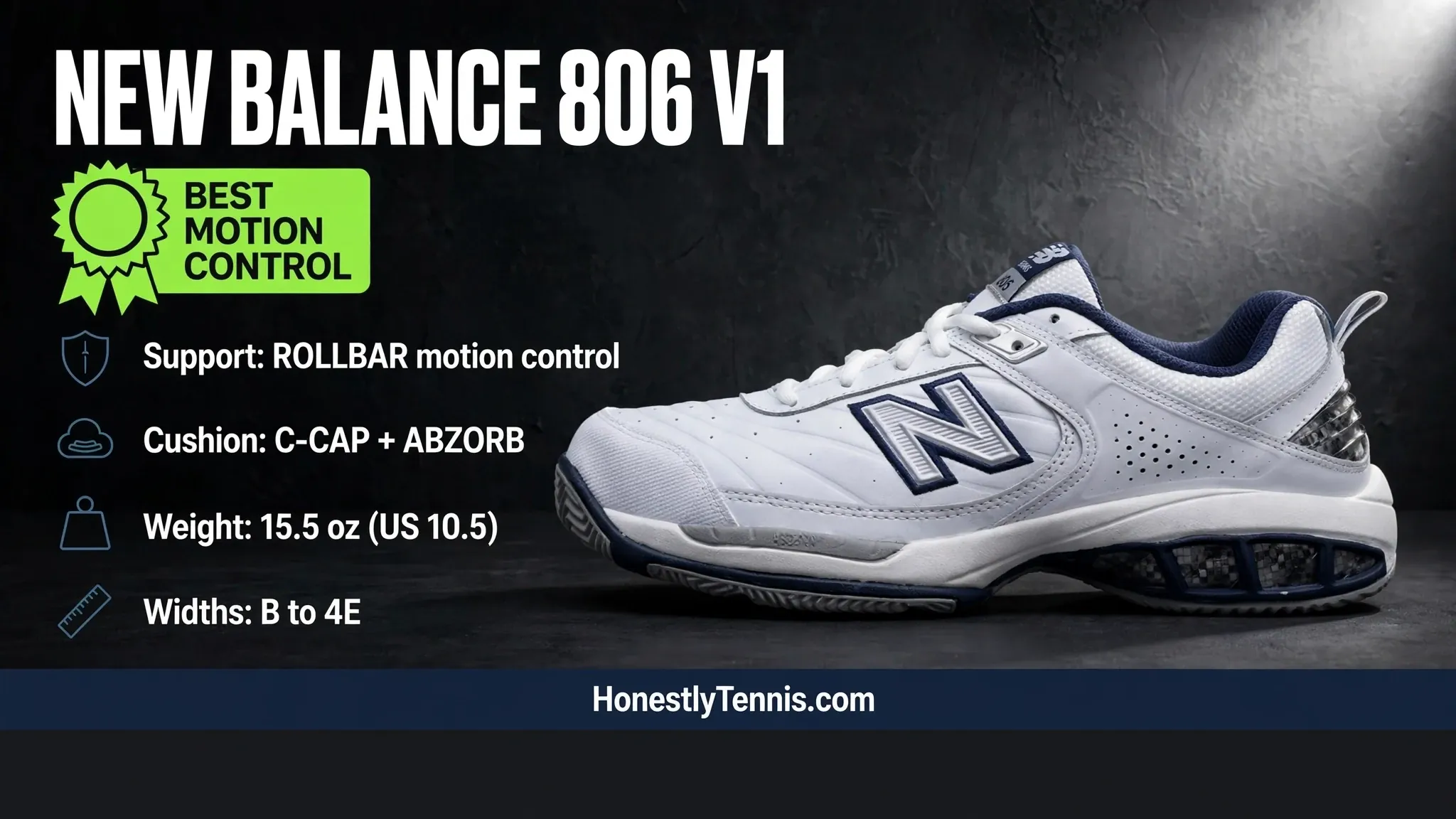
| New Balance 806 V1 | Best Motion Control | ROLLBAR post | 15.5 oz (US 10.5) |
ASICS Gel-Resolution X: Top Pick
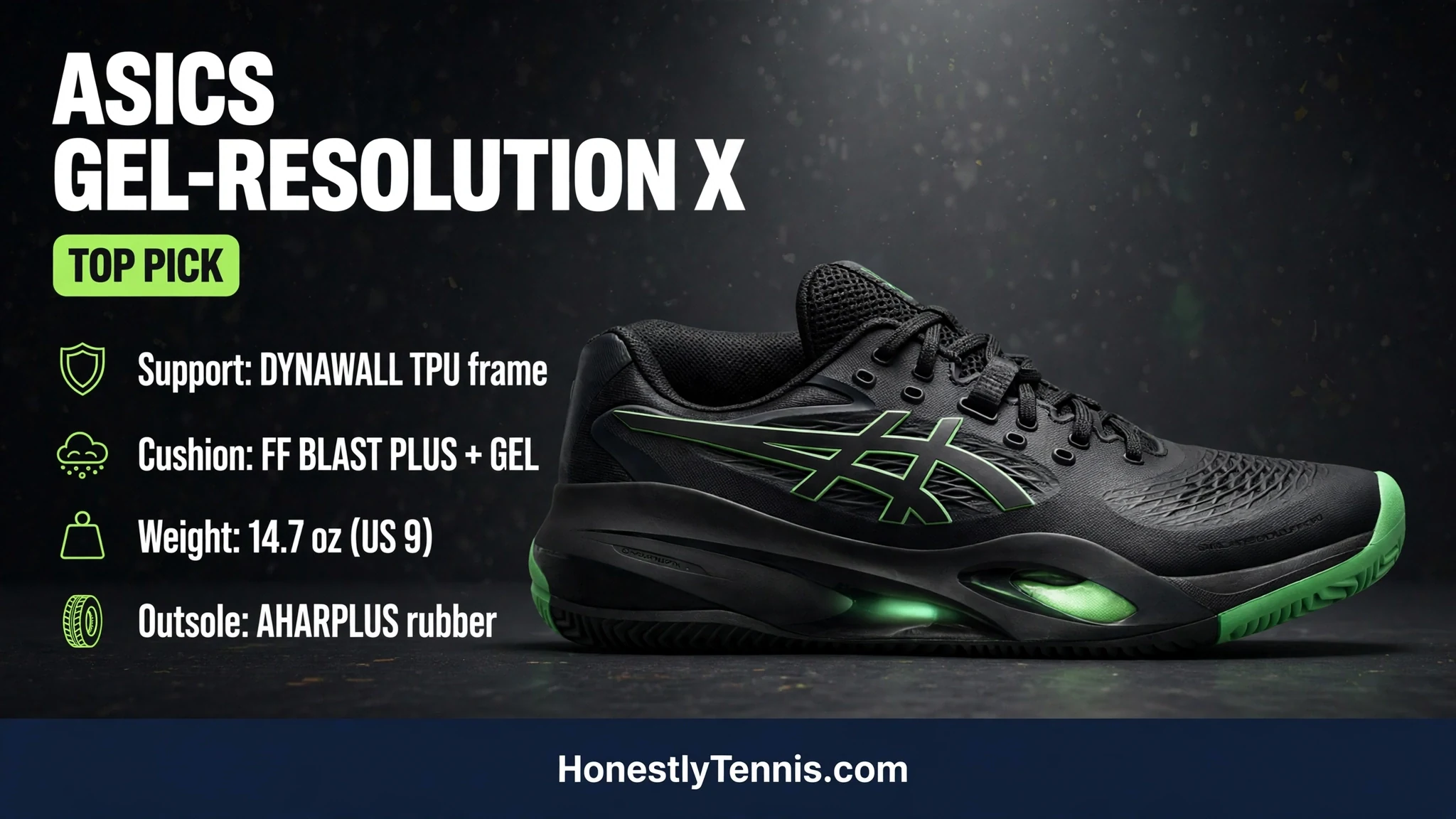
The Gel-Resolution X is ASICS’s most stable tennis shoe, and for flat feet, that matters most. A TPU frame called DYNAWALL wraps the midfoot and extends into the heel, so the foot stays centred when you plant and cut. Under it, FF BLAST PLUS foam with a GEL unit in the forefoot, and an AHARPLUS rubber outsole in a modified herringbone — the toughest rubber ASICS puts on a tennis shoe. It is heavy at 14.7 oz in a men’s US 9, and the stiff frame needs a few sessions to mould to your foot. But once it does, a 4.0 baseliner who slides into every ball will feel why it tops the best tennis shoes for flat feet: the shoe holds its line instead of letting the arch collapse inward. For a second opinion on the numbers, see the RunRepeat lab measurements for the Gel-Resolution X.
- Who It’s Best For: A 3.5–4.5 club player with low arches who plays mostly on hard courts and wants maximum lateral support. If your feet roll inward on hard stops, try this pair first — it comes in a men’s 2E wide.
- Who Should Skip It: A player who wants a light, quick shoe above all else, or anyone who hates a break-in period. At nearly 15 oz it feels clunky for the first few outings — take a lighter speed shoe if your arches are only mildly flat.
adidas Barricade 14: Best Stability
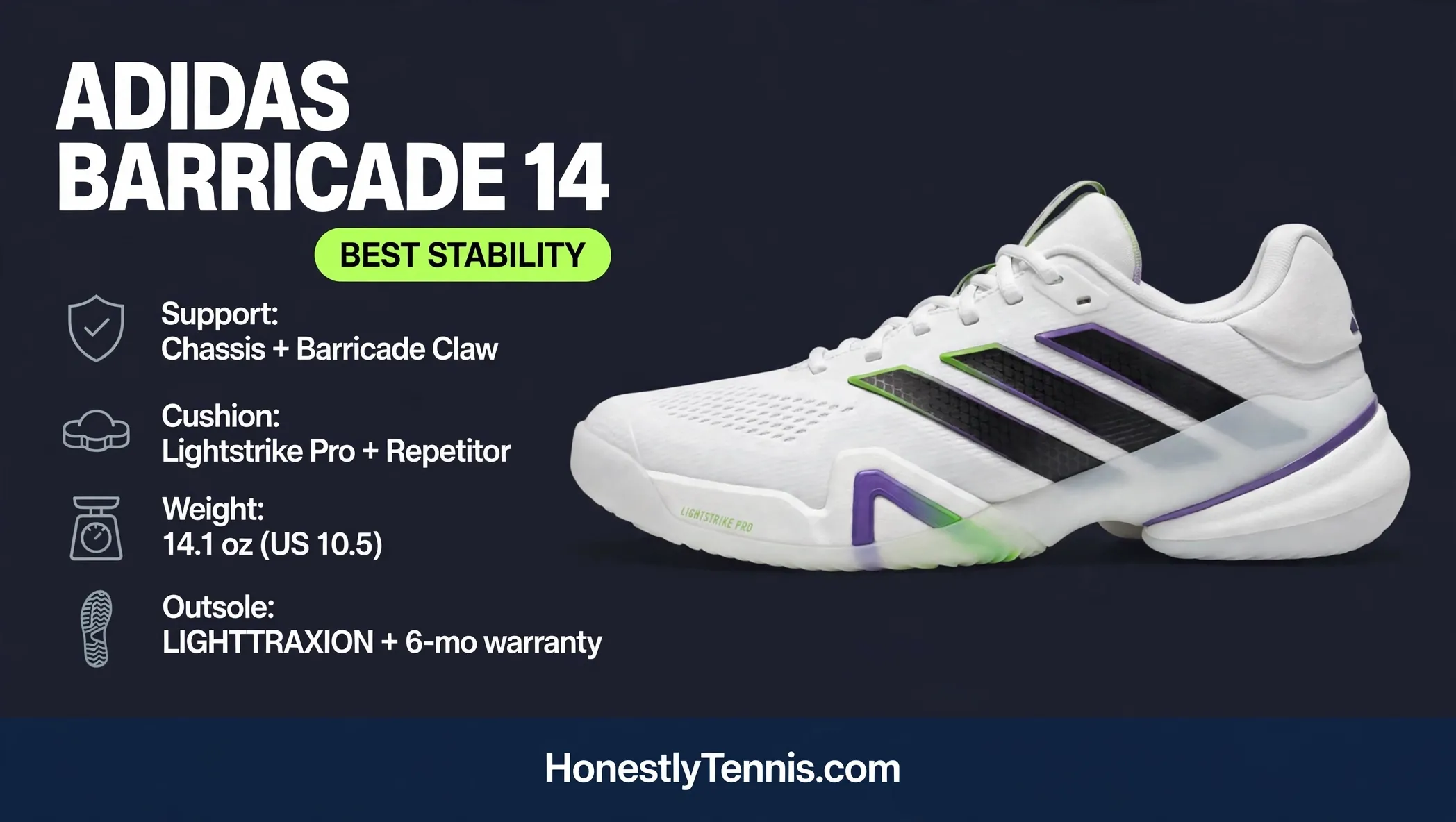
The Barricade has been the hard-court stability benchmark for years, and the 14th version is the lightest adidas has made — 14.1 oz in a men’s 10.5 — without giving up the support that puts it among the best tennis shoes for flat feet. A lightweight chassis plus the Barricade Claw locks the midfoot, Lightstrike Pro foam returns energy in the forefoot, and a Repetitor heel keeps the rearfoot soft on landing. The LIGHTTRAXION outsole grips hard and carries a six-month outsole durability guarantee. One honest note: adidas recommends sizing up half a size, and the toe box runs snug — if you are between sizes, go up half, or take the men’s 2E width instead.
- Who It’s Best For: A 4.0–4.5 hard-court player who wants stability without the weight penalty — someone who plays three times a week and wears through outsoles. The low, firm ride keeps you connected to the court.
- Who Should Skip It: A player with very wide feet who refuses to size up, or anyone who wants a soft, plush feel underfoot. The forefoot stack is low and firm by design — comfort seekers should look at the Gel-Resolution X.
K-Swiss Ultrashot 4: Best Arch Support
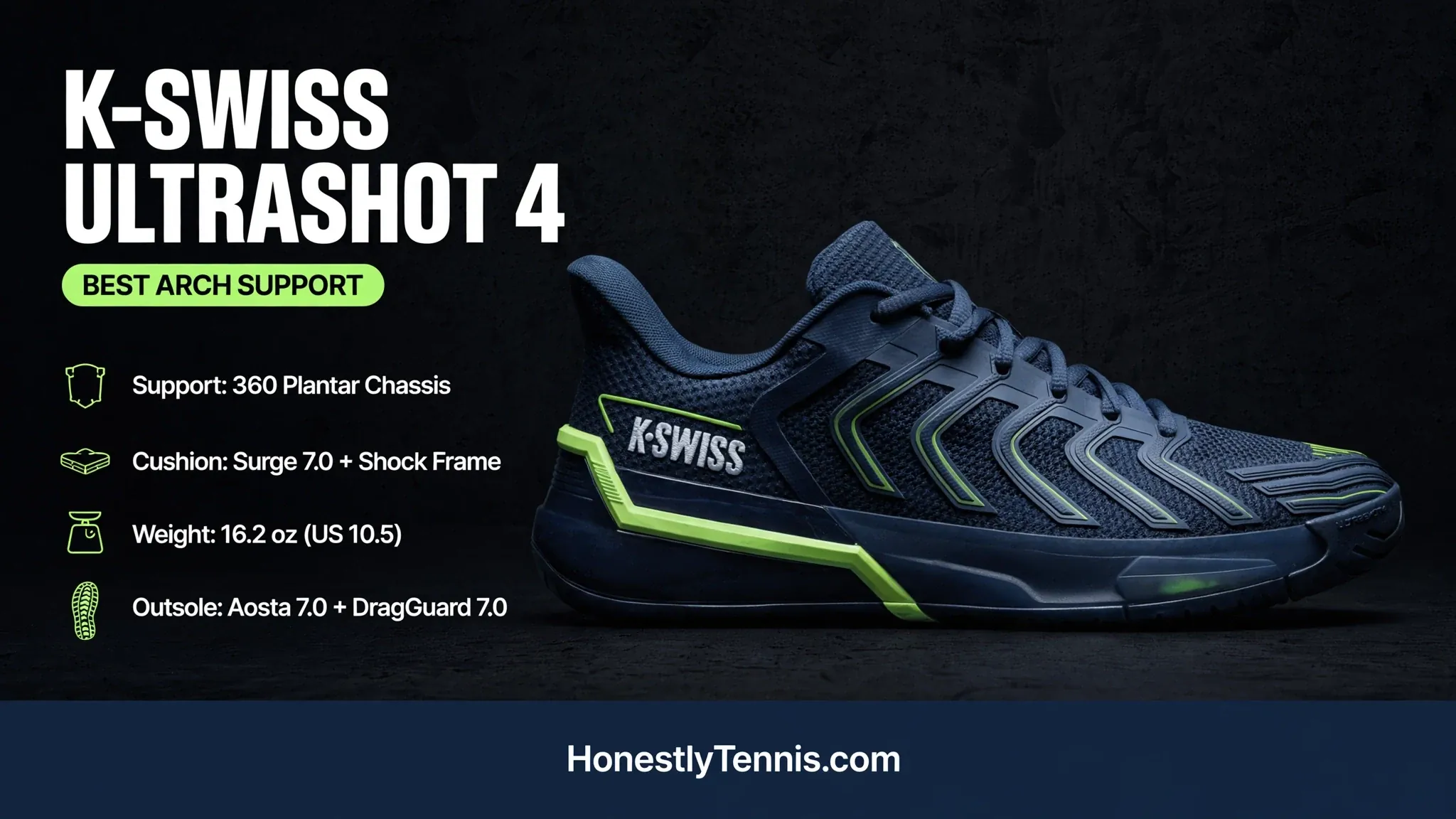
If your arch needs a cradle rather than a cushion, the Ultrashot 4 is the most complete support package here. A 360-degree Plantar Support Chassis wraps the midfoot and heel, a moulded TPU Shock Frame sits under the heel for shock absorption, and a Carbon Winglet adds lateral energy return. Surge 7.0 cushioning keeps the ride plush, and the Aosta 7.0 rubber outsole with DragGuard 7.0 in the high-wear zones carries a six-month outsole guarantee. The trade is weight: 16.2 oz in a men’s 10.5 makes it the heaviest of the best tennis shoes for flat feet, and you feel it in the third set. But for a player whose arch aches after an hour, the support is worth the grams.
- Who It’s Best For: A 3.5–4.0 club player with genuinely flat feet who plays long matches on hard courts and needs the arch held up all match. If your current shoes feel fine for 30 minutes before your arches burn, start here.
- Who Should Skip It: A fast, light-footed player who values speed over structure, or anyone who plays mostly on clay — this rubber is not built for sliding on clay. Take a lighter shoe if your arches are only mildly low.
New Balance 806 V1: Best Motion Control
The 806 V1 is the old-school answer, and for severe flat feet it is still right. A graphitic TPU post called ROLLBAR sits under the heel and controls rearfoot motion — the strongest motion-control design in this guide. A C-CAP midsole with ABZORB cushioning absorbs impact, the full-grain leather upper holds its shape, and a herringbone outsole with Ndurance rubber grips through lateral shuffles. The real reason it earns its place among the best tennis shoes for flat feet: widths. It comes in men’s B through 4E and women’s Wide on a straight last, with a deep heel cup that swallows thick custom orthotics without lifting your heel. At about 15.5 oz in a men’s 10.5 it is no featherweight, and the leather needs a break-in — but if your feet roll inward hard enough that modern mesh shoes feel like socks, this is the shoe that holds the line.
- Who It’s Best For: A club player with severely flat feet or overpronation who needs maximum rearfoot control — especially anyone who wears custom orthotics. If soft stability shoes still let your ankle collapse on hard cuts, the 806’s ROLLBAR post and 4E width fix it.
- Who Should Skip It: A player who wants a modern, breathable mesh shoe or a light feel. The leather upper runs warm and looks traditional — if your arches are only mildly flat, the Gel-Resolution X gives the same support with a more modern ride.
How to Choose the Right Pair
The four shoes above solve the same problem four ways. Here is how to pick the right pair from the best tennis shoes for flat feet — and avoid the mistakes that send players back to the shop.
Arch Support: What Actually Holds a Flat Foot
A flat foot needs structure, not softness. Look for a rigid midfoot — a TPU frame like DYNAWALL, a chassis like the Ultrashot’s 360 Plantar Support, or a post like ROLLBAR. Soft foam alone lets the arch collapse the moment you plant sideways, which is why running shoes fail on court: they are built for forward motion, not lateral stops. If you can twist the shoe like a towel, it will not hold a flat arch.
Fit & Width: Get the Right Size
Flat feet are often wide feet, and a narrow shoe flattens the arch. Three of the four picks come in wide versions — the Gel-Resolution X in men’s 2E, the Barricade 14 in men’s 2E, and the 806 V1 all the way to 4E. Try shoes on with the socks and orthotic you play in, and leave a thumb’s width at the toe. Between sizes, size up — a cramped shoe undoes the support you just paid for. Our guide to the best tennis shoes for wide feet covers the width question in full.
Hard-Court Outsole & the 6-Month Warranty
Hard courts eat soft rubber. Look for a durable rubber outsole in a herringbone pattern — the hard-court standard — and check the warranty: the Barricade 14 and Ultrashot 4 both carry a six-month outsole guarantee, covering the rubber wearing through to the midsole. Clay is a different job and needs a full herringbone outsole, so do not wear a hard-court shoe on clay and expect it to grip. Our best tennis shoes for hard courts and most durable tennis shoes for hard courts guides compare the outsole options head to head.
When to Replace Your Shoes
A stability shoe stops being stable before it looks worn out. Replace the best tennis shoes for flat feet when the herringbone is smooth under the ball of the foot, when the heel counter bends easily in your hand, or when the midsole feels dead on landing — for most club players, that is a season of regular play. Playing on in a dead shoe is how flat feet turn into sore knees, so check the outsole every few weeks and retire the pair when the grip is gone.
Final Verdict
The best tennis shoes for flat feet on hard courts have a rigid midfoot and a wide, stable base — and the ASICS Gel-Resolution X does that job best for most players. Want the same stability lighter? Take the Barricade 14. Arch aching after an hour? The Ultrashot 4’s full chassis is the answer. If your feet roll inward hard or you wear custom orthotics, the New Balance 806 V1 is the motion-control workhorse that holds the line. Buy the structure first and the cushioning second — your arches will thank you by the third set.
FAQ
Can I play tennis with flat feet without pain?
Yes — with the right shoe. The best tennis shoes for flat feet have a rigid midfoot that keeps the arch from collapsing on hard cuts, where most flat-foot pain starts. Pair it with the right fit and replace it when the support dies. If pain persists, see a podiatrist — this guide covers gear, not medical advice.
Do I need custom orthotics with these shoes?
Not necessarily — most flat-footed players do fine with a structured shoe alone. But if you already wear custom orthotics, the New Balance 806 V1 fits best: its deep heel cup swallows thick orthotics without lifting your heel. For the other three, check that the insole comes out cleanly first.
Can I wear running shoes for tennis if I have flat feet?
No — and flat feet make it worse. Running shoes are built for forward motion: soft heels, narrow bases, no lateral support. On court, the first hard sideways stop rolls a flat arch inward with nothing to catch it, and the soft outsole wears smooth within weeks. A tennis shoe’s lateral support and durable rubber exist for this job.


Hi, I’m Coach Mitchell. With over a decade of experience on the tennis court, I created Honestly Tennis to share my passion for the game. Whether you are a beginner looking for your first racquet or an advanced player wanting to upgrade your gear, my goal is to provide honest reviews and helpful guides to elevate your game.