Disclosure: At Honestly Tennis, we independently test gear. As an Amazon Associate, we earn from qualifying purchases at no extra cost to you.
Wilson Clash 100 V2
Exact Product Name: Wilson Clash 100 V2
If you only read one review on this page, read this one, because this is the frame I hand to students when their arm is screaming and they refuse to stop playing (they always refuse).
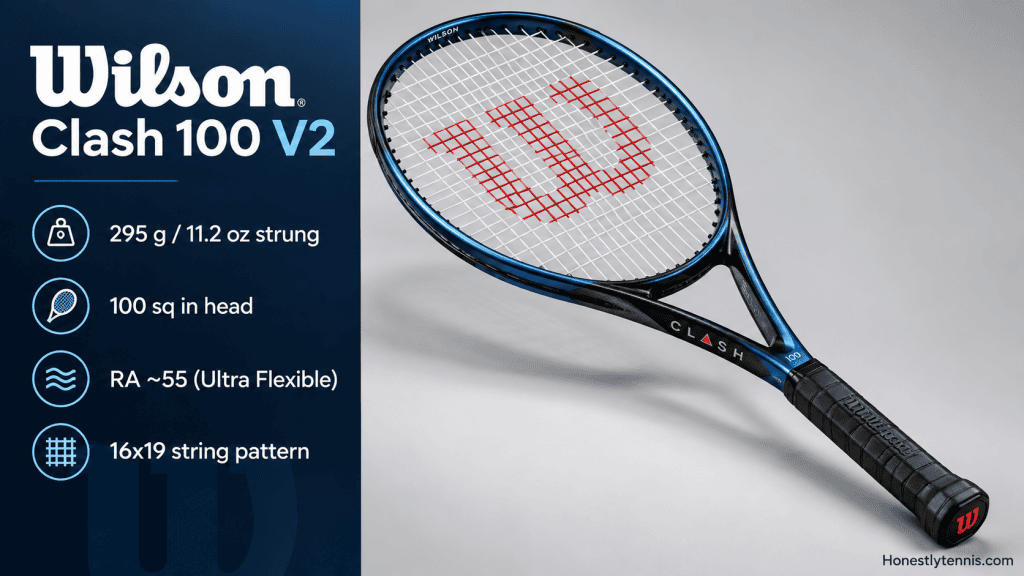
The Clash 100 V2 is built around Wilson’s Freebend technology — the hoop and shaft are designed to flex in opposite directions on impact. What does that actually mean on court? It means the frame absorbs a huge chunk of the shock wave that normally travels straight down your forearm and into that tendon that’s already angry at you. The RA stiffness rating sits around 55, which is about as flexible as modern rackets get. For comparison, plenty of “players’ rackets” out there are in the mid-60s to low 70s — and those are the ones ruining arms at clubs all over the country.
The On-Court Reality: The first thing you notice is the sound. A stiff racket cracks; the Clash goes thud — a dull, muted thwack that sounds like the ball landed in a pillow. My student Diane, 54, couldn’t hold a coffee cup without wincing after her Tuesday doubles nights. Six weeks on the Clash with multifilament strings, she’s playing three sets and gripping her mug like a normal human again. That’s not marketing. That’s her telling me at the fence, grinning.
The arm felt fine after two-hour sessions — no ice, no sleeve, no whining. The V2 also fixed the biggest complaint about the original: stability. The V1 Clash twisted on off-center hits like a wet noodle; the V2 added some structure and it’s noticeably more solid without giving up the flex.
Now, the honesty part. This racket is not powerful. If you have a short, compact swing and you’re used to an ultra-light pre-strung stick from a big-box store, the Clash will feel like you’re hitting with a damp towel. You’ll need to supply your own pace. And the flex, that beautiful arm-saving flex, makes the hoop feel a touch unpredictable on hard flat serves — you get used to it, but the first week you’ll spray a few.
Who Should Buy It:
- Players with active tennis elbow who refuse to take six weeks off (again)
- Intermediate players, 3.0–4.5, with full-ish swings who want comfort plus control
- Anyone whose current frame has an RA over 65 — this is your replacement
Who Should Avoid It:
- Beginners needing free power
- Flat hitters who want a laser serve without working for it
- Players who like a crisp, connected feel — this is plush bordering on soft
Key Specs Breakdown:
- Weight: 11.2 oz strung (295 g unstrung)
- Head size: 100 sq in
- RA stiffness: ~55 (very flexible)
- Balance: 7 pts head light
- String pattern: 16×19
What I Loved / What Drove Me Crazy:
- ✅ The most arm-friendly mainstream frame Wilson has ever made, full stop
- ✅ Surprisingly good spin once you commit to the swing
- ✅ V2 stability fixes — off-center hits don’t twist anymore
- ❌ Low power — you swing big or you hit short
- ❌ The mushy response annoys crisp-feel purists
- ❌ Priced like a premium racket, because it is one
Yonex EZONE 100 L
Exact Product Name: Yonex EZONE 100 L
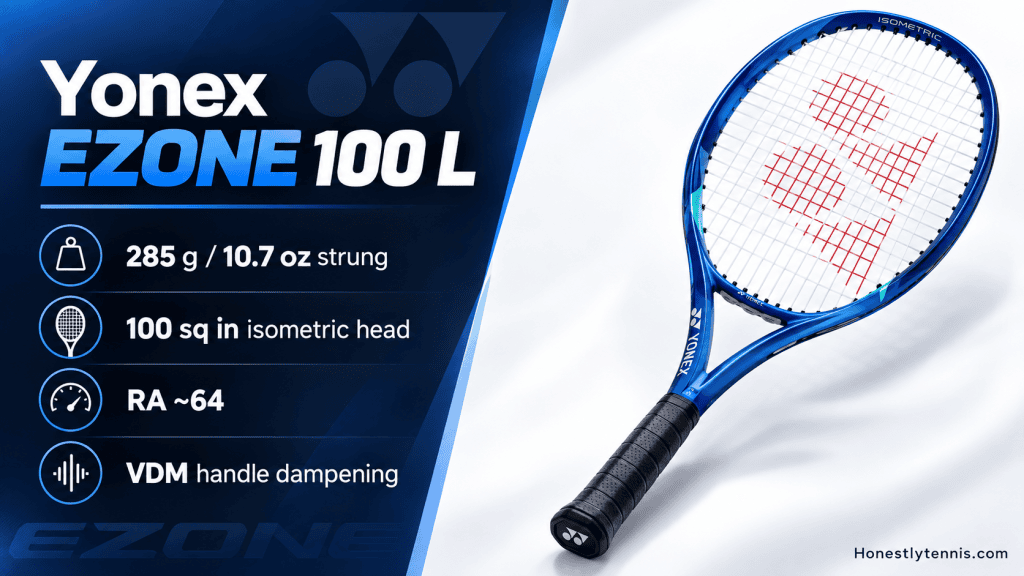
Yonex quietly makes some of the most comfortable rackets on the market and nobody talks about it enough. The EZONE line uses Vibration Dampening Mesh built into the handle — a stretchy mesh layer inside the grip that soaks up high-frequency vibration before it ever reaches your hand. On paper it sounds like a gimmick. In your palm, it’s the difference between a zing and a thud.
The “L” here is the Light version — 10.7 oz strung, about a half-ounce under the standard EZONE 100. The RA is around 64, so it’s stiffer than the Clash, but the combination of the isometric head shape, the dampening mesh, and the lower static weight makes it the pick for older players or anyone whose arm complains specifically about swing weight and effort, not just stiffness.
The On-Court Reality: This is the racket that surprised me most. It’s got noticeably more free power than the Clash — the slightly stiffer frame and the aerodynamic frame shape (Yonex’s isometric head really does help on serves) means easy depth on balls you barely swing at. For a 60-something club player with a shortened swing, that matters more than any spec sheet.
One of my test players, Bob — 67, two shoulder surgeries, elbow that sounds like a bowl of Rice Krispies — hit with the EZONE 100 L for a month and asked me where he could buy one before he’d even returned my demo. His exact words: “It’s the first racket in years that didn’t make my elbow throb on the drive home.”
The honest downside: at this weight, against bigger hitters, the racket gets pushed around. If your 4.5-level opponent is pounding serves at you, the L version plows through fewer balls than the standard EZONE. And the stiffer frame means it’s slightly less forgiving than the Clash on truly bad-contact days — comfortable, but not plush.
Who Should Buy It:
- Older players or anyone with a slower, compact swing
- Players with joint pain (arthritis plus tennis elbow is a brutal combo — this helps)
- Doubles specialists who want easy volleys and maneuverability at net
Who Should Avoid It:
- Strong players who need plow-through against heavy pace
- Anyone who wants maximum dampening above all — the Clash is plusher
- Big servers chasing free mph from the frame
Key Specs Breakdown:
- Weight: 10.7 oz strung (285 g unstrung)
- Head size: 100 sq in (isometric)
- RA stiffness: ~64
- Balance: 8 pts head light
- String pattern: 16×19
What I Loved / What Drove Me Crazy:
- ✅ The handle dampening mesh is legit — hand buzz is basically gone
- ✅ Free power without a stiff-beam punishment
- ✅ Light enough for arthritic hands and two-hour sessions
- ❌ Gets overpowered by heavy hitters
- ❌ Slightly stiffer feel than the Clash on mis-hits
- ❌ Yonex grip shapes are a little different — demo it first if you’re picky
ProKennex Ki Black Ace
Exact Product Name: ProKennex Ki Black Ace
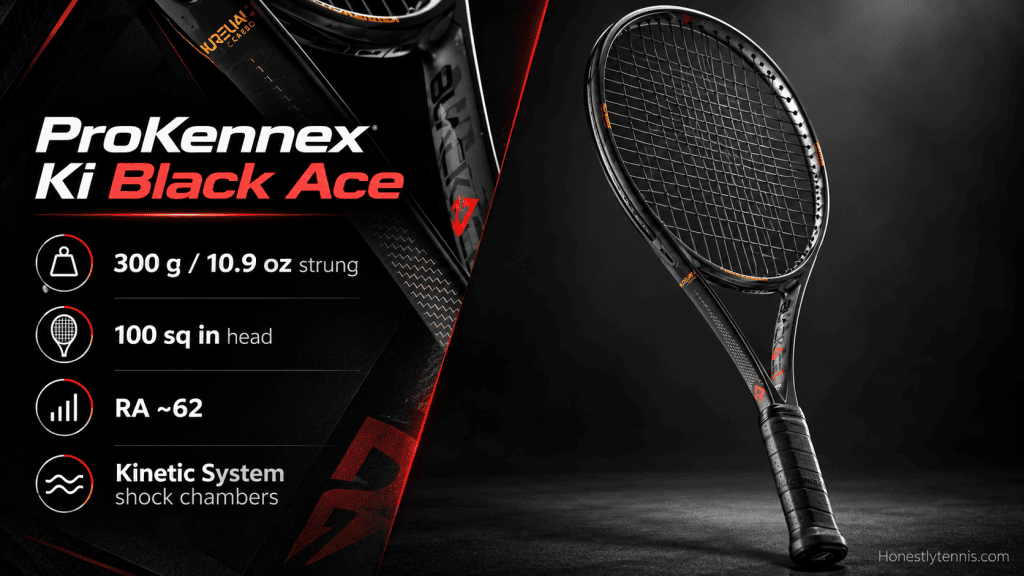
Nobody puts ProKennex on their list. I’m putting ProKennex on my list. This is the brand that has spent decades building rackets around one obsessive idea: kinetic energy management. The Kinetic System puts small tungsten-filled chambers in the hoop and throat that absorb and redistribute impact shock — it’s the most deliberate anti-vibration engineering in tennis, and it works.
The Ki Black Ace is their modern player’s racket with the full Kinetic treatment, coming in around 10.9 oz strung and an RA in the low 60s. Here’s the thing though — ProKennex claims their rackets reduce shock by a meaningful percentage versus comparable frames, and in my completely unscientific but very sore-forearm-informed opinion, they’re right. This racket plays like it has a shock absorber where other rackets have a stiff spine.
The On-Court Reality: My most important test case was a student, Marcus, 48, who had actual diagnosed lateral epicondylitis — not the “my elbow kind of hurts” version, the cortisone-shot version. His physio cleared him to hit gently. We started him on the Ki Black Ace with a multi at 48 pounds, half-court only. He’s now playing full sets. He’s tried the Clash and the Gravity since, and he still reaches for the Black Ace. His description: “It feels like the racket catches the punch before it gets to me.”
It plays like a proper player’s frame too — decent control, good spin potential, more precision than the EZONE. The Kinetic chambers give the hoop a slightly different, heavier feel at contact that takes a session or two to trust. Then it clicks.
The brutal honesty: ProKennex has all the marketing budget of a lemonade stand. You won’t see it in every club, stringing machines aren’t calibrated for it (kidding — mostly), and resale value is weak. Also, the racket runs a touch head-heavy for a “player’s” frame, and precision players will find the response slightly diffused rather than laser-crisp. And availability can be spotty — when you find one in your grip size, seriously consider buying it.
Who Should Buy It:
- Players in genuine injury recovery who need maximum shock reduction
- 3.5–4.5 players who still want a real player’s racket feel
- Anyone who’s tried the mainstream “comfort” frames and still hurts
Who Should Avoid It:
- Players who want a crisp, direct, Federer-style response
- People who care about brand clout at the club (it’s fine, nobody’s watching)
- Beginners — this is not a starter racket
Key Specs Breakdown:
- Weight: 10.9 oz strung (300 g unstrung)
- Head size: 100 sq in
- RA stiffness: ~62
- Kinetic System shock chambers in hoop/throat
- String pattern: 16×19
What I Loved / What Drove Me Crazy:
- ✅ Best shock absorption technology in the sport, period
- ✅ Still plays like a serious racket — comfort without mush
- ✅ The racket I recommend to friends with real diagnoses
- ❌ Hard to find in stores, weak resale, zero marketing hype
- ❌ Slightly diffused response on precise targets
- ❌ Feel takes a few sessions to get used to
Head Gravity MP
Exact Product Name: Head Gravity MP
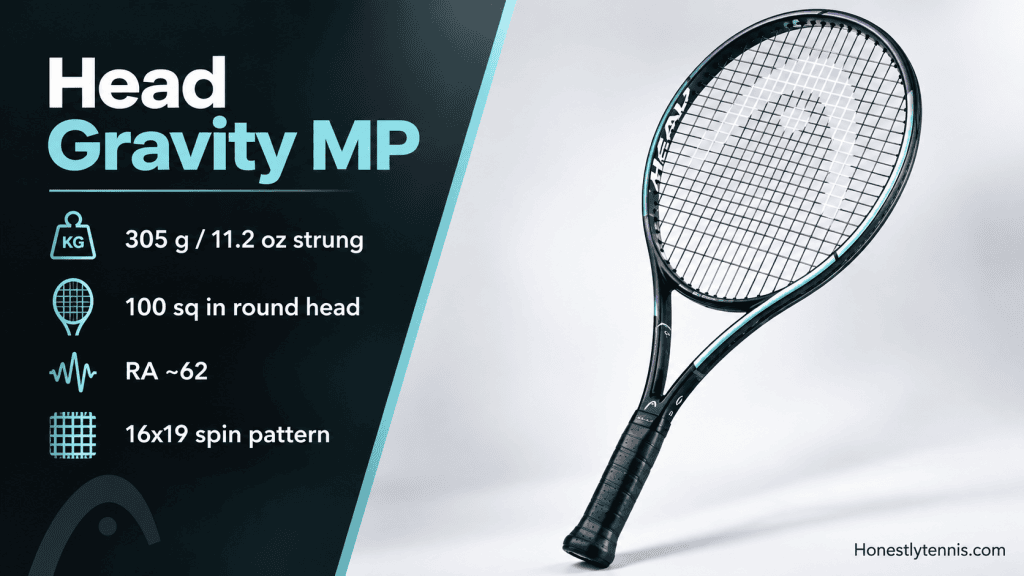
The Gravity MP is the “feel” pick of this list, and I mean that as a real compliment, not a consolation prize. Head built this line around a huge, round head shape and an auxiliary head-balance philosophy that gives it a uniquely soft, connected response. The RA sits around 62 — stiffer than the Clash, softer than most player’s rackets — and the sound at contact is that lovely low, dampened thwack that makes you want to hit for hours.
This is the racket for the player whose arm hurts but whose game would fall apart if the racket felt like a sponge. There are a lot of you. You still want to feel the ball, shape shots, drop shot, wrong-foot your opponent with a slice — and comfort rackets usually take that away from you. The Gravity MP mostly doesn’t.
The On-Court Reality: The oversized head (it plays bigger than its 100 square inches suggest) gives you a wider sweet spot, and a bigger sweet spot means fewer off-center shocks — which, if you think about it, is arm protection from a completely different angle. My testing partner Priya, 51, recovering from elbow tendinopathy, put it best: “The Clash forgives my arm. The Gravity forgives my misses.”
After two-hour sessions the arm status was good — not quite Clash-level numb-free, but close, and noticeably better than any standard player’s racket. Where it beats the Clash is on touch shots and spin: that 16×19 pattern with the round head scoops up crazy spin, and volleys feel plug-like and stable.
What drove me crazy: the flip side of all that feel is a slightly lower power ceiling than the EZONE, and the 2023+ cosmetic is, in my opinion, loud in the wrong way (the racket plays better than it looks — a rare problem, but real). Also, it punishes lazy footwork less than a true player’s frame, which means some players get comfortable hitting flat and late and never develop. Not my problem, you say. It becomes my problem when you ask me why your slice floats.
Who Should Buy It:
- Feel-oriented all-court players whose arms can’t tolerate a standard MP
- Spin and touch players recovering from elbow issues
- Players who found the Clash too muted and mushy
Who Should Avoid It:
- Big power baseliners — you’ll want more plow
- Players who need maximum dampening above everything (Clash or Black Ace)
- Anyone who hates a large, round head look at address
Key Specs Breakdown:
- Weight: 11.2 oz strung (305 g unstrung)
- Head size: 100 sq in (round, oversized feel)
- RA stiffness: ~62
- Balance: 7 pts head light
- String pattern: 16×19
What I Loved / What Drove Me Crazy:
- ✅ Best combination of comfort and genuine feel on this list
- ✅ Huge sweet spot = fewer painful mis-hits
- ✅ Spin and touch for days
- ❌ Not enough power for lazy swings
- ❌ Slightly more sting than the Clash on cold-day mis-hits
- ❌ The cosmetics — look, it’s a lot
Volkl V1 Classic
Exact Product Name: Volkl V1 Classic
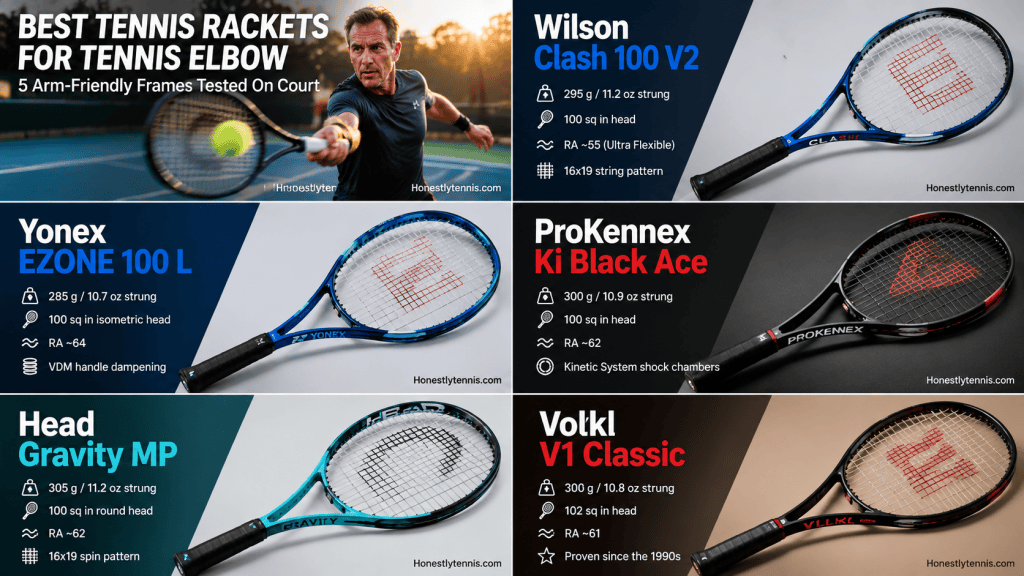
Some of you don’t want technology. You want the racket that felt right in 1998 and still feels right today. Enter the Volkl V1 Classic — a frame that has survived essentially unchanged for nearly three decades because it got the formula right the first time: medium-flex (RA around 61), moderate weight (10.8 oz strung), balanced response, and Volkl’s long-running handle damping system that makes every hit feel rounded and quiet.
This is the “grandpa racket” only in the sense that grandpas are frequently correct about things. It’s one of the original arm-friendly rackets, long before “arm-friendly” became a marketing category, and it’s still a genuinely comfortable choice for joint pain today.
The On-Court Reality: There are no surprises here, and that’s the entire point. The V1 Classic does everything at about 85%. Comfort: 85% of the Clash. Power: 85% of the EZONE. Control: 85% of the Gravity. But the sum is greater than the parts — it’s the easiest racket on this list to pick up and play well with immediately, because nothing about it is extreme.
My old doubles partner Gene, 71, has played with Volkl V1s since the Clinton administration. He’s outlived three elbow “cures” I’ve suggested and four of my racket recommendations, and he’ll happily tell you why: “It doesn’t fight me.” After my sessions with it, my forearm felt fine — not as pampered as with the Clash, but zero complaints, and this was strung with a multi at 54.
Honesty time: it’s dated. The look is a decade (or three) behind, it’s not sold everywhere, and if you’re a modern spin-heavy baseline player, you’ll find the 16×19-ish response a bit muted on heavy topspin drives. It also lacks the headline tech that gives younger players confidence (even though — parenthetical opinion — most of that tech matters less than strings and stiffness anyway).
Who Should Buy It:
- Long-time club players upgrading from an old comfortable frame
- Players who value consistency and predictability over specs
- Anyone 55+ who wants one racket to last a decade
Who Should Avoid It:
- Modern spin-generators chasing maximum RPMs
- Players who want the newest, flashiest technology
- Big hitters who need a high-power baseline weapon
Key Specs Breakdown:
- Weight: 10.8 oz strung (300 g unstrung)
- Head size: 102 sq in
- RA stiffness: ~61
- Balance: slightly head light
- String pattern: 16×19
What I Loved / What Drove Me Crazy:
- ✅ Proven comfortable for nearly 30 years — that’s a real track record
- ✅ Predictable, forgiving, easy to play with from day one
- ✅ Often priced below the premium hype frames
- ❌ Dated look and feel
- ❌ Muted spin response for modern topspin games
- ❌ Limited availability in some markets

Hi, I’m Coach Mitchell. With over a decade of experience on the tennis court, I created Honestly Tennis to share my passion for the game. Whether you are a beginner looking for your first racquet or an advanced player wanting to upgrade your gear, my goal is to provide honest reviews and helpful guides to elevate your game.