Disclosure: At Honestly Tennis, we independently test gear. As an Amazon Associate, we earn from qualifying purchases at no extra cost to you.
Tennis may at first appear confusing, especially due to its unique scoring system. Unlike most sports that use sequential numbers, tennis employs terms such as love, 15, 30, 40, deuce, and advantage.
Once you understand the fundamental rules, tennis becomes easier to follow and more enjoyable. The game is played by two players in singles or four players in doubles. The main goal is to hit the ball over the net and into the designated area of the court, making it difficult for your opponent to return the ball within the rules.
This guide introduces the basic rules of tennis, including the scoring system, serving procedures, and the criteria for winning points, games, sets, and matches.
What Is Tennis?
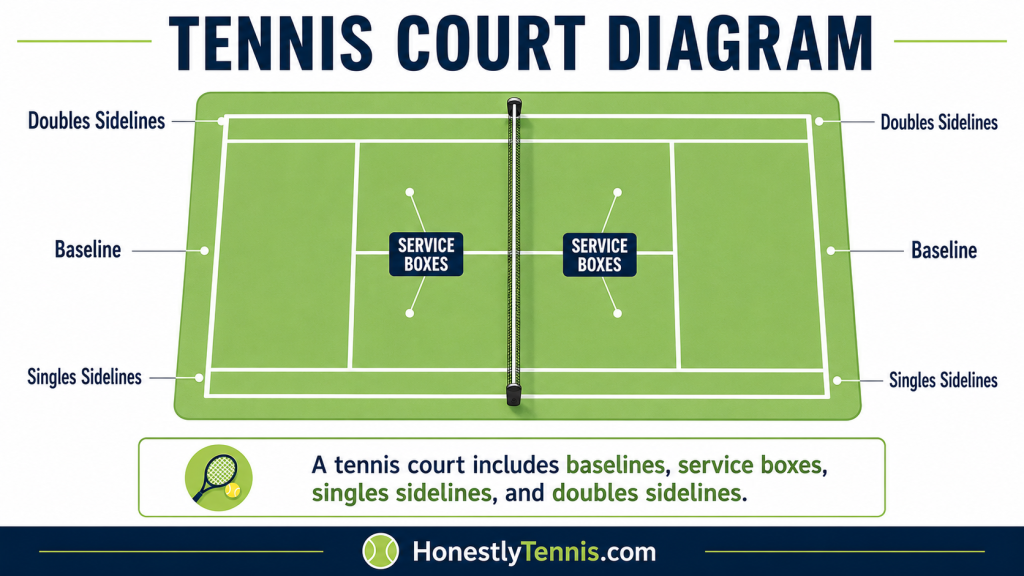
Tennis is a racquet sport played on a rectangular court. Players stand on opposite sides of a net and hit the ball back and forth using tennis racquets.
Tennis can be played in two main formats:
Singles: one player against one player
Doubles: two players against two players
The court is wider for doubles than it is for singles. In both formats, the basic goal is the same: hit the ball over the net and keep it inside the correct court area.
Once beginners understand the basic rules and scoring system, the next step is choosing equipment that matches their skill level. A suitable racquet can make learning easier and help new players develop better control. If you are looking for your first racquet, check our guide to the best tennis racquets for beginners before making a decision.
How Does a Tennis Match Start?
Before a tennis match begins, the players usually decide who serves first by a coin toss or racquet spin.
The winner may choose to:
Serve first
Receive first
Choose a side of the court
Let the opponent choose first
After this, the match begins with the first serve.
How Tennis Scoring Works
Tennis scoring has four main levels:
Point
Game
Set
Match
A player wins points to win a game.
A player wins games to win a set.
A player wins sets to win the match.
Although this structure may seem complex at first, it becomes straightforward once each part is understood.
Point Scoring in Tennis
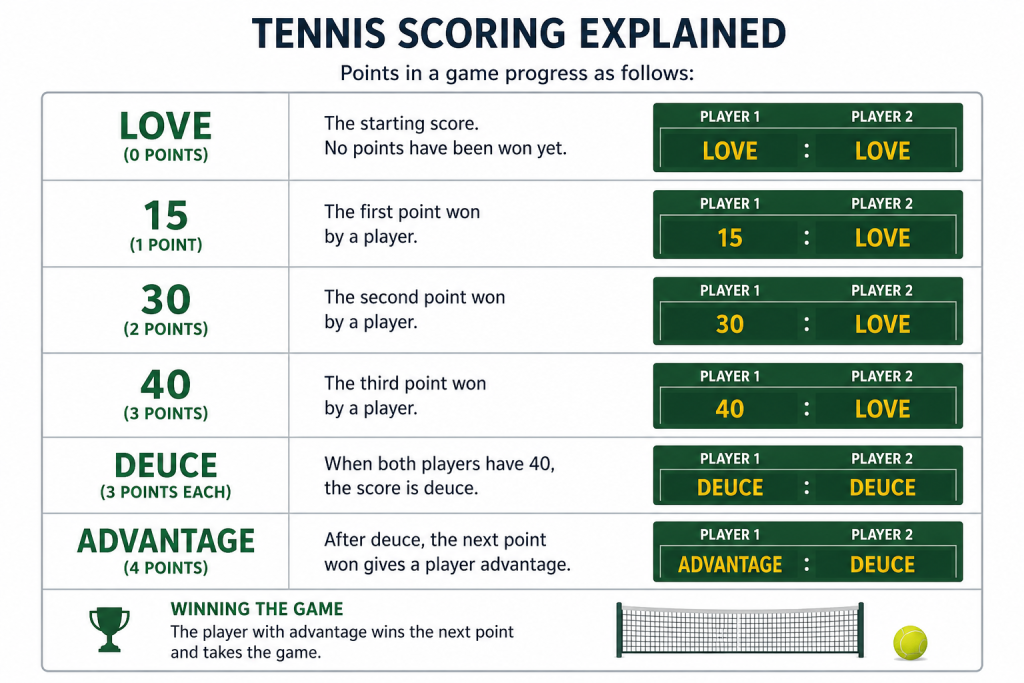
A tennis game is scored like this:
0 points = Love
1 point = 15
2 points = 30
3 points = 40
4 points = Game
For example, if the server has won two points and the receiver has won one point, the score is announced as 30-15.
The server’s score is always called first.
What Does Deuce Mean in Tennis?
If both players reach 40-40, the score is called deuce.
From deuce, a player must win two points in a row to win the game.
If a player wins the first point after deuce, they get an advantage. If they win the next point too, they win the game. If they lose the next point, the score goes back to deuce.
How to Win a Game
To win a game, a player usually needs to win at least four points and be ahead by two points.
For example, a player can win a game with scores such as:
40-0
40-15
40-30
But if the score reaches deuce, the player must win two points in a row.
How to Win a Set
A player usually wins a set by winning six games with at least a two-game lead.
Examples:
6-0
6-2
6-3
6-4
7-5
If the score reaches 6-6, many matches use a tie-break to decide the set.
What Is a Tie-Break?
A tie-break is usually played when the set score reaches 6-6.
In a standard tie-break, the first player to reach seven points wins, but they must win by at least two points.
For example:
7-4 wins the tie-break
7-5 wins the tie-break
8-6 wins the tie-break
10-8 wins the tie-break
Tie-break rules may vary depending on the tournament or match format, so check the specific rules before participating.
Most tennis matches are played as best of three sets. This means the first player to win two sets wins the match.
Some professional men’s matches are played as best of five sets. In that format, the first player to win three sets wins the match.
Basic Serving Rules
The server starts each point.
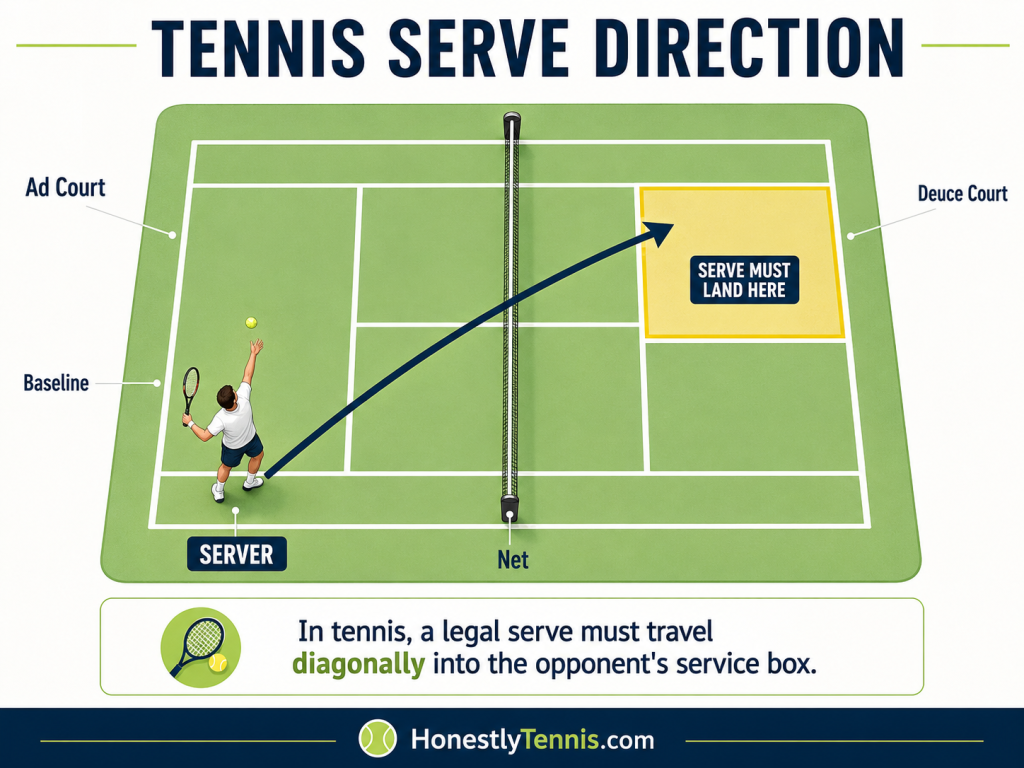
The server must stand behind the baseline and serve the ball diagonally into the opposite service box.
The server starts from the right side of the court. After each point, the server switches sides.
A legal serve must:
Go over the net
Land in the correct diagonal service box
Be hit before the ball touches the ground
Be served from behind the baseline
How Many Serves Do You Get?
The server gets two chances to make a legal serve.
If the first serve is missed, it is called a fault. The server then gets a second serve.
If the second serve also misses, it is called a double fault. When this happens, the opponent wins the point.
What Is a Foot Fault?
A foot fault happens when the server breaks the serving position rules.
For example, the server may commit a foot fault if they step on or over the baseline before hitting the ball.
To avoid a foot fault, the server should stay behind the baseline until the serve is made.
What Is a Let Serve?
A let serve usually happens when the served ball touches the net but still lands in the correct service box.
When this happens, the serve is replayed.
A let does not count as a fault if the ball lands in the correct service box.
Rally Rules in Tennis
After the serve is returned, the point continues as a rally.
During a rally, each player must hit the ball over the net and into the correct court area.
A player can hit the ball after one bounce, or they can hit it before it bounces. Hitting the ball before it bounces is called a volley.
A player loses the point if they:
Hit the ball into the net
Hit the ball outside the court
Let the ball bounce twice
Touch the net while the ball is in play
Hit the ball before it crosses the net
Commit a double fault while serving
Apart from learning the rules and techniques, small equipment choices can also improve your comfort on the court. Your grip affects how confidently you hold and control the racquet, especially during longer sessions. Learn more about choosing the best tennis racket grip tape to improve comfort and handling.
Is the Ball In or Out?
If the ball touches any part of the line, it is considered in.
This is one of the most important tennis rules for beginners. A ball does not need to land fully inside the court. If it touches the line, it is still in.
Singles vs Doubles Rules
Singles tennis is played with one player on each side. Doubles tennis is played with two players on each side.
In doubles, the wider part of the court is used. This gives players more space to hit the ball.
The serving order in doubles rotates among all four players. One player serves for an entire game, then the serve moves to the opposing team in the next game.
When Do Players Change Sides?
Players change sides after the first game, the third game, and every odd-numbered game after that.
During a tie-break, players usually change sides after every six points.
Changing sides maintains fairness in the match, particularly when environmental aspects such as wind, sunlight, or court conditions unequally affect one side.
Common Beginner Mistakes in Tennis
One common mistake is thinking the ball is out when it touches the line. If the ball touches the line, it is in.
One more mistake is forgetting that the server gets two serves. A missed first serve does not automatically lose the point.
Many beginners also forget that the server’s score is always called first. If you are serving and the score is 30-15, that means you have 30, and your opponent has 15.
Final Verdict
Although the rules of tennis may at first appear complex, the fundamental concepts are straightforward to learn.
To play tennis properly, you need to understand how points, games, sets, and matches work. You also need to know the basic serving rules, rally rules, and when a ball is considered in or out.
Once these rules are understood, tennis becomes significantly easier to play, observe, and appreciate.
FAQs
What are the basic rules of tennis?
The basic rules of tennis are to serve the ball diagonally into the correct service box, return the ball over the net, keep the ball inside the court, and return it before it bounces twice.
How does scoring work in tennis?
Tennis scoring goes love, 15, 30, 40, and game. If both players reach 40, the score is called deuce. From deuce, a player must win two points in a row to win the game.
How many serves do you get in tennis?
A player gets two serves. If the first serve misses, the player gets a second serve. If both serves miss, it is a double fault, and the opponent wins the point.
Is the ball in if it touches the line?
Yes. If the ball touches any part of the line, it is considered in.
What is a tie-break in tennis?
A tie-break is used to decide a set when the score reaches 6-6. In a standard tie-break, the first player to reach seven points wins, but they must win by two points.
What is a foot fault in tennis?
A foot fault happens when the server steps on or over the baseline before hitting the serve.
Can tennis be played indoors and outdoors?
Yes. Tennis can be played indoors or outdoors. The basic rules stay the same.


Hi, I’m Coach Mitchell. With over a decade of experience on the tennis court, I created Honestly Tennis to share my passion for the game. Whether you are a beginner looking for your first racquet or an advanced player wanting to upgrade your gear, my goal is to provide honest reviews and helpful guides to elevate your game.