

Before we dive deep into this Prince Ripstick 100 review, let me get one thing out of the way — this is the most polarizing racquet I’ve had on my court this year. Half my club thinks it’s ugly as sin. The other half has already ordered one. And after 20+ hours of hitting with it (and watching a lot of other people hit with it), I get why nobody’s neutral about this thing. It’s an arm-friendly power racquet with one of the wildest paint jobs ever put on a graphite frame, and Prince has basically bet the whole design on one technology: those strange holes in the hoop.
Here’s my promise to you: I’m going to tell you exactly who this racquet is for, who it’ll frustrate, and whether that whooshing sound those O-ports make is worth $200 of your money. No marketing fluff. I don’t get paid by Prince, and I’ve broken enough demo racquets to know that “free power” usually means “free pain” — unless a frame is built right.
The 30-Second Verdict
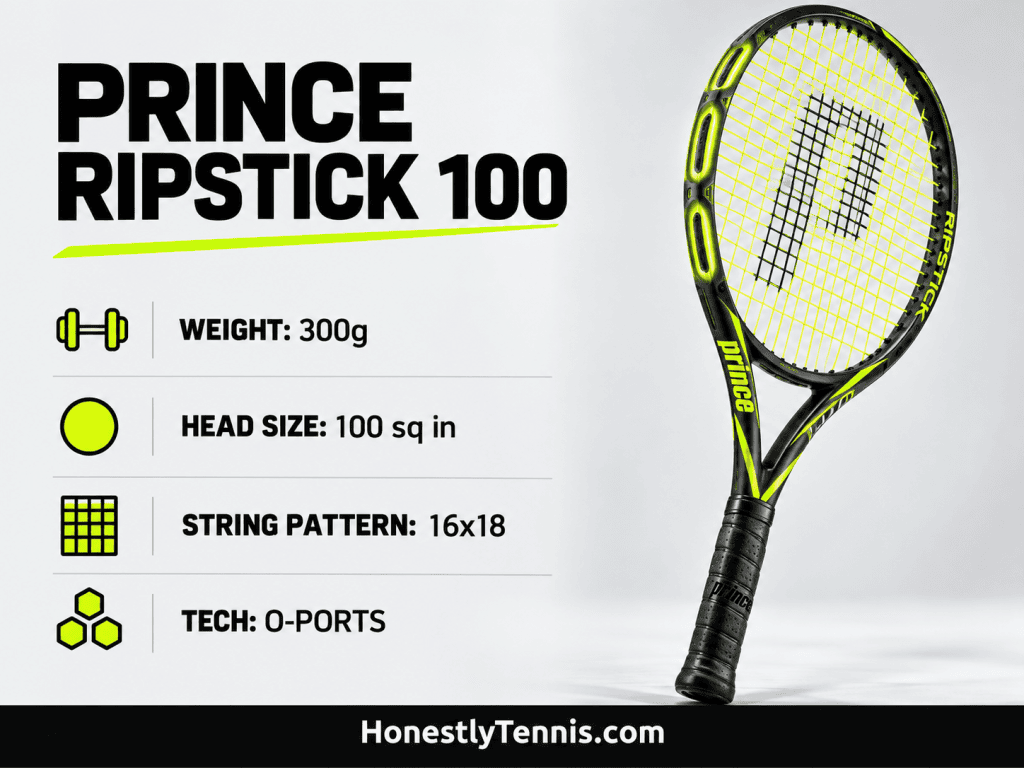
Spec | Detail |
Unstrung Weight | 300g |
Head Size | 100 sq in |
String Pattern | 16×18 (open) |
Balance | ~32.5cm (slightly head-light) |
Swingweight | Moderate |
Price Range | Value / mid-range |
Bottom line: if you’re an intermediate club player who wants big, easy power and spin without your elbow paying for it, this might be the best tennis racquet for intermediate players at this price — I’d say grab one. If you’re a strong 4.5+ who lives and dies on flat control and crisp feedback, you’ll probably hate it. (And yes, I’ll explain that below.)

Deep Dive: Groundstrokes & Spin
Let’s start with what this racquet actually does best, because the Ripstick 100 is built to do two things: launch the ball high and heavy, and do it without making you work like a laborer.
The power is real. I mean, it’s real real. The O-port technology removes chunks of material from around the grommet holes — the hoop has these elongated slots where solid string holes would normally be — which lets the hoop flex more freely on impact. That flex equals energy return, which equals free ball speed. On my first rally session, I hit my usual heavy topspin forehand and watched it land a solid two feet deeper than normal. My first thought wasn’t joy. It was “great, now I have to recalibrate everything.” That’s the deal with this frame: the launch angle is high, the ball jumps off the stringbed, and if your stroke shape is a little sloppy, you’re suddenly finding the back fence (or the net cord, in my case, twice — embarrassing).
The spin, though, is where it earns its money. Combine the open 16×18 pattern with that lively stringbed and you get extreme topspin without much extra effort. My topspin forehands dipped hard into the back third of the court — the kind of ball that pushes a 3.5 opponent into panic mode behind the baseline. One of my test hits was a guy at my club, a 3.5 who struggles badly with depth. I handed him the Ripstick at the end of a lesson and told him to just hit. Within ten minutes, his rally ball — usually a short floater my 12-year-old students would feast on — was consistently landing past the service line. He ordered one that night. I’m not making that up. That’s the free-depth story in one human being.
Here’s the flip side, and this is where I’m blunt: on flat shots, this racquet can get away from you. Drive a low, flat ball down the line and the same liveliness that helps your topspin rally ball turns into a trampoline. Two of my harder-hitting testers said the exact same thing: “I can’t trust it on flatties.” You learn to add a bit more shape or take a little pace off, but if you’re a flat hitter by nature, this isn’t your racquet. Don’t buy it because it’s cheap and pretty. (It’s not pretty. We’ll get there.)
Deep Dive: Serves & Returns
Serving with the Ripstick 100 is a bit like driving a powerful car with slightly vague steering.
Flat first serves are fast — faster than they have any right to be from a 300g frame. My flat serve speed was up noticeably versus my control racquet, and I hit a few in that sweet spot where the toss is decent and the ball just explodes off the bed. But precision took a hit. The high launch angle that loves your kick serve punishes your low toss laser. When I aimed tight to the T on deuce side, I had a couple sail long and wide that I’d normally make. On kick serves, though, it’s excellent. The open pattern bites the ball hard, and my second serve — the one that has to kick up over a returner’s shoulder — jumped higher off the court than usual. If you’re a spin serve player, you’ll love this. If your second serve is a flat “just get it in” push, this frame won’t fix that. (No racquet will. Take a lesson.)
Returns were the surprise of the test. I expected a 300g frame with O-ports to fold against big serving, but the moderate swingweight keeps the whip-through fast, and the free power means blocking back a 100+ mph first serve actually gets the ball deep with almost no effort. My 4.5 friend hit rockets at me during return practice, and I could redirect pace standing near the baseline without arm strain. What you give up is plow-through on heavier balls — against a big, heavy topspin ball, the frame can get pushed around a touch. Slice backhand returns also felt a little inconsistent; the lively bed can turn a defensive chip into a sail job. It’s a tradeoff, not a flaw.
Comfort & The “O-Port” Experience
Now let’s talk about the technology, in plain English, because this is the part Prince markets hardest.
The O-ports are essentially holes in the racquet’s hoop where you’d normally have solid string holes and grommets. By removing that material, the frame gets lighter and more aerodynamic in exactly the right places, and — this is the key bit — the hoop itself becomes slightly more flexible. A more flexible hoop absorbs some of the shock that would otherwise travel down your arm. So you get the power benefits of a stiffer frame with some of the vibration damping of a softer one. It’s like putting suspension on a truck: the frame stays rigid enough to hit hard but absorbs the rattle before it hits your elbow.
Does it work? For the most part, yes. My elbow felt fine through the whole test. My tennis-elbow student used it for two hours and reported no flare-up — and this is a guy who can’t get through a session with most modern stiff racquets. For anyone hunting an arm-friendly power racquet, this is one of the better ones I’ve tested at this price. I still wouldn’t call it plush — it’s muted rather than soft. Which brings me to the feel.
And the feel is where advanced players will walk away. The O-ports change the sound and the feedback of the frame in a way that takes real getting used to. When you swing, there’s this distinct airy “whoosh” from air rushing through the open ports — honestly, it sounds a little like the racquet is whistling at you. On impact, the response is dampened, almost hollow. You don’t get the crisp, connected “I know exactly where the ball is” feel of a solid-hoop frame. My 4.5 testers called it “dead” and “muffled.” I don’t fully agree — I’d say it’s quiet rather than dead — but if feel is your religion, this is a serious dealbreaker and I’d rather tell you now than have you find out from a return box.
Who Should Buy It vs. Who Should Avoid It
Buy the Prince Ripstick 100 if:
- You’re an intermediate club player (roughly 3.0–4.0) who wants more depth and spin without swinging harder
- You’re an older player or someone returning from injury who needs an arm-friendly power racquet that won’t wreck your elbow
- You struggle with depth and want free power that does the work for you
- You hit with heavy topspin and want your rally ball to jump and dip
- You’re on a budget and want big-brand tech without paying $250+
Avoid it if:
- You’re a strong 4.5+ flat hitter who needs pinpoint control — the trampoline effect will drive you nuts
- You’re a feel player who wants crisp, connected feedback on every shot
- You have a fast, compact swing and already generate plenty of your own pace (you’ll overspin and overshoot)
- You plan to add weight and customize heavily — this isn’t the platform for that project
- You have good taste in racquet graphics (more on that below)
Alternative Recommendations
If the Ripstick 100 doesn’t sound like your racquet, here’s where I’d send you instead.
Babolat Pure Aero 100 — If you liked the idea of extreme topspin but want more control and a stiffer, more connected feel, the Aero is the classic answer. It’s more expensive, stiffer on the arm, and demands a faster swing, but it rewards you with spin and precision the Ripstick can’t match. Better for solid intermediate-to-advanced players.
Wilson Clash 100 — If arm comfort was the thing pulling you toward the Ripstick, the Clash 100 is the other name in that conversation. It’s softer, more flexible, more controlled, and less powerful. You trade free power for control and plush feel. Older players and elbow-sensitive players should demo both before buying — they solve the same problem in opposite ways.
For a fuller breakdown of how these stack up against each other, check out my guide to the best tennis racquets for power and spin — I’ve hit with every frame on that list.
Is the Prince Ripstick 100 good for tennis elbow?
Mostly, yes — with a caveat. The O-port design makes the hoop more flexible, which absorbs vibration that would normally rattle your arm, and my tennis-elbow student hit for two hours without a flare-up. But "arm-friendly" isn't the same as "elbow-proof." String it with a soft multi or a low-tension poly, don't ignore the problem, and if your elbow is actively screaming, see a physio before you buy new gear.
Is the Ripstick 100 too powerful for intermediate players?
It depends entirely on your stroke. If you hit with full, loopy topspin strokes, the power is manageable and the depth is a gift. If you have a short, compact, flat swing, yes — it can be too much. The racquet rewards you for swinging big and punishes you for muscling flat shots. My advice: demo it and hit fifty flat drives. If you're sailing them long, this isn't your frame.
How does the Ripstick 100 compare to the Prince Ripstick 300g?
The 300g version is the lighter sibling — same O-port technology and 16x18 pattern in a more maneuverable package. It's better for smaller players, juniors moving up, or anyone with a slower swing who needs easier handling. The 100 is the better all-court choice for most adults, with more stability and plow-through on returns. Unless you specifically need the lighter weight, I'd go with the 100.
Final Thoughts
To wrap up this Prince Ripstick 100 review, look — I came into this test expecting a gimmick. Holes in the hoop? Sounds like something a marketing team invented after too many energy drinks. But after 20 hours, I’m a convert for a specific player: the intermediate who wants free power, big spin, and a frame that won’t punish their arm. The muted feel and the flat-shot trampoline effect are real flaws, and strong players should absolutely look elsewhere. But for everyone else? This racquet quietly solves three problems at once, and it does it at a price that doesn’t require a second mortgage. And if you can live with a paint job that half my club calls “toxic spill” and the other half calls the coolest thing they’ve seen all year — well, that’s a personality test, not a gear test.


Hi, I’m Coach Mitchell. With over a decade of experience on the tennis court, I created Honestly Tennis to share my passion for the game. Whether you are a beginner looking for your first racquet or an advanced player wanting to upgrade your gear, my goal is to provide honest reviews and helpful guides to elevate your game.