

- How We Chose
- Tennis Racket Grip Size Chart
- Method 1: Measure Your Hand With a Ruler
- Method 2: The Finger-Gap Test
- What If You Fall Between Two Sizes?
- Too Small vs Too Big: What a Wrong Grip Feels Like
- Grip Shape Matters More Than the Number
- What About a Two-Handed Backhand?
- What to Do When Your Racket Arrives
- FAQ
- Final Verdict
Your grip size is the circumference of your racket handle — the distance around it, not its length. This guide shows you how to measure tennis racket grip size in about two minutes, two ways: with a ruler, and with the finger-gap test on a racket you already hold. Measure from the bottom crease of your palm to the tip of your ring finger, and that number in inches is your size — 4 1/4 inches means L2, 4 3/8 inches means L3. Most adults land on L1 to L3, and the size matters more than most players think: a handle that’s too small makes you squeeze harder on every shot, and that extra squeezing is a straight road to wrist and elbow pain.
How We Chose
Grip size is one of those topics where every guide repeats the same two methods. We cross-checked every step of how to measure tennis racket grip size against the Tennis Warehouse learning centre, the Babolat size chart and the TennisCompanion guide, and kept only what all three agree on: the ruler method, the finger-gap test, the L0–L5 chart, and the rule that between sizes you always go smaller. No playtesting claims, no invented numbers — every figure here traces to a published size chart. For the authoritative version of both methods, see the Tennis Warehouse learning centre guide to measuring grip size.
Tennis Racket Grip Size Chart
Once you know how to measure tennis racket grip size, match your number to this chart. Sizes run in 1/8-inch steps, and the number on the handle is the circumference in inches — the European number (L0–L5) is the same size in a different label.
| US Size | Inches | EU | Millimetres | Typical Player |
|---|---|---|---|---|
| L0 | 4″ | 0 | 102 mm | Juniors and very small hands |
| L1 | 4 1/8″ | 1 | 105 mm | Smaller hands, many women |
| L2 | 4 1/4″ | 2 | 108 mm | Most women, smaller-handed men |
| L3 | 4 3/8″ | 3 | 111 mm | Most men |
| L4 | 4 1/2″ | 4 | 114 mm | Large hands |
| L5 | 4 5/8″ | 5 | 117 mm | Very large hands, rarely stocked |
Most adults land on L1 to L3. L0 shows up mostly on junior rackets, and L5 is rare enough that many shops don’t stock it. One more mix-up: grip size is the circumference of the handle, not the length of the racket — junior rackets are sized by length and age, a different chart entirely. The size is stamped on the butt cap, the plastic cap at the bottom of the handle — check there on any racket you already own.

Method 1: Measure Your Hand With a Ruler
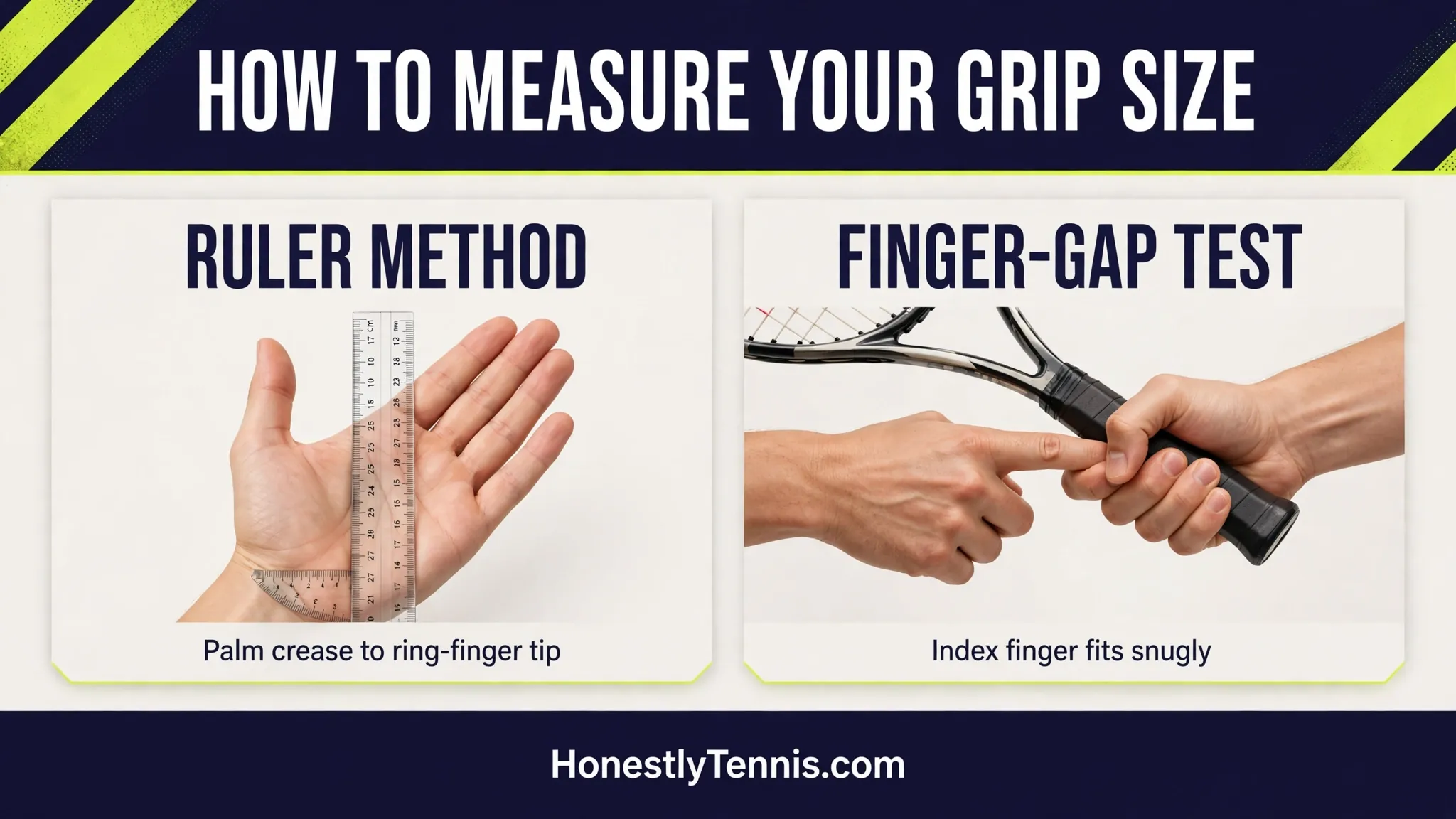
The ruler method is the most reliable way to learn how to measure tennis racket grip size when you’re buying online and can’t hold the racket first. You need one thing: a ruler or a measuring tape.
- Open your dominant hand flat, fingers together and fully extended — the hand you hold the racket with.
- Find the bottom lateral crease of your palm — the second main horizontal line down from your fingers, running across the lower middle of your palm.
- Line the bottom of the ruler up with that crease.
- Measure straight up to the tip of your ring finger — not your middle finger, not your pinky.
- Read the number in inches. That number is your grip size: 4 1/4 inches means L2, 4 3/8 inches means L3.
If you land between two sizes — say 4 5/16 inches — write the number down and read the “between sizes” section below before you order. Measure twice: hands change a little through the day.
Method 2: The Finger-Gap Test
The finger test is the second half of how to measure tennis racket grip size — it confirms what the ruler told you, on a real racket. Use it in a shop, on a demo, or on a racket you already own.
- Hold the racket in your dominant hand with an eastern forehand grip — the “handshake” grip, palm on the same bevel as the string face.
- Wrap your fingers naturally around the handle, the way you would on a forehand.
- Look at the gap between your fingertips and the heel of your palm.
- Slide the index finger of your other hand into that gap.
If your index finger fits snugly — not forced, not loose — the grip is the right size. If there’s no room for it, your fingertips digging into your palm, the grip is too small. If there’s clear space beyond a finger’s width, the grip is too big. Try both methods if you can — the ruler for buying online, the finger test for confirming in person. When they disagree by a step, trust the finger test: feel beats a number.
What If You Fall Between Two Sizes?
If you already know how to measure tennis racket grip size and your number lands between two sizes, the rule is simple: take the smaller one. A grip can be built up, but it can almost never be made smaller — and every major guide agrees on this. Here’s the fix ladder, cheapest first.
| Fix | Adds about | When to use it |
|---|---|---|
| One overgrip | 1/16 inch (half a size) | Between sizes, or you want more tack |
| Thicker replacement grip | Up to 1/8 inch (one full size) | You want a softer, bigger feel |
| Heat-shrink sleeve | 1/8 inch (one full size) | You need a permanent full step up |
| Sleeve + overgrip | 3/16 inch (about one and a half sizes) | You need more than one size |
An overgrip is the easiest fix in tennis: wrap one over the base grip and you’ve added about half a size — our guide to the best tennis overgrips for sweaty hands covers the tacky and absorbent options if your hands sweat. A thicker replacement grip does the same job with more cushion — see the best tennis racket grip tape guide. A heat-shrink sleeve is the permanent route: your stringer fits it under the grip and it adds a full size. Going the other way — shrinking a grip that’s too big — means stripping the base grip down to the bare handle or shaving foam, a job for a pro shop. That’s why smaller is the safe choice.
Too Small vs Too Big: What a Wrong Grip Feels Like
The whole point of learning how to measure tennis racket grip size is avoiding this section — but if your arm already hurts, the grip is one of the first things to check.
| Too small | Too big | |
|---|---|---|
| Feel | Handle twists in your hand; you squeeze to hold on | Can’t close your hand; wrist feels locked |
| Forehand | Over-rotation, shots spraying | Flat, no wrist snap, late contact |
| Serve & volley | Squeezing through the motion, wrist ache | Can’t snap the wrist, weak serves |
| Arm | Forearm and wrist overload, elbow strain over time | Forearm fatigue, mishits jar the elbow |
A grip that’s too small is the worse of the two for your arm. When the handle is thin, your fingers wrap too far around it and your forearm muscles stay clenched to keep the racket from twisting — that constant squeezing loads the wrist and the elbow. A 3.5 baseliner who plays three times a week with a too-small grip often feels it first on the serve, a dull ache on the outside of the elbow after the session.
A grip that’s too big has the opposite problem: you can’t snap your wrist through contact, so you muscle the ball with your forearm instead, and mishits jar straight into the elbow. Neither is a diagnosis — if pain sticks around, see a clinician — but the right size takes one avoidable load off your arm. Our guide to the best tennis rackets for tennis elbow covers frames that pair well with a correct grip size.
Grip Shape Matters More Than the Number
Here’s the part the size chart can’t tell you: the same L3 feels different on different brands. Head handles have traditionally been more rectangular, Wilson more rounded — so a Head L3 can feel a touch smaller in the hand than a Wilson L3, even though the circumference is the same. Babolat and Yonex run slightly larger than Wilson and Head at the same listed size. The practical takeaway: if you switch brands, re-check with the finger test instead of assuming your old number transfers. Learning how to measure tennis racket grip size is only half the story — the brand’s grip shape is the other half.
What About a Two-Handed Backhand?
If you hit a two-handed backhand, how to measure tennis racket grip size matters twice: your dominant hand sets the size, but your non-dominant hand has to fit on the handle too. A grip that’s right for your forehand can feel cramped when both hands crowd on for the backhand — especially on a 4 1/4-inch handle with two big hands. The fix is the same finger test, done with both hands on the handle: if your top hand’s fingers dig into your bottom hand’s palm, the handle is too short or too small for your two-hander. Some two-handers go up half a size for this reason.
What to Do When Your Racket Arrives
You already know how to measure tennis racket grip size — now confirm it on the real thing. When the racket arrives, don’t string it first. Hold it with an eastern forehand grip and run the finger test: snug means keep it, no room means send it back or plan an overgrip, and clear extra space means it’s a size too big. Check the butt cap too — the stamped size should match what you ordered. If you’re buying your first racket, our guide to how to choose a tennis racket walks through weight and head size next. And if you’re still deciding between frames, the beginner racket picks list is a good place to start.
FAQ
What is the easiest way to learn how to measure tennis racket grip size?
The ruler method: open your dominant hand flat, measure from the bottom crease of your palm to the tip of your ring finger, and read the inches. Confirm it with the finger-gap test on a real racket whenever you can — the two methods together beat either one alone.
Can I make a grip smaller if it’s too big?
Only with effort. You can strip the base grip off and play on the bare handle, fit a thinner replacement grip, or have a pro shop shave the foam — none of it is as clean as building a grip up. That’s why every guide on how to measure tennis racket grip size says the same thing: between sizes, always go smaller.
Does grip size really affect tennis elbow?
A wrong size adds avoidable load to your forearm and wrist — squeezing a too-small handle, or muscling a too-big one, both strain the tendons around the elbow over time. The right size won’t cure tennis elbow on its own, but it’s one of the cheapest fixes in the game: measure first, buy second.
Final Verdict
Now you know how to measure tennis racket grip size: ruler from palm crease to ring-finger tip, or the finger-gap test on a real racket — and if you’re between sizes, take the smaller one and build it up with an overgrip. Measure it, check the chart, confirm it on arrival — and your next racket will fit your hand the way it should.
- Measure your dominant hand, palm crease to ring-finger tip.
- Match the inches to the chart — most adults land on L1 to L3.
- Between sizes? Go smaller; an overgrip adds half a size.
- Confirm with the finger test when the racket arrives.
- Pain that sticks around? See a clinician — a grip fix helps, it doesn’t diagnose.



Hi, I’m Coach Mitchell. With over a decade of experience on the tennis court, I created Honestly Tennis to share my passion for the game. Whether you are a beginner looking for your first racquet or an advanced player wanting to upgrade your gear, my goal is to provide honest reviews and helpful guides to elevate your game.