

Polyester vs multifilament tennis strings is the first choice every club player has to make at the stringing machine, and it decides how your racket feels more than the frame itself. Choose polyester if you swing fast, hit heavy topspin, and break strings often. Choose multifilament if you want comfort, easy power, and a softer feel on your arm. This guide compares the two on the five things that actually change your game — power, spin, control, comfort, and how long they last — with real tensions and real string models.
- How We Chose
- Polyester vs Multifilament at a Glance
- The 5 Differences That Decide Your Game
- Tension: The Numbers That Matter
- The Hybrid Done Right
- Which One Belongs in Your Racket?
- Our Picks: One Poly, One Multi
- Watch: Tennis Strings Explained
- Final Verdict
- FAQ
How We Chose
No staged playtests — just the physics that governs every string bed, the official specs of real string models, and the patterns we see week after week from 3.0 to 4.5 club players. Every recommendation below names a real string, a real gauge, and a real tension range you can hand to your stringer.
Polyester vs Multifilament at a Glance
Polyester is one solid strand; multifilament is hundreds of tiny fibers bundled together — and that single difference explains nearly everything in the table below.
| Feature | Polyester | Multifilament |
|---|---|---|
| Construction | Single solid strand (monofilament) | Hundreds of tiny fibers bundled together |
| Feel | Firm, direct, connected | Soft, plush, pocketing |
| Power | Low — you supply the pace | High — easy depth with less effort |
| Spin | Very high, especially shaped polys | Moderate |
| Control | High — lower launch, precise | Medium — livelier, higher launch |
| Comfort | Low — stiff, more shock to the arm | High — absorbs shock |
| Durability | Breaks rarely, but goes dead fast | Frays and breaks sooner under topspin |
| Tension holding | Loses tension fastest | Holds tension better than poly |
| Best for | Fast swings, heavy topspin, string breakers | Comfort, easy power, sore arms |
The 5 Differences That Decide Your Game
1. Power: Who Supplies It?
Multifilament wins on easy power. The fibers stretch and snap back, so the ball leaves with pace you did not have to generate. Polyester is low-powered by design and expects you to bring the pace. A 4.0 baseliner with a full swing loves poly; a 3.5 player with a compact swing often finds the same poly makes shots land short.
2. Spin: The Poly Advantage Is Real
Polyester is the spin string, and shaped polys take it further. A shaped profile like the square-edged Solinco Hyper-G bites the ball and snaps it back. Multifilament can produce spin, but its smooth, soft surface does not grab the ball the same way.
3. Control: Lower Launch vs Livelier Response
Control follows stiffness. A firm poly bed launches the ball lower and more predictably, so you can swing hard and trust the ball to stay in. A multi bed is livelier and launches higher — great until you take a full cut and the ball sails long. Poly forgives a fast swing; multi forgives a slow one.
4. Comfort and Your Arm
Here the choice is about health, not performance. Polyester is measurably stiffer than any other string type, and stiff strings transmit shock straight to the elbow and wrist. If your arm aches after matches, multifilament is the safer pick — the softest option short of natural gut. Pair it with one of the best tennis rackets for tennis elbow and most players feel the difference in the first session.
5. Durability and Tension Loss
Polyester wins the breakage contest and loses the tension contest. A poly string rarely snaps, but it loses tension faster than any other type — it goes dead while it still looks fine. Frequent players cut poly out on a schedule; our guide to how often to restring explains the timing. Multifilament holds tension better, but its fibers fray and break sooner under heavy topspin. For players weighing polyester vs multifilament tennis strings on durability alone, the trade-off is clear: poly rarely snaps but goes dead, while multi holds tension but frays.
Tension: The Numbers That Matter
The polyester vs multifilament tennis strings choice means little without the right tension, and the two types want opposite numbers. Polyester is stiff and low-powered, so string it at 45–50 lbs. Multifilament is softer and more powerful, so string it 2–4 lbs HIGHER than poly — 51–55 lbs. Switching from poly to multi, many players drop the tension out of habit, and the lively multi sprays balls long. If you played poly at 48 lbs, start your multi at 51–53 lbs. Our loose vs tight string tension breakdown covers the full picture.
Independent lab measurements from the Tennis Warehouse University String Performance Database show the same pattern — polyester strings measure stiffer and lose tension faster than multifilaments.
The Hybrid Done Right
A hybrid mixes two strings in one racket — and most guides tell you to put polyester in the mains and multifilament in the crosses. We do it the other way round, and physics backs it up. Your mains control 70–80% of the feel and shock, so the soft string belongs in the mains: a multifilament main gives comfort and power, while a smooth, round, soft co-poly in the crosses — 2–4 lbs lower — adds control. Our cross pick is Yonex Poly Tour Pro at 48–50 lbs under a 51–53 lb multi main. Never pair a sharp or shaped poly with a multifilament: the shaped edges saw through the soft fibers and your multi will fray out in days.
Which One Belongs in Your Racket?
So which side of the polyester vs multifilament tennis strings debate belongs in your racket? Most club players recognize themselves in one of these five profiles.
- Heavy topspin baseliner (4.0–4.5, breaks strings monthly): Polyester, 48–50 lbs. You have the swing speed, and you need the spin and breakage resistance. Cut it out before it goes dead.
- All-court 3.5, twice a week: Multifilament. Easy depth, a soft feel at the net, an arm that still feels fresh on Monday.
- Sore elbow: Multifilament, no debate. Drop the poly until the arm is fully settled, and read our arm-friendly rackets guide too.
- Improving intermediate (3.0–3.5, first restringing): Multifilament or a soft hybrid. Start with the string that helps your game now — our picks for best tennis strings for intermediate players build on this logic.
- Flat hitter who wants feel: Multifilament, or the hybrid above. You do not need poly’s spin, and the pocketing of a multi gives you the touch you want.
Our Picks: One Poly, One Multi
Two strings we point club players to first when they ask about polyester vs multifilament tennis strings — one from each side, both with verified specs.
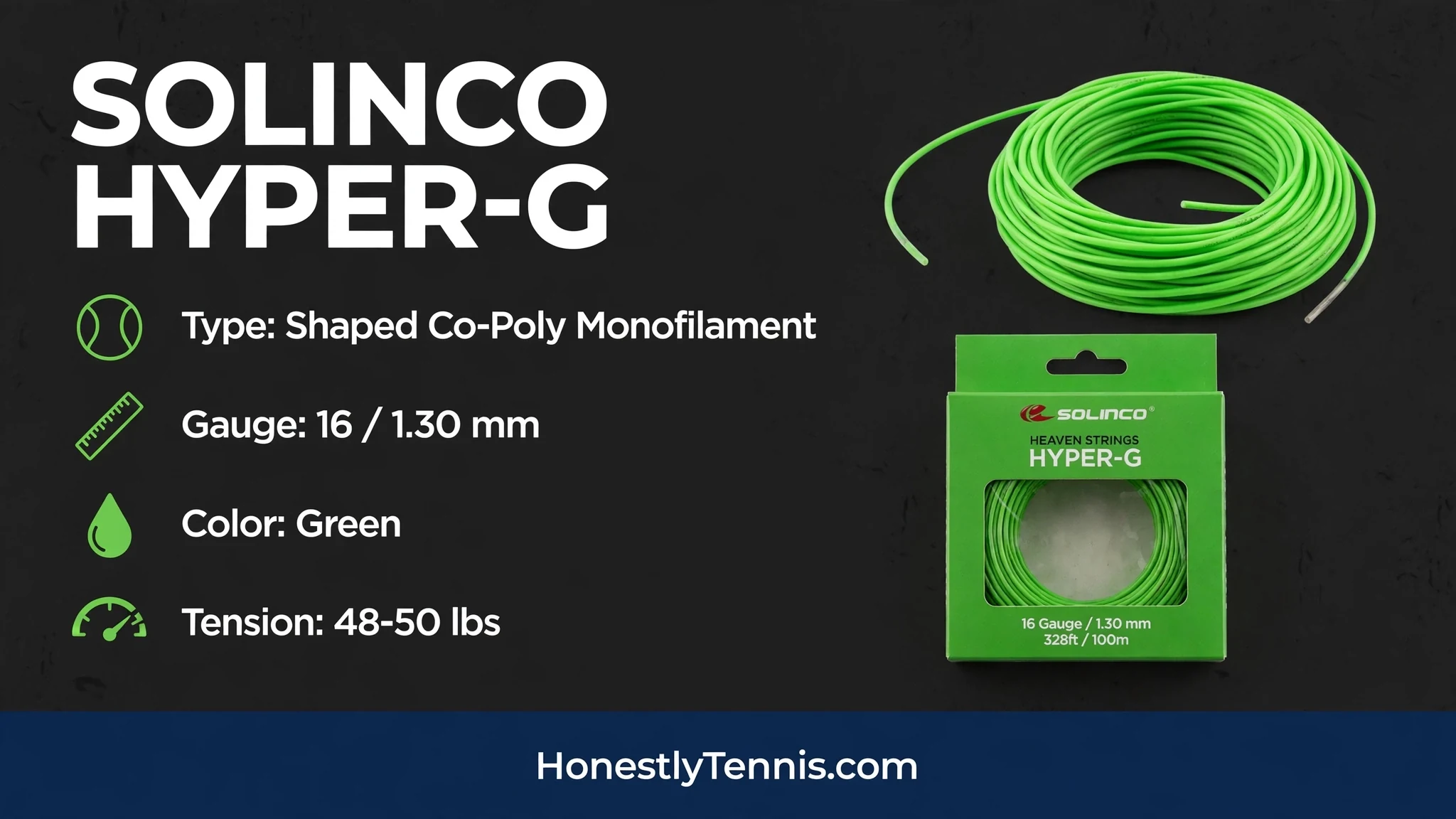
Solinco Hyper-G: The Poly Pick
Solinco Hyper-G is a shaped co-poly built for maximum bite, with the control and durability heavy topspin players need. String it at 48–50 lbs in a full bed. It belongs with players who swing fast and break strings — not in a hybrid with a multifilament, where its edges would saw through the soft fibers.
- Who It’s Best For: A 4.0–4.5 baseliner with a fast, full swing who breaks strings every few weeks and wants maximum spin and control. A heavy topspin player who restrings on a schedule and cuts poly out before it goes dead will get the most from this string.
- Who Should Skip It: A 3.0–3.5 player with a compact swing or a sore elbow. If you do not break strings often, the stiff, low-powered response will cost you depth and comfort — a multifilament will serve your game better.

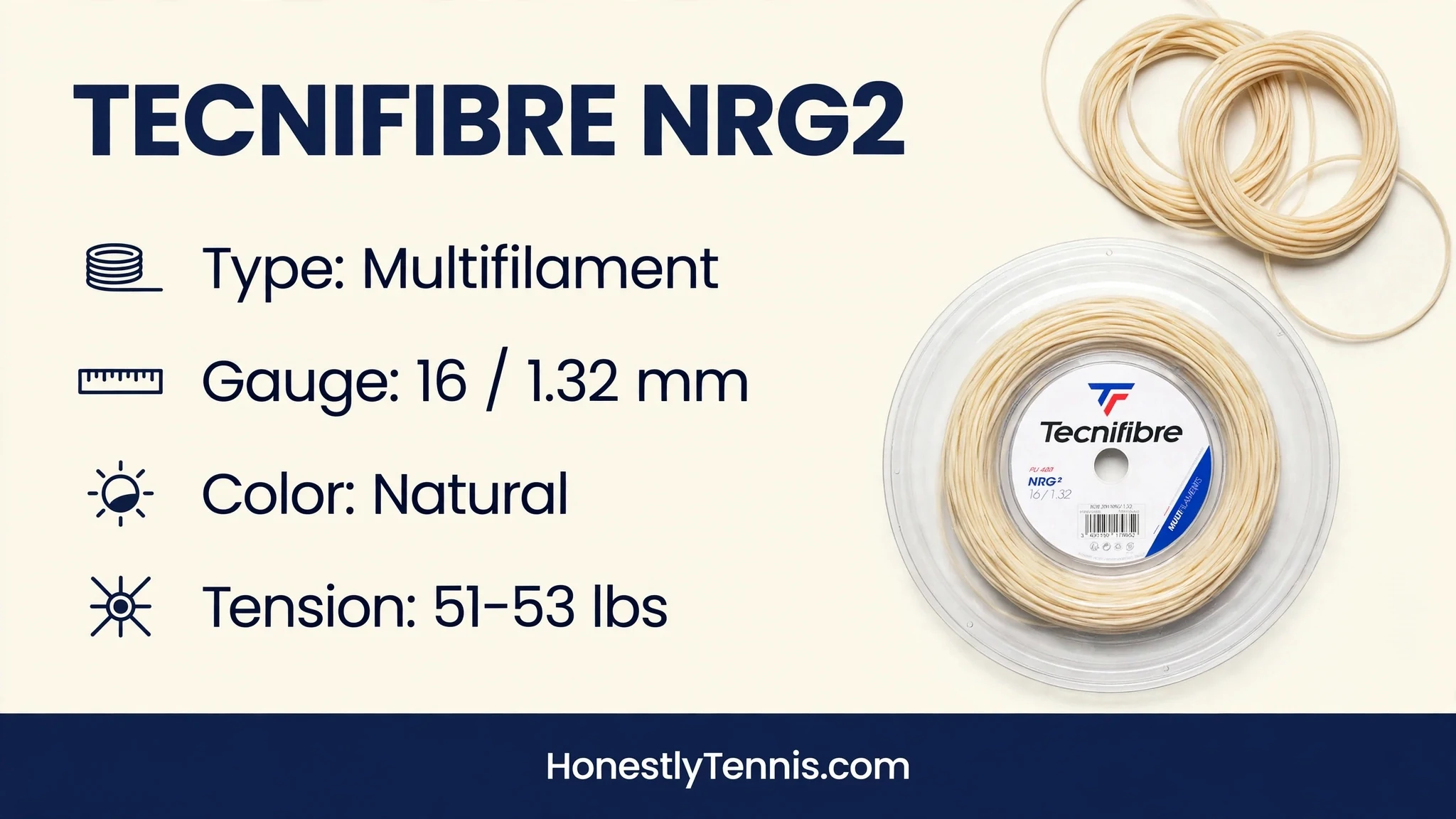
Tecnifibre NRG2: The Multi Pick
Tecnifibre NRG2 is the premium multifilament club players keep coming back to: hundreds of elastic fibers with a polyurethane fill, built to play as close to natural gut as a synthetic gets. It pockets the ball, spares the arm, and holds tension better than any poly. String it at 51–53 lbs, or use it as the main in the hybrid above.
- Who It’s Best For: A 3.0–4.0 club player who wants easy depth, a soft feel, and an arm that stays fresh — especially anyone coming back from elbow soreness. A player with a moderate swing who values comfort and pocketing over maximum spin will love this string.
- Who Should Skip It: A 4.5 heavy topspin hitter who breaks strings in days. The soft fibers fray and snap fast under heavy spin, so a string breaker will spend more on restringing than on the string itself — a shaped poly is the better call.
Watch: Tennis Strings Explained

Final Verdict
Polyester vs multifilament tennis strings comes down to your swing and your arm. Fast swing, heavy spin, frequent breakage — polyester, strung 48–50 lbs, cut out before it goes dead. Moderate swing, sore elbow, easy depth — multifilament, strung 51–53 lbs. Want both — a soft multi main with a smooth round co-poly cross. Pick the string that fits the player you actually are.
FAQ
Can beginners use polyester strings?
Beginners are better off starting with multifilament or synthetic gut. Polyester needs a fast, full swing, and it punishes slow swings with short balls and a sore arm. Move to poly only when you break strings regularly.
Is multifilament good for tennis elbow?
Yes — multifilament is the softest practical option short of natural gut, and the string we recommend first for sore elbows. Pair it with an arm-friendly racket and the right tension, and most players feel the difference in the first session.
Can I mix polyester and multifilament in one racket?
Yes, as a hybrid — but put the soft string in the mains. A multifilament main at 51–53 lbs with a smooth, round, soft co-poly cross 2–4 lbs lower gives comfort with control. Never pair a sharp or shaped poly with a multifilament: the shaped edges saw through the soft fibers.



Hi, I’m Coach Mitchell. With over a decade of experience on the tennis court, I created Honestly Tennis to share my passion for the game. Whether you are a beginner looking for your first racquet or an advanced player wanting to upgrade your gear, my goal is to provide honest reviews and helpful guides to elevate your game.