

Your elbow hurts after every match, and the frame is not the only suspect. The best tennis strings for tennis elbow change how much shock reaches your arm on every shot.
A stiff polyester string bed at high tension turns your racket into a shock delivery system: the strings barely give, and the vibration travels straight down the frame into your elbow. Swap that stiff bed for a soft multifilament or natural gut, and the same racket feels like a different piece of equipment.
This guide covers five strings that protect sore arms, with real manufacturer specs and honest trade-offs. No invented test scores.
Table of Contents
- Quick Verdict
- How We Chose
- Best Tennis Strings for Tennis Elbow Specs at a Glance
- Why Your String Choice Decides How Your Elbow Feels
- Tecnifibre NRG2: The Soft Power Pick
- Wilson NXT: The All-Round Comfort Pick
- Babolat VS Touch: The Natural Gut Standard
- Tecnifibre X-One Biphase: The Gut-Like Feel Pick
- Head Velocity MLT: The Control and Value Pick
- How to Choose the Right Arm-Friendly String
- Watch: Tennis Strings Explained
- Final Verdict
- FAQ
Quick Verdict
Short on time? Here is the bottom line.
Buy the Tecnifibre NRG2 for the softest synthetic string with easy power.
Buy the Babolat VS Touch if your elbow is seriously angry — natural gut is still the softest string material in tennis.
Buy the Head Velocity MLT for real comfort at a friendlier price.
How We Chose
No made-up test scores here. These picks come from official manufacturer specifications, string physics, and consistent feedback from 3.0 to 4.5 club players. Where specs and marketing disagree, the specs decide.
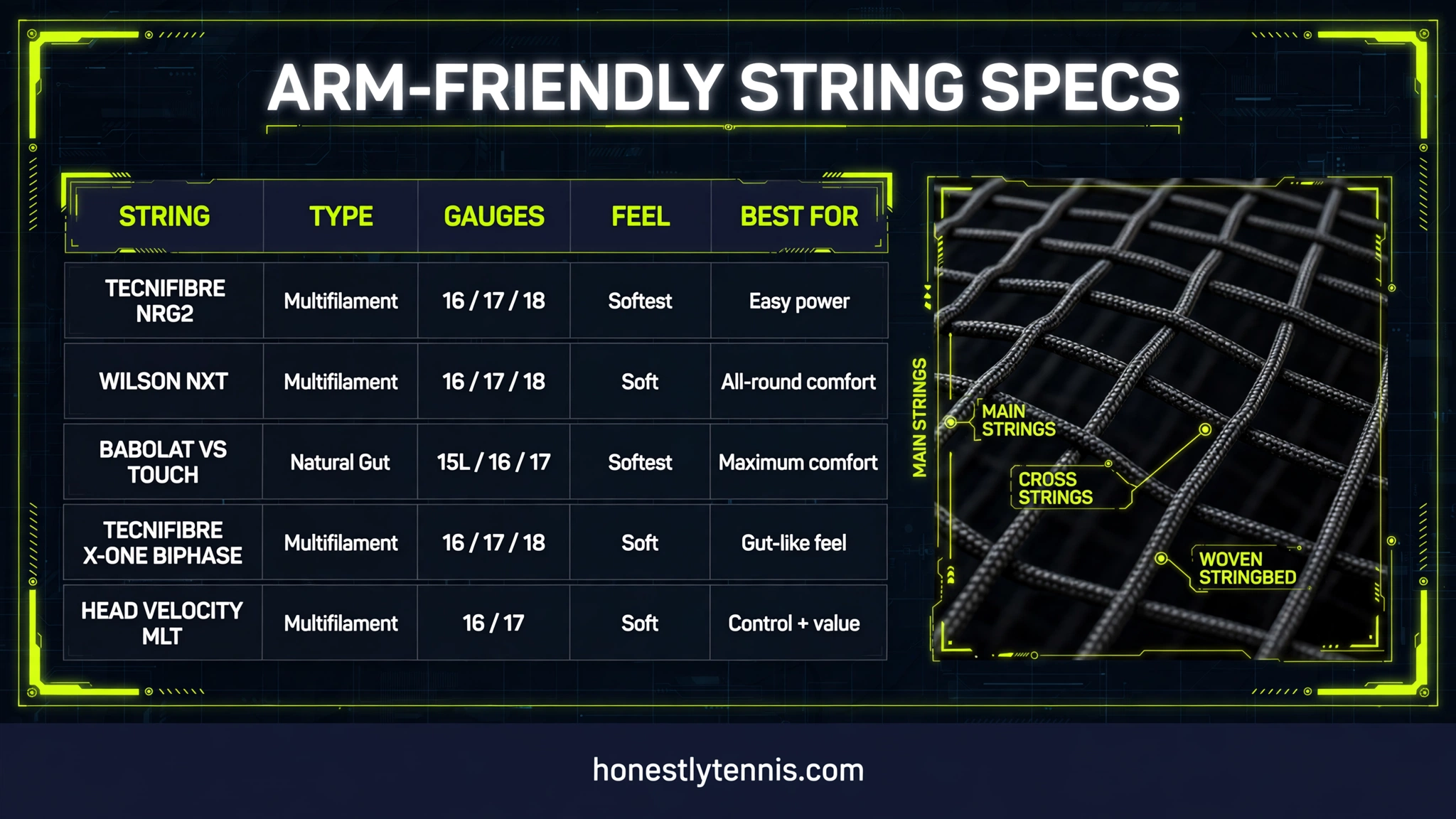
Best Tennis Strings for Tennis Elbow Specs at a Glance
| String | Material | Gauges | Feel | Best For |
|---|---|---|---|---|
| Tecnifibre NRG2 | Multifilament | 16 / 17 / 18 | Softest | Easy power |
| Wilson NXT | Multifilament | 16 / 17 / 18 | Soft | All-round comfort |
| Babolat VS Touch | Natural gut | 15L / 16 / 17 | Softest | Maximum comfort |
| Tecnifibre X-One Biphase | Multifilament | 16 / 17 / 18 | Soft | Gut-like feel |
| Head Velocity MLT | Multifilament | 16 / 17 | Soft | Control + value |
All five strings sit in the soft half of the string world. The differences are feel, power, and durability. If your frame is part of the problem too, start with our guide to the best tennis rackets for tennis elbow — string and frame work as a pair.

Why Your String Choice Decides How Your Elbow Feels
A tennis string is a shock absorber. At impact, the ball compresses the string bed, the strings stretch, and the energy either returns to the ball or travels into your arm as vibration. Soft strings stretch more and hold the ball longer. Stiff strings barely move, so more impact energy goes straight to your elbow.
That is why material matters more than brand. Natural gut is the most elastic string material in tennis. Multifilaments copy that idea with hundreds of tiny nylon fibers soaked in polyurethane. Polyester is a single stiff monofilament, built for spin and control, not comfort — and it gets stiffer as it ages.
Tension is the second lever: a tighter bed plays firmer and sends more shock into the arm, and dropping 3 to 4 lbs is often the cheapest arm fix in tennis. Our loose vs tight string tension guide explains the trade-offs in plain words. One more thing: dead strings hurt. A dead poly feels like a wooden board, and a frayed multi loses its softness — our guide on how often to restring a tennis racket gives you a simple schedule by playing frequency. The ITF Rules of Tennis set the legal limits for string patterns.
Tecnifibre NRG2: The Soft Power Pick
NRG2 is Tecnifibre’s most powerful multifilament: more than 1,200 Elastyl microfilaments in a polyurethane matrix, with an SPL coating to fight notching. It plays soft and lively at once, giving you free depth without asking you to swing harder. The 16 gauge (1.32 mm) lasts longest, the 17 (1.24 mm) adds feel, the 18 (1.18 mm) is for touch. The trade is durability: soft multis fray faster than polyester.
Tecnifibre NRG2 Pros
- Softest synthetic feel with easy power
- Lively response that rewards a relaxed swing
- Three gauges to tune feel and durability
Tecnifibre NRG2 Cons
- Frays faster than polyester
- Power can send balls long for flat swingers
- Loses tension faster than natural gut
Who Should Buy the NRG2, and Who Should Skip It
Buy it if you are a 3.0–4.0 club player whose elbow aches after a two-hour match, especially on hard courts where the ball comes back fast and your arm takes the shock. It suits a relaxed, medium-paced swing that wants free depth without swinging harder. Skip it if you are a heavy topspin string-breaker who snaps multis in under two weeks — you will restring more often than you play.
Coach’s Stringing Secret: string NRG2 at 51 to 53 lbs. In a Tuesday night 3.5 doubles match, that softer bed lets you swing freely on a second-serve kick. For more spin, put NRG2 in the mains and a smooth round soft co-poly like Yonex Poly Tour Pro in the crosses at 48 to 50 lbs — 2 to 4 lbs lower than the mains.
If NRG2 breaks too fast, Wilson NXT below lasts longer with a similar soft feel.
Wilson NXT: The All-Round Comfort Pick
NXT is Wilson’s best-selling multifilament because it does nothing wrong. Xycro microfibers and polyurethane give it a soft, muted response with easy power. It sits a half-step firmer than NRG2, with a clean, predictable response and easier control. It comes in 16 (1.30 mm), 17 (1.24 mm), and 18 (1.22 mm). Where NXT loses ground is tension maintenance: it softens and frays over time.
Wilson NXT Pros
- Soft, muted comfort with easy power
- Clean, predictable response and good control
- Consistent feel from the first hit
Wilson NXT Cons
- Frays over time, needs regular restringing
- Less lively than NRG2 or X-One Biphase
- Little extra bite for topspin players
Who Should Buy the NXT, and Who Should Skip It
Buy it if you want one safe, soft string for every match — a 3.5 all-court player who mixes baseline rallies with net play and does not want to think about the string. It is a good first step off polyester for a sore elbow. Skip it if you rely on the string for free power: a short, compact swing will not get the easy depth that NRG2 or X-One Biphase gives.
Coach’s Stringing Secret: string NXT at 52 to 55 lbs. In a 3.5 club match, the defensive slice on the run punishes a sore elbow most, and NXT’s soft response takes the edge off that shot. If the frame is part of the problem, pair NXT with one of the arm-friendly tennis rackets in our guide.
For a livelier version, Tecnifibre X-One Biphase below adds more power and gut-like feel.
Babolat VS Touch: The Natural Gut Standard
VS Touch is natural gut, the standard every other comfort string gets measured against. No synthetic matches its elasticity: it stretches deep at impact and snaps back with more energy than any multifilament, giving free power and the softest impact in tennis. Babolat’s BT7 coating protects the fibers and holds tension better than older gut. The catch is cost and care — gut costs more and hates moisture. It comes in 15L (1.35 mm), 16 (1.30 mm), and 17 (1.25 mm).
Babolat VS Touch Pros
- Softest, most elastic string material in tennis
- Free power with the gentlest impact on the arm
- Best tension maintenance of any string type
Babolat VS Touch Cons
- Costs more than any synthetic string
- Damaged by moisture — needs dry storage
- Breaks sooner for heavy topspin hitters
Who Should Buy the VS Touch, and Who Should Skip It
Buy it if your elbow is seriously sore and you are willing to pay for the softest string in tennis — a 4.0–4.5 player who plays three times a week and feels every mishit in the joint will notice the difference on the first return. Skip it if you play outdoors in damp or rainy conditions, where moisture kills gut, or if you break strings constantly and the cost per set would sting.
Coach’s Stringing Secret: string VS Touch at 55 to 58 lbs — gut plays softer than its number, so do not string it as low as a multi. A 3.5 serve-and-volley player feels the difference most on the return, where gut absorbs pace instead of passing it to the arm.
If gut is outside your budget, Tecnifibre X-One Biphase below is the closest synthetic feel for far less money.
Tecnifibre X-One Biphase: The Gut-Like Feel Pick
X-One Biphase is Tecnifibre’s answer to players who want gut-like feel without the gut price or the moisture worry. H2C fibers and a polyurethane core give it a soft, powerful response that sits closer to natural gut than any other synthetic here. It comes in 16 (1.30 mm), 17 (1.24 mm), and 18 (1.18 mm); the 17 is the sweet spot for most club players. The downside is familiar: it frays, and it loses tension faster than natural gut.
Tecnifibre X-One Biphase Pros
- Closest synthetic feel to natural gut
- Lively power with a soft, clean response
- Easy depth without a big swing
Tecnifibre X-One Biphase Cons
- Frays and breaks faster than polyester
- Loses tension faster than natural gut
- Premium multifilament price
Who Should Buy the X-One Biphase, and Who Should Skip It
Buy it if you want gut-like feel on a synthetic budget — a 3.5–4.0 player with a full swing who likes a lively response but does not want to baby natural gut. Skip it if you are a chronic string-breaker: the soft fibers fray fast under heavy topspin, and you will burn through sets.
Coach’s Stringing Secret: string X-One Biphase at 51 to 54 lbs. In a tight third set, when your legs are gone and your swing shortens, a lively string keeps your rally ball deep. If you break multis too fast, try X-One Biphase in the mains with Yonex Poly Tour Pro crosses at 48 to 50 lbs — the smooth round poly slides cleanly instead of sawing through the soft mains.
For the same comfort at a lower price, Head Velocity MLT below trades liveliness for control and value.
Head Velocity MLT: The Control and Value Pick
Velocity MLT is the value pick, and it earns the spot on control as much as comfort. It is a multifilament with a slightly firmer response than the other strings here, giving control players the feedback they want without the harshness of polyester. It comes in 16 (1.30 mm) and 17 (1.25 mm). What you give up is power: it does not hand you the free depth of NRG2 or X-One Biphase. For a full swing, that is a fair trade.
Head Velocity MLT Pros
- Softer than polyester with real control
- Good tension maintenance for a multifilament
- Best value in this guide
Head Velocity MLT Cons
- Less free power than NRG2 or X-One Biphase
- Still frays faster than polyester
- Only two gauges to choose from
Who Should Buy the Velocity MLT, and Who Should Skip It
Buy it if you are a 3.5–4.5 control player with a full, flat swing who wants comfort without a mushy feel — especially on hard courts, where its firmer response keeps deep balls in. Skip it if you need free power from the string: a short swing or an older arm that cannot generate its own pace will find it underpowered.
Coach’s Stringing Secret: string Velocity MLT at 52 to 55 lbs. It plays firmer than its multi cousins, so do not string it high and expect comfort. A 3.5 baseliner who hits flat and deep will like the control on the backhand side, where a mushy string can send balls long. If you are moving up from beginner strings, our guide to the best tennis strings for intermediate players covers the step-up options.
If Velocity MLT feels too firm for your elbow, Wilson NXT above is the softer step up.
How to Choose the Right Arm-Friendly String
The best tennis strings for tennis elbow are only half the story — how you string them decides how much of that comfort actually reaches your arm.
Tension: The Cheapest Arm Fix
Before you buy any string, check your tension. Dropping 3 to 4 lbs softens the string bed more than most players expect. A good starting window for multifilaments is 48 to 55 lbs in a 100 square inch frame.
Gauge: Feel vs Durability
Thinner strings feel softer and spin more. Thicker strings last longer. The 17 gauge is the middle ground for most sore elbows: soft enough to notice, durable enough to live with.
Hybrids: Comfort Plus Spin
A hybrid pairs two strings: one in the mains, one in the crosses. For a sore elbow, put the soft string in the mains — the mains control 70 to 80% of the feel and shock — and a smooth round soft co-poly in the crosses. NRG2 or NXT in the mains at 51 to 53 lbs, with Yonex Poly Tour Pro in the crosses at 48 to 50 lbs, is a setup club stringers build every week. Never put a stiff or sharp-edged poly in the mains when you have tennis elbow: it becomes the string your arm feels most, and a shaped poly saws through soft crosses.
Watch: Tennis Strings Explained
The video below from our channel explains how tennis strings actually work — and why your string choice changes how your racket plays.

Final Verdict
For most players with a sore elbow, Tecnifibre NRG2 is the smartest buy. It is the softest synthetic here with real power.
Babolat VS Touch is the buy if your elbow is genuinely angry and you can afford the best — nothing synthetic fully matches natural gut.
Head Velocity MLT is the buy for comfort with control at a kinder price.
Whichever of the best tennis strings for tennis elbow you pick, string it soft, restring it on time, and pair it with a frame that does not fight your arm.
FAQ
What is the best string for tennis elbow?
Tecnifibre NRG2 for most players — the softest synthetic multifilament with easy power. If your elbow is seriously sore and budget allows, Babolat VS Touch natural gut is softer still.
Is multifilament or natural gut better for tennis elbow?
Natural gut is the softest and most elastic material, so it absorbs the most shock. Multifilament is the best synthetic option and costs far less.
What tension should I string at for tennis elbow?
For multifilaments, 51 to 55 lbs in a 100 square inch frame; for natural gut, 55 to 58 lbs. Multifilaments are more powerful than polyester, so they usually go on 2 to 4 lbs tighter than a poly bed — only drop to 51 to 53 lbs if you were already playing an extra-tight setup above 55 lbs.
Should I stop using polyester strings if I have tennis elbow?
A full bed of stiff polyester at high tension is the worst setup for a sore elbow. If you love poly, use a soft co-poly like Yonex Poly Tour Pro at 48 to 50 lbs, or hybrid it the right way: put a multifilament in the mains and the soft poly in the crosses, 2 to 4 lbs lower. Never play with dead polyester.
How often should I restring multifilament strings?
Multifilaments lose tension and fray, so the soft feel fades before the string breaks. Restring when the feel goes dead or the string frays.



Hi, I’m Coach Mitchell. With over a decade of experience on the tennis court, I created Honestly Tennis to share my passion for the game. Whether you are a beginner looking for your first racquet or an advanced player wanting to upgrade your gear, my goal is to provide honest reviews and helpful guides to elevate your game.