

You crack open a fresh can of tennis balls. That sharp hiss sounds like the start of a great afternoon on the court. Twenty minutes later, something feels horribly wrong. One ball flies off your strings like a rocket. Another barely clears the service line. By the second set, you’re swinging out of your shoes just to get the same depth.
Sound familiar?
Finding the best tennis balls for hard courts isn’t about grabbing the most expensive can on the shelf. It’s about finding a ball that maintains a predictable bounce, handles heavy topspin, and doesn’t completely shed its felt after a few hard baseline rallies.
Here’s the biggest mistake I see club players make: they buy discounted “Regular Duty” balls and then wonder why the gritty court surface chews through the felt in twenty minutes. Hard courts are brutal on equipment. The same sandpaper-like surface that destroys tennis balls also tears right through your shoes. If your outsoles are disappearing faster than expected, you need to read my guide to the best tennis shoes for hard courts.
Let’s sort out which balls actually deserve a place in your tennis bag.
Why Trust Coach Mitchell?
After more than 12 years teaching on blistering public hard courts, I’ve learned one brutal truth: the label on the can doesn’t tell you how a ball will behave after a long afternoon of hitting.
For a proper hard-court test, we take retail-purchased cases (no handpicked promotional samples from Wilson or Penn) to abrasive public courts. We feed thousands of balls through a ball machine and hit heavy topspin with 4.0 league grinders. We track exactly how many hours it takes for the internal pressure to drop and the felt to fluff up unplayably.
I buy all my test cases at retail and accept zero freebies. This is just the brutal truth about what works on gritty asphalt.
Coach’s Quick Matrix: Top 5 Hard Court Balls at a Glance
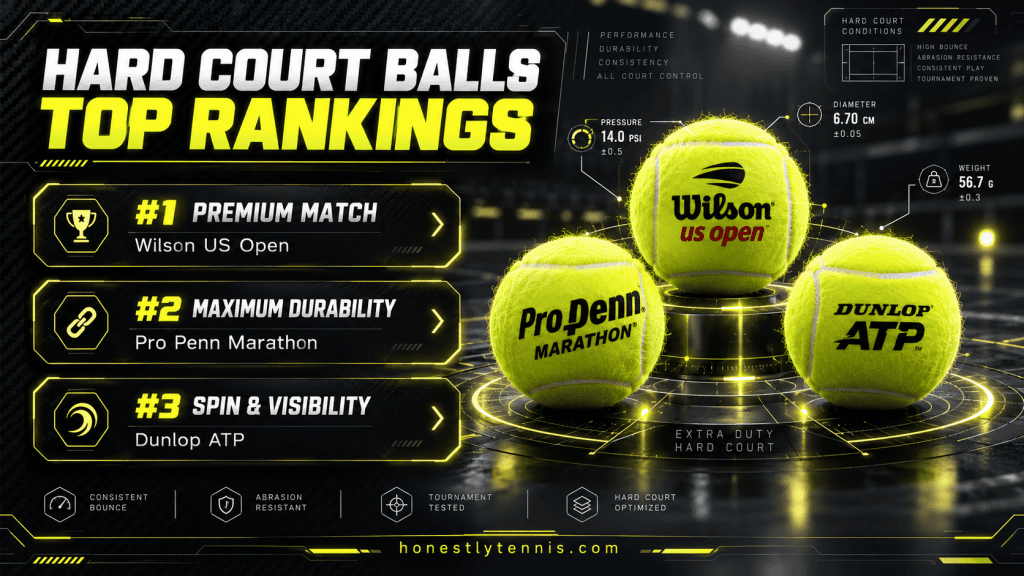
- Wilson US Open Extra Duty: The undisputed gold standard for premium match play and consistent bounce.
- Pro Penn Marathon Extra Duty: The absolute tank of tennis balls, offering the longest-lasting felt and internal pressure.
- Dunlop ATP Extra Duty: The sleeper hit for heavy-spin players who want a slightly firmer, highly visible ball.
- Penn Championship Extra Duty: The ultimate budget-friendly value pick for recreational practice and weekend doubles.
- Babolat Gold All Court: The best premium alternative with a slightly softer feel on contact.

1. Wilson US Open Extra Duty: The Gold Standard
The On-Court Vibe
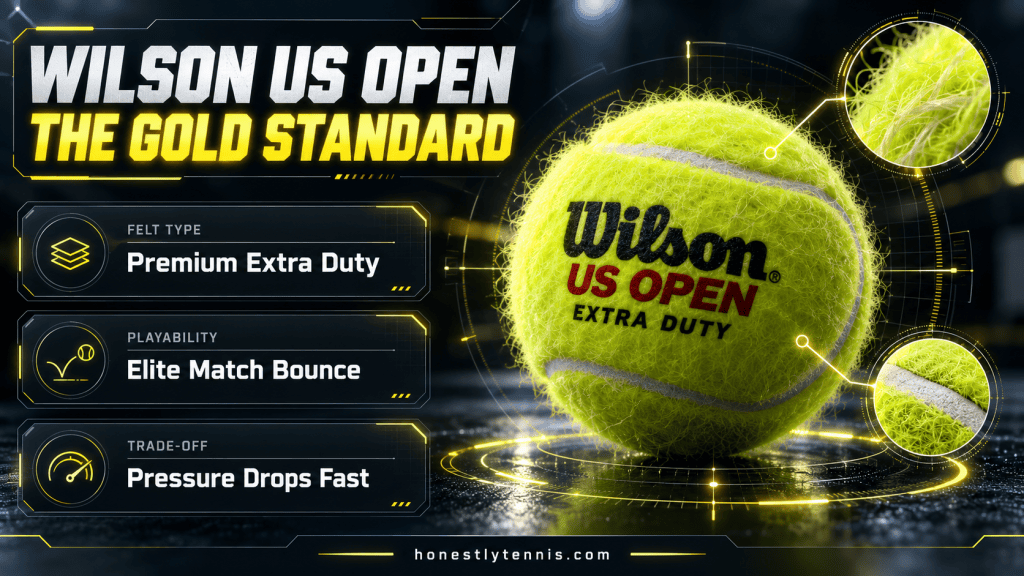
When you drive through a heavy forehand, you want a clean, predictable response off the stringbed. The US Open Extra Duty gives you exactly that. It strikes a beautiful balance—lively enough to put away short balls, but controlled enough that you trust where it will land deep in the court. Out of a fresh can, it feels perfect, not like a rock and not like a marshmallow.
Tech That Actually Works
Wilson uses premium woven felt specifically suited to abrasive hard surfaces. This thick felt helps protect the internal rubber core while maintaining optimal aerodynamics. It is the official ball of the US Open for a reason: it delivers elite, predictable match performance.
Where It Bleeds
They are expensive, and the premium bounce tends to drop off a cliff right around the 2.5-hour mark of heavy hitting. On a rough public court, a serious topspin hitter will wear the felt down quickly, turning them into practice balls by the second match.
Coach’s Pro Tip (Storage & Usage)
Keep the can sealed until the exact moment you step on the court for a serious match. Do not use these for everyday feeding drills; it is too expensive. If one ball starts bouncing significantly lower than the other two in the can, toss it immediately.
Alternative Pick
Try the Dunlop ATP Extra Duty if you want another premium competitive ball with slightly brighter visibility.
2. Pro Penn Marathon Extra Duty: The Longevity King
The On-Court Vibe
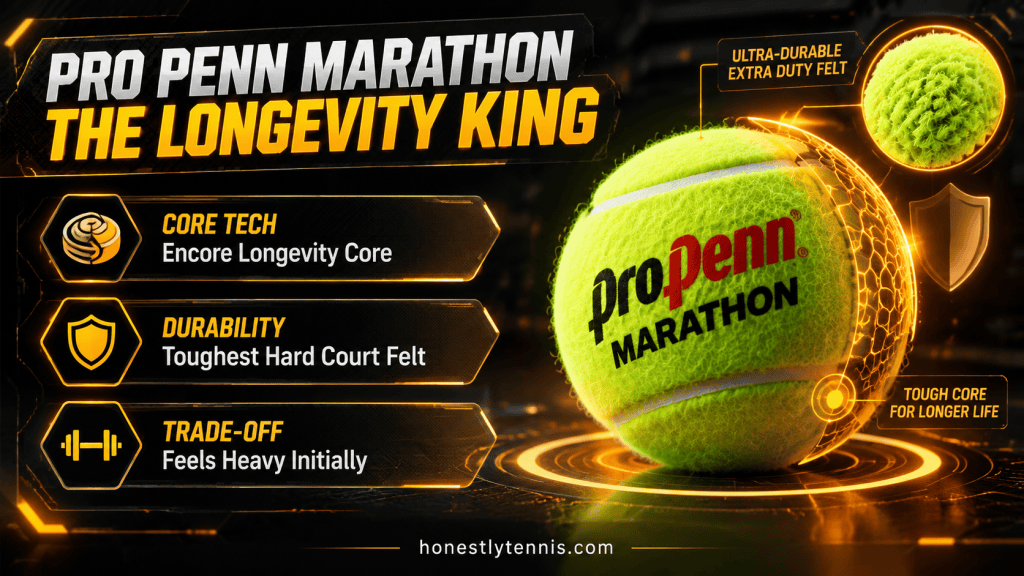
If you are tired of your tennis balls dying before the third set, this is your holy grail. The Pro Penn Marathon is built like an absolute tank. It is the ball I recommend for players who grind for three hours on heavily textured acrylic courts. However, out of a fresh can, they feel noticeably stiffer and heavier on the arm than a Wilson.
Tech That Actually Works
Penn utilizes their proprietary Encore Technology core, which they claim lasts 22% longer than older models. More importantly, the LongPlay Extra Duty felt takes an absolute beating on abrasive asphalt without balding or fluffing up too quickly.
Where It Bleeds
Because they are built for maximum durability, they feel quite firm on impact. If you use a stiff polyester string setup and already struggle with tennis elbow, the initial stiffness of a fresh Marathon ball might aggravate your arm for the first 20 minutes of play.
Coach’s Pro Tip (Storage & Usage)
This is the ultimate coaching and ball-machine ball. Use them for a heavy practice session, and when they finally lose a bit of their match-level bounce, throw them into your teaching basket. They will last for weeks as practice balls.
Alternative Pick
Choose the standard Penn Championship Extra Duty if you want a lower-cost practice ball and don’t need absolute maximum longevity.
3. Dunlop ATP Extra Duty: The Heavy Topspin Specialist
The On-Court Vibe
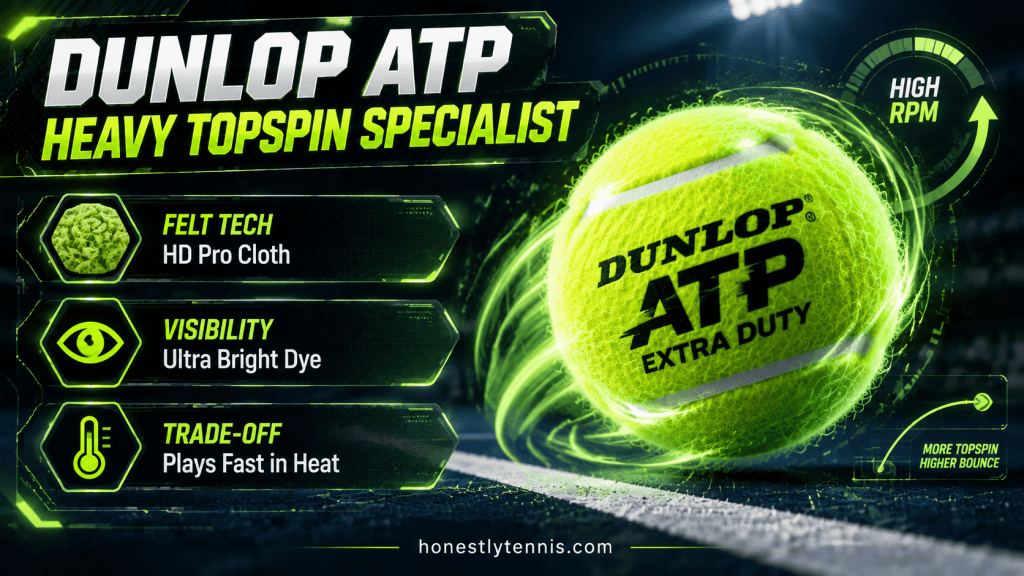
Heavy topspin is brutal on tennis balls. The strings grab the felt, and the gritty court rips it apart on the bounce. The Dunlop ATP holds its shape and felt integrity beautifully under heavy RPMs. It is highly visible, making it an excellent choice for fast baseline exchanges in fading evening light.
Tech That Actually Works
As the official ball of the ATP Tour, Dunlop uses their HD Pro Cloth and HD Pro Core technologies. The felt dye is incredibly bright, and the internal core is engineered to withstand the punishing, heavy-spin baseline game that dominates modern competitive tennis.
Where It Bleeds
On extremely hot summer days, these balls can feel slightly “fly-away” or too fast through the air. Players who prefer a softer, slower response might find them a bit too lively until they get broken in.
Coach’s Pro Tip (Storage & Usage)
If you are working on heavy topspin mechanics, pay attention to the ball’s depth and bounce height rather than judging your spin strictly by the sound of contact. The firm core of the Dunlop will give you great feedback on your stringbed.
Alternative Pick
Switch to the Wilson US Open Extra Duty if you want a slightly more controlled, traditional feel on impact.
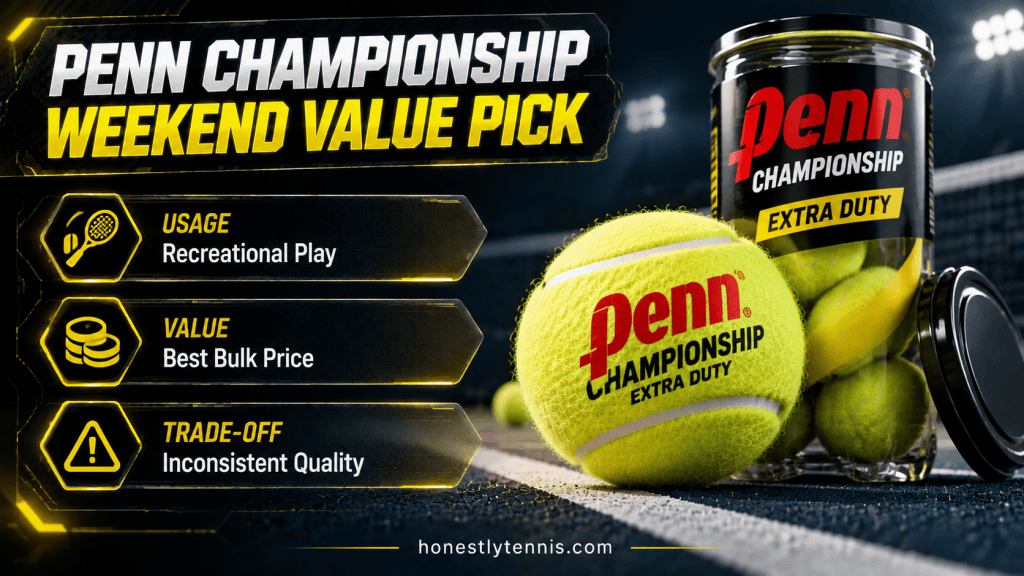
4. Penn Championship Extra Duty: The Weekend Value Pick
The On-Court Vibe
Sometimes you are just meeting a friend on Saturday morning for a casual hour of hitting. You don’t need to open a $6 premium can for that. The Penn Championship Extra Duty is America’s best-selling ball for a reason: it offers completely acceptable pressurized performance at a price point that makes sense for weekend warriors.
Tech That Actually Works
Penn uses a controlled fiber release construction in the wool-blend felt to help maintain a consistent nap on hard courts. It is a genuine pressurized ball made for standard play, offering great value when purchased by the 12-can or 24-can case.
Where It Bleeds
The biggest issue here is inconsistent quality control. Every now and then, you will open a fresh can and find one ball that is already slightly dead or softer than the others. Additionally, the felt tends to fluff up much faster than the Pro Penn Marathon.
Coach’s Pro Tip (Storage & Usage)
Buy these by the case to save money. Keep a few sealed cans in your bag for casual doubles, and use the older, fluffed-up ones exclusively for serving practice where perfect bounce consistency isn’t strictly required.
Alternative Pick
Upgrade to the Pro Penn Marathon Extra Duty if you are tired of the felt fluffing up too quickly during practice.
5. Babolat Gold All Court: The Premium Alternative
The On-Court Vibe
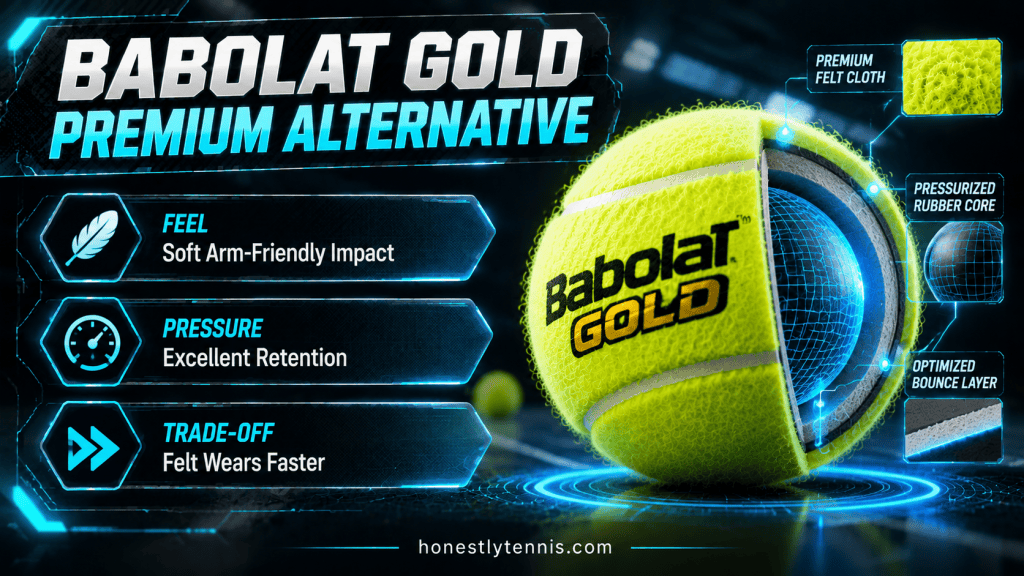
Not everyone wants a tennis ball that feels like a rock on impact. The Babolat Gold offers a much softer, more cushioned sensation on the stringbed. If you play a mix of hard courts and softer synthetic surfaces, this ball provides a very comfortable, arm-friendly hitting experience during long rallies.
Tech That Actually Works
Babolat designed the Gold All Court with a specific rubber core formulation that prioritizes comfort and excellent internal pressure retention. The woven felt is versatile enough to be used across multiple court surfaces.
Where It Bleeds
The felt is labeled “All Court” rather than strictly “Extra Duty.” This means if you play exclusively on old, highly abrasive asphalt that feels like sandpaper, the Babolat felt will go bald faster than a dedicated Extra Duty ball from Wilson or Penn.
Coach’s Pro Tip (Storage & Usage)
If your arm is hurting, switching to a softer ball like the Babolat Gold can help, but it won’t fix poor technique. Ensure you are also playing with the right racket and string tension to protect your joints.
Alternative Pick
Try the Wilson US Open Extra Duty when absolute hard-court durability matters more to you than multi-surface versatility.
Buying Guide: How to Choose the Best Tennis Balls for Hard Courts
Extra Duty vs. Regular Duty Felt: The Ultimate Trap
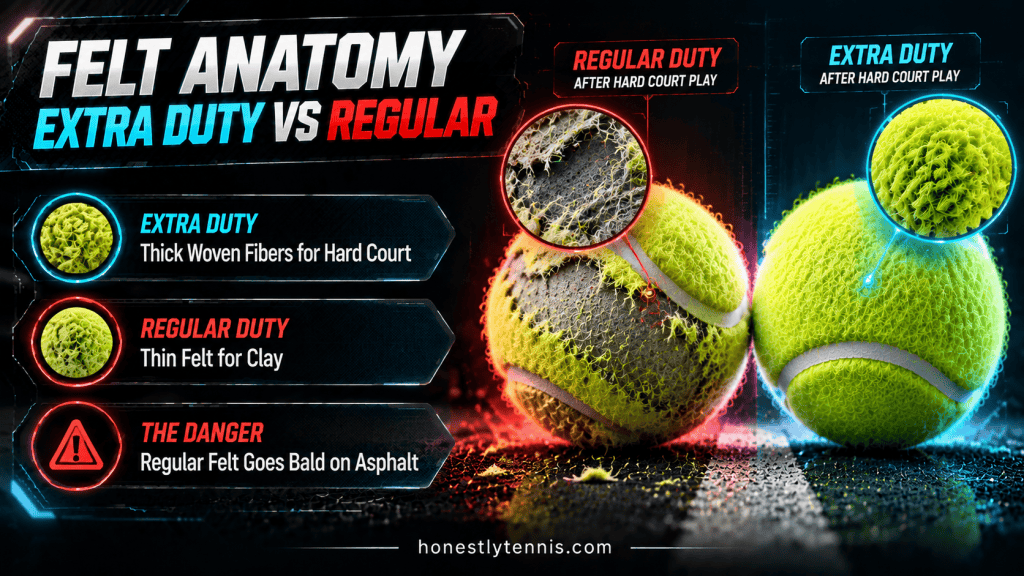
This is the number one buying mistake I see. Regular Duty tennis balls have thinner felt designed for clay and indoor courts so they don’t pick up dirt. If you use them on a hard court, the abrasive asphalt will shave them bald in a single set. Extra Duty balls feature thicker, tightly woven felt specifically engineered to survive the intense friction of hard courts. Remember, the exact same gritty surface that destroys your balls will also destroy your shoes, which is why you need the most durable tennis shoes for hard courts.
Pressurized vs. Pressureless Balls: Know the Difference
Standard competitive balls (like our top 5) are pressurized. They come in a vacuum-sealed can and bounce using internal gas. Once opened, that gas slowly escapes, which is why they eventually go “dead.” Pressureless balls bounce using the actual thickness of the rubber core. They last forever, but they feel like hitting heavy bowling balls and can wreck your elbow. To understand how string tension interacts with ball feel, check out my guide on loose vs tight tennis string tension.
Temperature and Altitude Factors
Leaving your tennis bag in a freezing car overnight will temporarily kill the internal pressure of your balls. Always store unopened cans in a climate-controlled room or deep inside the best tennis racket bag. Also, if you play in places like Denver, you need specific high-altitude balls. The International Tennis Federation (ITF) has strict testing standards, and sea-level balls will fly to the fence in thin mountain air.
Frequently Asked Questions (FAQ)
How long do pressurized tennis balls last on hard courts?
For premium competitive match play, a can of pressurized balls will last between 2 to 3 hours of heavy hitting. After that, the internal pressure drops and the felt wears down, making them suitable only for casual practice or feeding drills.
Can I use regular duty tennis balls on a hard court?
You can, but you shouldn’t. Regular duty felt is designed for clay or indoor courts. Gritty outdoor hard courts will shred the thinner regular duty felt very quickly, causing the ball to go completely bald and fly unpredictably.
Why do tennis balls lose their bounce so fast?
Pressurized balls rely on internal gas for their bounce. The moment you pop the vacuum seal on the can, that gas slowly begins escaping through the porous rubber core. Cold temperatures and heavy impacts accelerate this pressure loss.
Are Extra Duty tennis balls heavier than regular balls?
No. Extra Duty and Regular Duty balls must meet the exact same official weight limits. However, because Extra Duty balls have thicker, fluffier felt, they create more aerodynamic drag, making them feel slightly heavier or slower through the air.
What is the best way to store unopened cans of tennis balls?
Store unopened cans in a climate-controlled environment at room temperature, like a closet inside your house. Never leave them in a freezing garage or a blazing hot car trunk, as extreme temperature swings will damage the rubber core.
Final Verdict: Stop Hitting Dead Rocks
You shouldn’t have to ruin a great afternoon of tennis because your balls feel like dead rocks by the second set. Finding the best tennis balls for hard courts comes down to buying Extra Duty felt and understanding how long you expect the pressure to last.
For premium, tournament-level match play, the Wilson US Open Extra Duty is the absolute gold standard. If you want maximum lifespan for long league matches or coaching sessions, the Pro Penn Marathon Extra Duty is an absolute tank. And if you just need an affordable case of balls for weekend doubles and serving practice, you cannot beat the value of the Penn Championship Extra Duty.
Stop buying clay-court balls on discount, keep your cans sealed until you step on the court, and get back to grinding.



Hi, I’m Coach Mitchell. With over a decade of experience on the tennis court, I created Honestly Tennis to share my passion for the game. Whether you are a beginner looking for your first racquet or an advanced player wanting to upgrade your gear, my goal is to provide honest reviews and helpful guides to elevate your game.