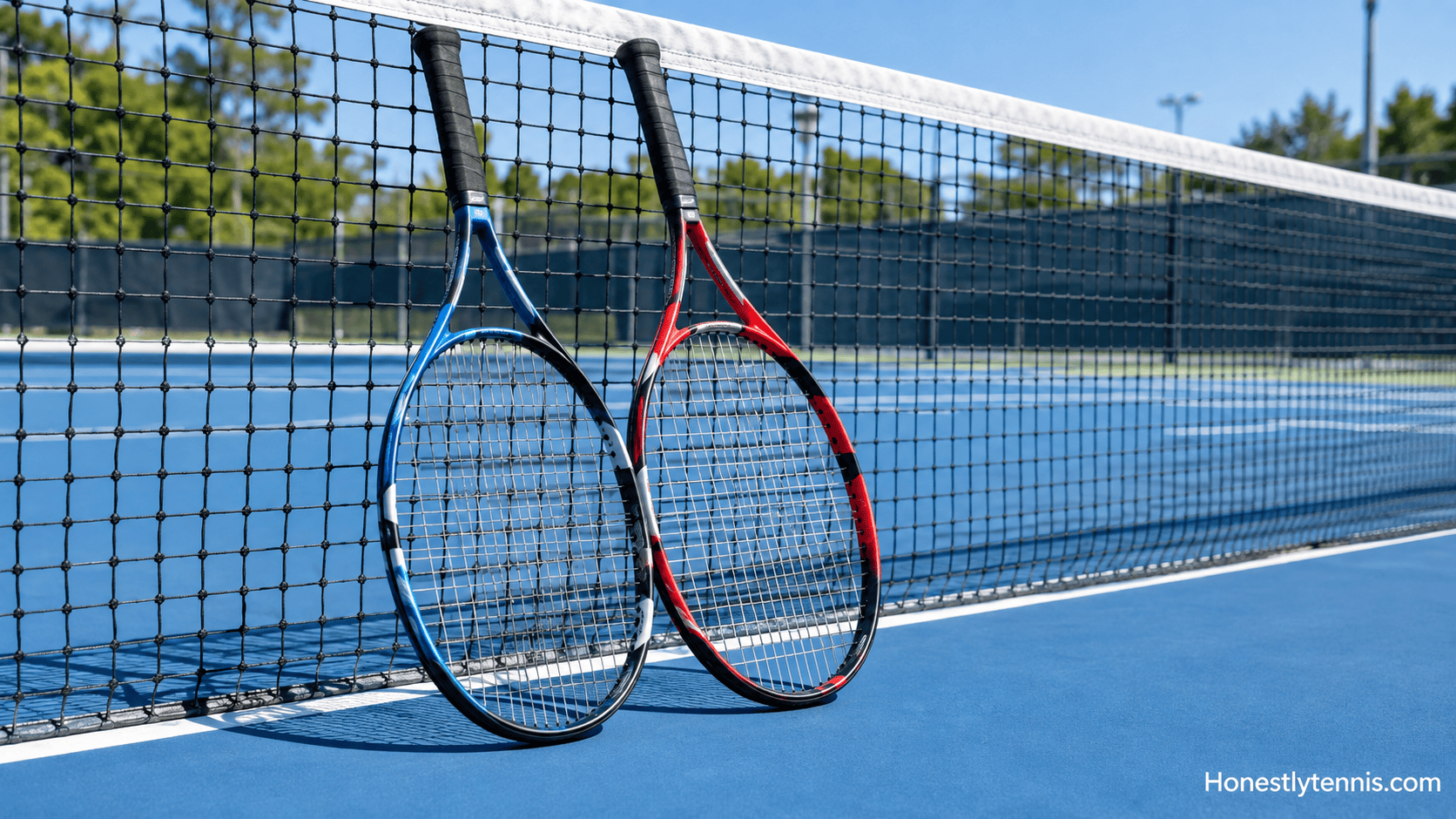
You are standing on the baseline, racket in hand, wondering why your shots either fly long or leave your arm throbbing. I see it every single day on the courts. Choosing between the Babolat Pure Drive and the Wilson Clash isn’t just about brand loyalty. It is about matching frame geometry to your unique biomechanics.
Quick Answer: The Babolat Pure Drive is a stiff, power-centric racket built for aggressive baseliners who want maximum ball speed and effortless depth. In contrast, the Wilson Clash is a highly flexible, arm-friendly racket designed for players prioritizing comfort, vibration dampening, and injury prevention without sacrificing control.
The Tale of Two Philosophies: Power vs. Flexibility
These two rackets represent complete opposites in tennis engineering. As a coach, I look at how a frame interacts with a player’s natural swing path.
The Pure Drive is built on stiffness. It uses an elliptical beam design to prevent the racket from bending when it hits the ball. This energy return is what gives you that explosive pop off the stringbed.
The Clash flips that script entirely. Wilson engineered this frame to bend both horizontally and vertically. They call it FortyFive technology. This flexibility pockets the ball longer, creating a plush, buttery feel on impact.
Here’s the catch: flexibility and stiffness directly impact your physical health on the court.
Frame Stiffness (RA Rating) Explained
To really understand the Babolat Pure Drive vs Wilson Clash debate, we have to look at the RA rating. This number measures frame stiffness.
According to general equipment standards recognized by the International Tennis Federation (ITF), a higher RA rating means the racket is stiffer, transferring more shock to your arm but generating more power.
The Pure Drive typically sits around a 71 or 72 RA. That is incredibly stiff. When the ball hits the strings, the frame does not yield. All that energy goes directly back into the ball—and down into your wrist and elbow.

The Clash 100 sits at a remarkably low 55 RA. Historically, rackets this flexible felt like wet noodles. They offered zero power. But Wilson cracked the code. They managed to create a 55 RA frame that still offers enough stability to punch the ball deep into the corners.
Why does this matter? Because your swing speed dictates how these rackets behave. If you swing fast, the Pure Drive turns you into a weapon. If you have a slower, more deliberate swing, the Clash offers the forgiveness you need.
Baseline Dynamics and Court Penetration
Let’s talk about real court performance. When hitting heavy topspin against a baseline pusher on clay, you need depth.
Last Tuesday, a 4.0 player named Greg walked onto my court struggling against moon-ballers. He was using a control-oriented racket and exhausting himself. I handed him a Pure Drive. Suddenly, his standard rally ball was pushing his opponent three feet further back. The racket did the work.
The Pure Drive gives you “free power.” You don’t have to perfectly time every shot to get pace. The sweet spot is massive, sitting slightly higher in the hoop.
The Clash, however, rewards a different playstyle. Because the frame flexes so much, you feel deeply connected to the ball. You know exactly where the ball is going before it even crosses the net. It lacks the brute force of the Pure Drive, but it allows you to swing out fully without fear of launching the ball into the back fence.
Serving Mechanics: Spin, Slice, and Flat Bombs
When you step up to serve, these rackets feel distinctly different.
The Pure Drive is a server’s dream. If you want to hit flat bombs down the T, the stiff frame delivers pure kinetic energy. It also generates massive action on kick serves due to the open 16×19 string pattern and aerodynamic throat.
The Clash takes a bit more effort on the serve. You won’t get that same explosive pop off a flat first serve. However, the flexibility really shines on slice serves. Because the frame pockets the ball, you can really carve around the outside of the ball, pulling your opponent wide off the deuce court.
Common Mistakes Players Make (And How to Fix Them)
I watch players sabotage their equipment choices constantly. Here are the biggest errors I see with these two specific frames:
Stringing the Pure Drive with tight polyester. This is a recipe for disaster. You are taking a stiff racket and putting stiff, unforgiving string in it. If you choose the Pure Drive, string it with a synthetic gut, a multifilament, or a soft co-poly at a lower tension (around 50-52 lbs) to protect your arm.
Over-swinging with the Clash. Players transitioning from stiffer rackets often feel like the Clash lacks power, so they start muscling the ball. This ruins your mechanics. Let the racket flex. Trust the frame to do its job. Smooth, fluid strokes work best here.

Ignoring grip size differences. Both brands offer standard grip sizes, but Wilson’s pallet shape is slightly more rectangular, while Babolat’s is slightly rounder. Ensure you are wrapping your overgrip correctly so the bevels remain defined. You need to find your continental grip quickly for volleys.
Volleys and Net Play
Up at the net, stability is everything. When a passing shot is coming at you at 70 mph, you need a frame that won’t twist in your hand.
The Pure Drive is incredibly solid on volleys. Block the ball, and it punches deep into the open court. It is point-and-shoot. But it can feel a bit clunky on touch volleys or delicate drop shots.
The Clash gives you incredible touch. The flex allows you to absorb the pace of a heavy passing shot and drop it dead just over the net. However, on off-center hits against heavy pace, the Clash can occasionally feel a bit unstable compared to the rigid Pure Drive.
Final Thoughts from the Baseline
Choosing between the Babolat Pure Drive vs Wilson Clash comes down to what you are trying to fix in your game.
If you are a healthy player looking to add aggression, pace, and heavy spin to dominate from the baseline, the Pure Drive is the undisputed king of modern power tennis.
If you want to play tennis for the next twenty years without icing your elbow after every match, or if you value pinpoint control and a plush feel, the Clash is a mechanical masterpiece.
Evaluate your body, analyze your swing style, and demo both. Your racket should feel like an extension of your arm, not a foreign object you have to fight against.

Hi, I’m Coach Mitchell. With over a decade of experience on the tennis court, I created Honestly Tennis to share my passion for the game. Whether you are a beginner looking for your first racquet or an advanced player wanting to upgrade your gear, my goal is to provide honest reviews and helpful guides to elevate your game.